
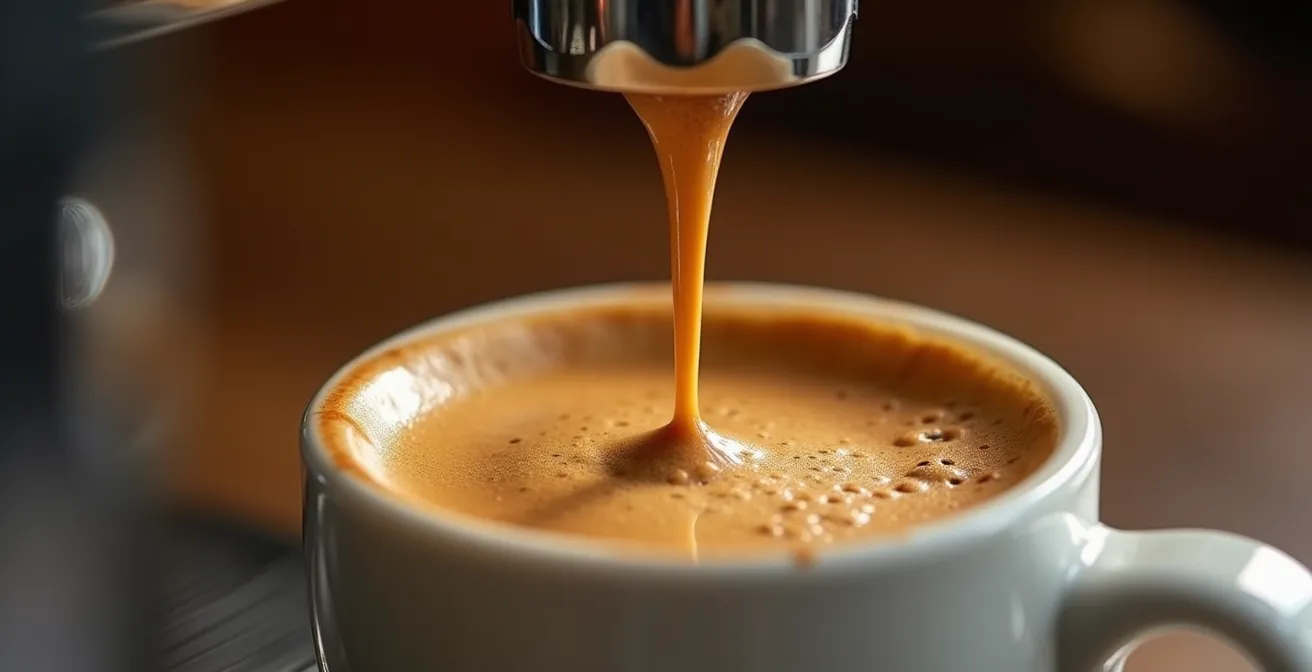
The belief that 100% Arabica is the only path to a quality espresso is a modern myth; the thick, stable crema and bold flavor of a true Italian shot is a feat of engineering that is impossible without Robusta.
- Robusta beans contain more oils and gas-retaining compounds, which are scientifically essential for creating a dense, long-lasting crema.
- Master blenders don’t just ‘mix’ beans; they use each component strategically to build a consistent flavor profile—a chocolatey base, a balanced mid-palate, and aromatic high notes.
Recommendation: Stop chasing the myth of “pure” Arabica and start appreciating the craftsmanship of a traditional Italian blend. Look for roasters who are transparent about their blend components, including the percentage and origin of their Robusta.
You consider yourself a purist. You hunt for single-origin, 100% Arabica beans, you talk about tasting notes of fruit and florals, and you believe you are on the right path to the perfect espresso. Yet, you have a memory that haunts you: that small, thick, syrupy shot you had at a bar in Rome or Naples. A shot topped with a deep, hazelnut-brown crema that clung to the spoon and lasted to the final sip. A powerful, unapologetic coffee flavor. You try to replicate it with your prized Arabica, but the crema is always thin, bubbly, and gone in a flash. The taste, while clean, lacks that classic, potent punch.
The coffee world has told you that Robusta is a cheap, harsh filler bean used to cut costs. The truth, as any old-school Italian barista knows, is that the perfect traditional espresso is not an accident of nature; it is a deliberate act of engineering. The secret is not to avoid Robusta, but to embrace it. It is the tool a master blender uses to build the body, the bitterness, and the very structure of the crema that you miss. This isn’t a compromise on quality. This is the art of creating a consistent, powerful, and functional beverage, perfected over generations.
This guide will not tell you to abandon your love for Arabica. Instead, it will show you how to think like an Italian roaster. We will dismantle the process, from the scientific reason Robusta creates better crema to the strategy of building a flavor that is the same in January as it is in June. It is time to revive the art of the perfect daily shot, not as a compromise, but as a masterpiece of flavor construction.
In this article, we will explore the time-honored techniques and scientific principles behind the perfect Italian espresso blend. You will learn how each component is chosen and balanced to create a result that is far greater than the sum of its parts.
Summary: The Art and Science of the Traditional Espresso Blend
- Why Robusta Creates Thicker Crema Than Arabica?
- How to Use 5 Different Beans to Create One Consistent Flavor?
- Third Wave Acid vs Traditional Bitter: Which is “True” Espresso?
- The Blending Mistake: Changing Components Without Retasting
- When to Stop the Shot: Why Blends Tolerate Longer Times?
- When to Add Brazil to a Blend: The Base Layer Strategy
- Why Stale Beans Produce Zero Foam on Your Espresso?
- Why Your Espresso Has No Crema and How to Fix It Immediately?
Why Robusta Creates Thicker Crema Than Arabica?
The first truth you must accept is a chemical one: the dense, persistent crema you desire is a physical impossibility with 100% Arabica beans alone. Crema is an emulsion of coffee oils and an infusion of CO2 gas, trapped in a protein and sugar matrix. Robusta beans are simply better equipped to produce it. Professional blenders know that Italian espresso blends typically contain 10 to 30% Robusta to guarantee a thick, stable result. This is not a guess; it’s a formula.
The reason lies in the bean’s composition. High-quality Robusta, particularly from regions like Vietnam, is naturally richer in oils and the specific compounds that help retain gas. During the high-pressure extraction of espresso, these oils emulsify more readily and the dissolved gases form smaller, more stable bubbles. The result is a crema that is not just thicker but also has a finer, more elastic texture that can last for several minutes, holding sugar on its surface before it slowly sinks. Arabica crema, by contrast, is often composed of larger bubbles that dissipate quickly, like foam on a soft drink.
Of course, there is also the matter of caffeine. Many are quick to point out Robusta’s potency, and it is true. While there is variation, research shows that Robusta contains nearly double the caffeine of Arabica on average (around 2.7% vs 1.5%). In the context of the traditional Italian “functional beverage,” this is a feature, not a flaw. That quick, powerful boost is part of the design. The key is balance—using just enough Robusta to build the crema and add the classic bitter punch without overwhelming the cup with harshness.
How to Use 5 Different Beans to Create One Consistent Flavor?
A master blender is like an architect building a house, not a cook throwing ingredients in a pot. The goal of a blend is not just complexity, but consistency. A customer should be able to buy your blend in December and have it taste exactly the same as the bag they bought in July. This is impossible with a single-origin bean, which changes with every harvest. Blending is the only way to engineer a consistent, signature flavor profile year after year.
This is achieved by assigning a specific role to each component bean. Imagine building a flavor in layers:

As you can see, each component has a distinct character. A typical high-end Italian blend might be constructed with this “flavor engineering” approach:
- The Base (60-80%): This is the foundation. A natural-processed Brazilian Arabica is often used here for its low acidity, heavy body, and dominant notes of chocolate and nuts. It creates the canvas.
- The Mid-Palate (10-15%): This adds sweetness and complexity. A washed Colombian Arabica can bring balance and a rounder body.
- The High Notes (5-10%): This is the aromatic flair. An Ethiopian heirloom might be added for a touch of floral or fruity complexity that surfaces in the aroma and finish.
- The Crema & Body (10-30%): This is Robusta’s role. It adds the essential bitterness, the caffeine kick, and most importantly, the structural integrity for a thick, lasting crema.
- The Flex Spot (0-5%): A small, reserved portion that the roaster can change seasonally to make micro-adjustments, ensuring the final profile remains unchanged even if one of the core components varies slightly.
This method allows the roaster to maintain a consistent “Master Profile” by slightly adjusting the ratios or swapping the flex component, a feat that is simply not possible when relying on the whims of a single-origin harvest.
Third Wave Acid vs Traditional Bitter: Which is “True” Espresso?
Much of the modern confusion comes from the rise of “Third Wave” coffee culture, which champions 100% single-origin Arabica. These coffees are celebrated for their bright acidity and complex, often fruity or floral, flavor notes. This has led many to believe that bitterness in espresso is a sign of a poor-quality, over-roasted bean. This is a misunderstanding of purpose. There is not one “true” espresso; there are two different philosophies.
An expert from Faema Montréal captured this distinction perfectly, explaining that the two styles serve entirely different functions. As they put it:
Traditional Italian espresso is a ‘functional beverage’ designed for a quick, powerful shot to be consumed at a bar, while Third Wave espresso is a ‘contemplative beverage’, designed to be savored and analyzed for its complex acidity.
– Faema Montréal Coffee Expert, Arabica vs Robusta: Battle of the Coffee Beans
Neither is inherently superior; they are simply different tools for different jobs. The traditional Italian blend is designed for a bold, syrupy, and potent experience. Its bitterness, balanced by nutty and chocolatey notes, is a core part of its identity. The Third Wave shot is designed for flavor exploration, where acidity is the star. Trying to judge one by the standards of the other is like comparing a shot of whiskey to a glass of wine.
This comparative table, based on an analysis of the two coffee philosophies, highlights the fundamental differences in their construction and purpose.
| Characteristic | Traditional Italian | Third Wave |
|---|---|---|
| Bean Composition | 60-70% Arabica, 30-40% Robusta | 100% Single-Origin Arabica |
| Roast Level | Dark (Italian/French) | Light to Medium |
| Primary Taste | Bitter, Bold, Nutty | Acidic, Fruity, Floral |
| Crema | Thick, Dense, Long-lasting | Thin, Delicate, Quick-dissipating |
| Caffeine Content | 90mg per shot | 52mg per shot |
| Purpose | Quick energy boost at bar | Flavor exploration experience |
The Blending Mistake: Changing Components Without Retasting
A purist respects process and precision. This is where the art of the blend should earn your respect. A common mistake, even among some roasters, is to treat blending as a fixed recipe. They might swap a Colombian bean for a Guatemalan one at the same percentage and assume the result will be the same. This is a fatal error. Every component change, no matter how small, can throw the entire flavor profile out of balance. This is especially true when working with the potent character of Robusta.
Maintaining a consistent Master Profile requires a rigorous and constant process of tasting and calibration. Professional roasters use a method known as “triangulation tasting” every time a new lot of a component bean arrives. This is not a casual sip; it is a scientific protocol to ensure the signature taste of the blend remains unchanged. It is a testament to the fact that blending is a discipline, not a shortcut.
This dedication to consistency is what separates an artisanal blend from a commodity product. The roaster is not just mixing beans; they are actively managing a living product to deliver a predictable and reliable experience in every single cup. It requires discipline, a sensitive palate, and a deep understanding of how each component interacts with the others.
Action Plan: The Triangulation Tasting Protocol
- Prepare three samples: A (original blend), B (new blend with changed component), C (new component solo).
- Cup all three at the same temperature (195-205°F) using identical parameters.
- Document deviations in body, acidity, and aftertaste compared to the Master Profile.
- Test blend stability at days 3, 7, 10, and 14 post-roast to detect time-decay issues.
- Only approve the change if the new blend maintains profile consistency across its full life cycle.
When to Stop the Shot: Why Blends Tolerate Longer Times?
Every barista learns to watch for the “blonding” of the espresso stream—the moment the rich, reddish-brown flow turns pale and watery. With a 100% Arabica shot, this transition happens quickly, and pulling the shot even a second too long can result in a thin, sour, and unpleasant taste. This is because the desirable flavor compounds in a light-roast Arabica are extracted very quickly. Blends containing Robusta, however, are far more forgiving.
The reason for this tolerance lies in the physical density and composition of the Robusta bean. Technical studies confirm that Robusta’s denser cellular structure contains up to 30% more soluble solids than Arabica. This means there is simply more flavor material packed into the bean to be extracted. As the shot progresses, you continue to extract rich, syrupy compounds and desirable bitterness from the Robusta long after the Arabica has given up its best flavors.
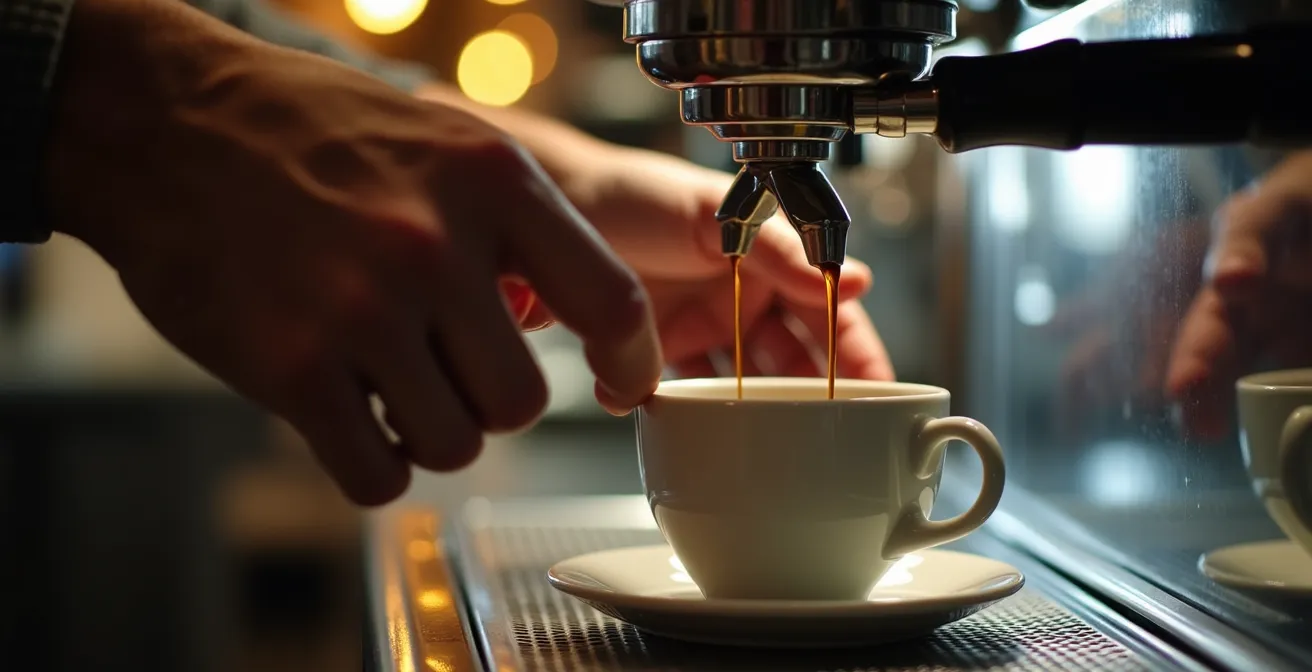
This allows for a longer extraction time—often pushing 30 seconds or more—without the resulting shot tasting “over-extracted” in the way a pure Arabica would. This longer contact time is also crucial for emulsifying the extra oils from the Robusta, contributing further to that thick, stable crema. It gives the barista a wider margin for error and contributes to the consistent, bold flavor profile that is the hallmark of a traditional Italian espresso. The shot is not just more robust in flavor, but more robust in its very preparation.
When to Add Brazil to a Blend: The Base Layer Strategy
If Robusta provides the structure and punch, then a solid base bean provides the soul of the blend. Not all Arabica beans are created equal, and not all are suited for the bright, acidic profile of a Third Wave single-origin. For a traditional blend, the goal is a foundation of comfort and depth. This is the strategic role of Brazilian Arabica.
Brazilian beans, particularly those processed using the “natural” method where the cherry is dried around the bean, are famous for their low acidity, heavy body, and powerful notes of chocolate and caramel. They are not meant to be the star of the show with flashy fruit flavors. Instead, they are the canvas upon which the rest of the blend is painted. Their job is to provide a smooth, rich, and deeply satisfying foundation that can support and balance the sharper notes of other beans, including the potent bitterness of Robusta.
Using a Brazilian bean as the majority component (often 60% or more) creates that classic, comforting “coffee” flavor that people expect from an espresso. It ensures the final cup is round and full-bodied, not thin or overly acidic. It’s a deliberate choice to prioritize sweetness and body over bright acidity, which is fundamental to the philosophy of the traditional Italian blend. Choosing the right base is the first and most important step in building a flavor profile that is both complex and approachable.
Why Stale Beans Produce Zero Foam on Your Espresso?
You can have the most perfectly engineered blend in the world, but if your beans are stale, you will get no crema. It is that simple. The CO2 created during the roasting process is the gas that inflates the bubbles of the crema. This gas, however, is not stable. It begins to escape the bean the moment the roasting process ends, a process called degassing.
There is a “peak freshness” window for espresso. If the beans are too fresh (1-3 days post-roast), they contain too much volatile CO2, resulting in a bubbly, unstable crema that dissipates instantly. If the beans are too old (3-4 weeks or more), most of the CO2 has already escaped. Without this gas, there is nothing to infuse into the coffee oils during extraction. The result is a flat, lifeless shot with little to no foam, no matter how good your technique or your machine.
For this reason, a roast date on a bag of coffee is not a suggestion; it is a critical piece of data. Baristas and knowledgeable consumers know that the magic happens in a specific timeframe. In general, professional baristas confirm that optimal crema forms when beans are used between 5 and 15 days after roasting. You can test the freshness of your beans with a simple “bloom test”: pour a small amount of hot water over fresh grounds. If they bubble vigorously, they are full of CO2 and ready to produce crema. If they sit flat, they are stale.
Key Takeaways
- The thick, lasting crema of Italian espresso is a result of Robusta’s higher oil content, a feat pure Arabica cannot replicate.
- Masterful blending is a form of flavor engineering, using specific beans as components to build a consistent, layered taste profile.
- Bean freshness is paramount; the ideal window for espresso is 5-15 days post-roast to ensure sufficient CO2 for crema formation.
Why Your Espresso Has No Crema and How to Fix It Immediately?
You now understand the theory: a well-crafted blend using fresh beans is the secret. But what if you are standing at your machine right now, pulling a sad, crema-less shot? Theory must translate into practice. The absence of crema is a symptom, and your job is to diagnose the cause. In 90% of cases, the problem is not your expensive machine; it’s one of a few fundamental variables.
The most common culprits are always the beans themselves or the way you are preparing them. Stale beans are the number one cause. If your coffee doesn’t have a roast date, assume it’s stale. The second is grind size. If the water flows through the coffee puck too quickly, it doesn’t have enough contact time or pressure to emulsify the oils. These two factors account for the vast majority of crema problems at home.
Before you blame your equipment, work through the most likely issues. The following matrix provides a clear, immediate path to diagnosing and fixing your crema problems. Start at the top and work your way down. Your perfect shot is likely just one or two adjustments away.
| Crema Problem | Likely Cause | Immediate Fix |
|---|---|---|
| No Crema | Stale beans (3+ weeks old) | Buy fresh beans roasted within 5-15 days |
| No Crema | Grind too coarse | Adjust grinder 2-3 notches finer |
| Pale/Thin Crema | Under-dosing basket | Increase dose to 18-20g for double basket |
| Pale/Thin Crema | Low water temperature | Increase to 195-205°F if adjustable |
| Bubbly/Fast-Dissipating | Beans too fresh (1-3 days) | Rest beans for 2-3 more days before use |
| Dark/Bitter Crema | Over-extraction | Reduce shot time to 20-30 seconds |
Now that you have the knowledge, it’s time to stop chasing the ghost of 100% Arabica and start exploring the world of high-quality, traditional Italian blends with the confidence of a seasoned barista. Seek out roasters who respect this tradition and start tasting the difference that true flavor engineering can make.
Frequently Asked Questions About Espresso Blends
Does grinder quality affect crema production?
Absolutely. A quality burr grinder that produces a consistent particle size is essential for proper extraction. Inconsistent grounds lead to channeling, where water finds an easy path, preventing the even pressure needed to create dense crema. The fine particles produced by a good grinder, known as ‘fines’, are also key to the rich texture and “tiger-flecking” that indicate a perfect shot.
Why does my crema disappear in under 1 minute?
A fast-dissipating crema is almost always a sign of a problem with the beans. The most likely cause is that the beans are stale and the oils have oxidized, making them unable to maintain the foam structure. A less common cause is that the beans are roasted far too dark; the excessive surface oil breaks down the foam’s surface tension, causing it to collapse quickly.