
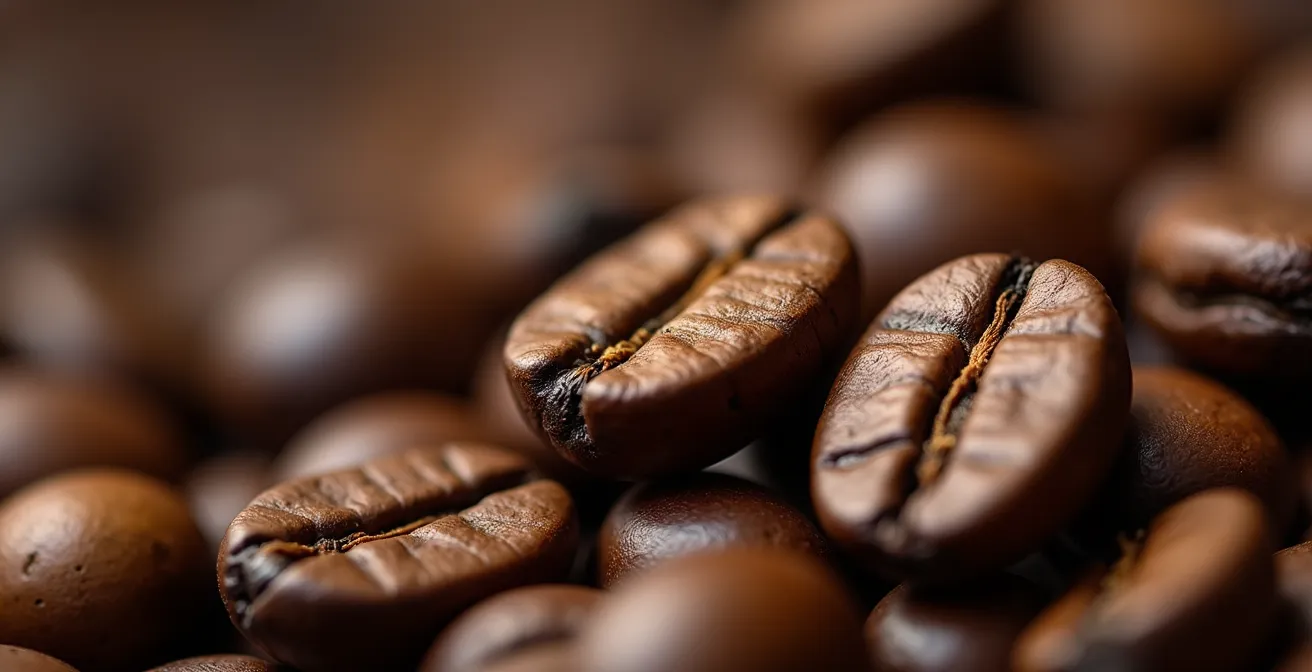
The high price of a micro-lot is only justified if you treat it as an investment in a verifiable story and a targeted sensory education, not just a better daily drink.
- Micro-lots offer unique, singular flavor profiles tied to a specific day’s harvest, unlike the consistent but less adventurous taste of blends.
- True value comes from traceability—using tools like QR codes and blockchain to verify the coffee’s origin, processing, and ethical pricing.
Recommendation: Before buying, use a value audit: verify the cupping score (87+), specific varietal, and detailed origin info. The price should align with your goal to learn, not just to collect something rare.
As a coffee buyer, I see the hesitation. You’re standing in front of a wall of coffee, eyeing a small, beautifully designed bag with a $50 price tag. Next to it, a much larger bag from the same roaster—a house blend—sits at a comfortable $18. The question is inevitable: is that micro-lot *really* worth three times the price? The common wisdom says they offer higher quality and unique flavors, but this often feels like a vague marketing promise designed to justify the expense. Many will tell you it’s about supporting farmers or enjoying a rare product, but for a budget-conscious enthusiast, that’s not a satisfying answer.
But what if the entire framework of “better” vs. “worse” is wrong? The real key to understanding the value of a micro-lot isn’t just about taste; it’s about treating the purchase as a calculated investment. The premium you pay isn’t for a superior daily beverage—in fact, a blend is often “safer” for that. Instead, you are paying for two distinct, verifiable assets: a transparent, traceable story from farm to cup, and a specific, high-fidelity sensory education for your palate. The price is a barrier to entry, but it’s also a gatekeeper for an entirely different kind of coffee experience.
This article will guide you through the professional coffee buyer’s mindset. We will dissect the anatomy of a micro-lot, explore how technology is making traceability a reality, and give you the tools to audit a coffee’s value beyond the hype. We’ll uncover where your money really goes, how to protect your investment, and how to spot the difference between a genuine specialty offering and clever marketing. By the end, you won’t just see a high price tag; you’ll see a clear value proposition you can confidently accept or reject.
To navigate this complex world of specialty coffee, this guide breaks down the essential concepts you need to master. From understanding the fundamentals of a coffee “lot” to exploring the cutting edge of processing, each section builds upon the last to empower you as an informed consumer.
Summary: A Buyer’s Guide to the True Value of Micro-Lot Coffee
- Why a “Lot” Must Come from a Single Harvest Day?
- How to Use QR Codes to Meet the Farmer Virtually?
- Blends vs Micro-Lots: Which is Safer for Daily Drinking?
- The Scarcity Trap: Buying Beans Just Because They Are Rare
- When to Freeze Your $50 Coffee Bag to Preserve Terroir?
- Why Only $0.10 of Your $4 Latte Goes to the Farmer?
- The Grade 4 Mistake: Buying Commercial Grade Thinking It’s Specialty
- Why Anaerobic Coffee Tastes Like Wine and Who Should Drink It?
Why a “Lot” Must Come from a Single Harvest Day?
The term “micro-lot” is often used, but its foundation lies in a simple, powerful concept: isolation. At its core, a coffee lot represents a specific, consolidated quantity of coffee that can be traced back to a particular farm, a specific processing method, and, most importantly, a single period of harvest—often just a single day. Why is this so crucial? Because coffee cherries on the same plant don’t ripen uniformly. A picker’s pass on Monday will yield cherries with a different sugar content and flavor potential than a pass on Wednesday.
By keeping a day’s harvest separate, a producer can isolate a batch of exceptional quality. This is the first step in creating value. Instead of blending slightly under-ripe, perfectly ripe, and slightly over-ripe cherries into one large, generic “average” lot, the producer can pinpoint the peak of the harvest. As Jolene Zehnder, Director of Sales at Mercon Specialty, explains, this strategy is both for quality control and economic empowerment. She notes, “Breaking up a larger lot into smaller lots makes it easier for producers to differentiate between their coffees. This could help them identify smaller lots that are of higher quality, that could fetch higher prices per pound on average.”
This is where the premium pricing begins. A micro-lot isn’t just “small”; it’s a meticulously curated snapshot of a farm’s best effort on its best day. It’s an expression of a precise moment in time, representing the pinnacle of that season’s potential. These coffees inherently operate at the premium end of the specialty coffee market precisely because they are the result of this labor-intensive selection process. You’re paying for the discipline and foresight required to not blend the good with the great.
How to Use QR Codes to Meet the Farmer Virtually?
Defining a micro-lot by its harvest day is the first step, but how can you, the consumer, be sure of that claim? This is where the concept of a “verifiable story” becomes critical and where modern technology transforms a marketing narrative into a traceable fact. The most powerful tool driving this transparency revolution is often found right on the bag: the QR code. Far from a simple gimmick, this code is your direct portal to the coffee’s origin, connecting you with the people and places behind your cup.
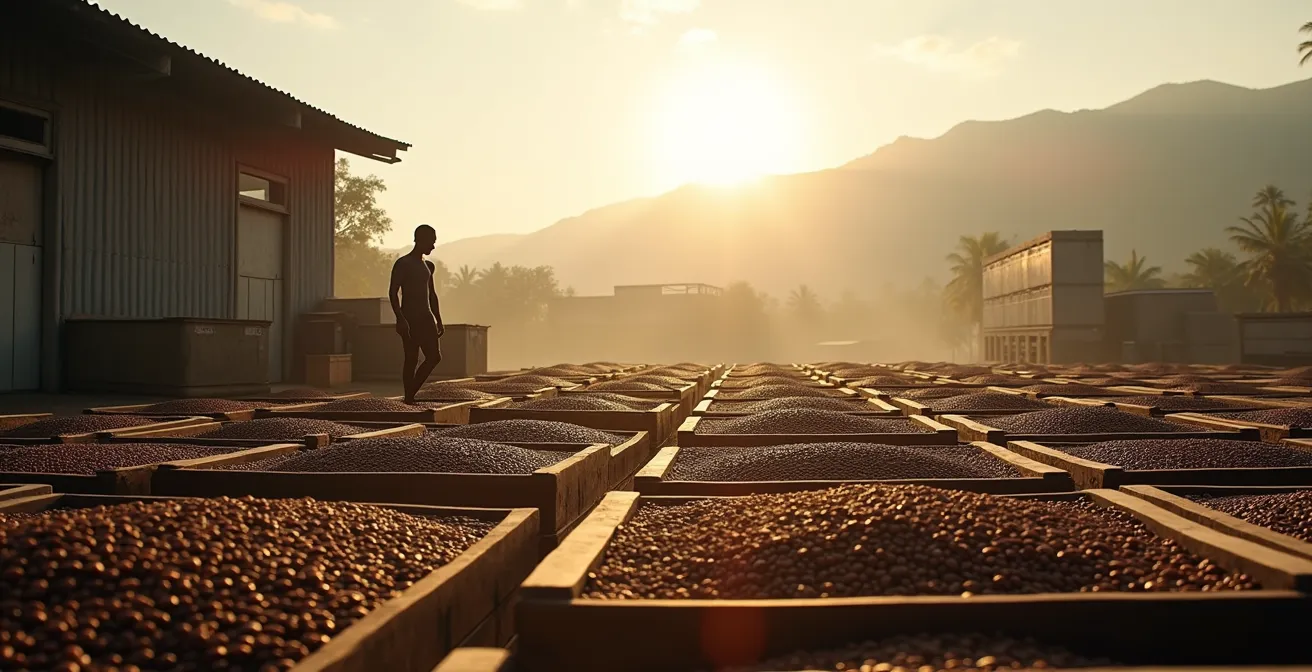
A scan can reveal a wealth of information that justifies a premium price: the specific farm or washing station name, photos of the producers, the exact altitude where the coffee was grown, the varietal of the coffee plant, and the detailed processing method used. This isn’t just “storytelling”; it’s data. It allows you to move beyond generic labels like “Ethiopian coffee” and connect with, for example, a specific lot from the Gedeo Zone, processed by a particular cooperative. This level of detail is the hallmark of a true micro-lot and a key part of what you are investing in.
The Shift to Verifiable Fact: Blockchain in Coffee
The quest for ultimate transparency is pushing the industry even further. While QR codes provide a window, emerging technologies like blockchain offer an immutable ledger. This technology makes it easier for everyone in the supply chain to transparently record and trace information tied to a coffee lot. This represents a fundamental shift from a feel-good marketing ‘story’ to a verifiable, tamper-proof fact, setting a new standard for traceability systems in specialty coffee and ensuring the information you receive is accurate and trustworthy.
When you encounter a high-priced coffee, the QR code is your first tool for due diligence. If it leads to a generic corporate website, be skeptical. If it leads to a page detailing the farm’s history, the names of the producers, and specific data about the lot, you are looking at a product where transparency is part of its inherent value.
Blends vs Micro-Lots: Which is Safer for Daily Drinking?
Now that we understand a micro-lot’s value is rooted in its specificity and traceability, a practical question arises: when should you actually buy one? The answer depends entirely on your goal. For your daily morning cup, where you crave reliability and a familiar, comforting taste, a blend is often the “safer” and more logical choice. Roasters design blends for consistency. They skillfully combine coffees from different origins to create a balanced, predictable flavor profile that they can replicate year-round, insulating you from the seasonal variability of single farms.
As a 2023 industry analysis reveals, specialty roasters are increasingly embracing this dual strategy: offering affordable, reliable blends for the daily drinker, complemented by a rotating selection of exotic micro-lots for moments of exploration. A micro-lot, by its very nature, is a one-time experience. It’s a snapshot of a specific harvest that cannot be perfectly replicated. Its flavors can be wild, complex, and sometimes challenging—an adventure for your palate, but perhaps not the dependable friend you need at 7 a.m.
| Characteristic | Blends | Micro-Lots |
|---|---|---|
| Consistency | Reliable, predictable flavor | Variable, unique each harvest |
| Price Range | More budget-friendly | Premium pricing (often 3x) |
| Risk Profile | Safe, balanced flavors | Adventurous, may not match taste |
| Availability | Year-round stable supply | Limited seasonal batches |
| Target Drinker | Daily consistency seekers | Exploration enthusiasts |
The decision to buy a micro-lot, therefore, should be an intentional one. You are not buying a replacement for your daily coffee; you are buying an experience. It’s akin to choosing between a reliable table wine and a single-vineyard vintage. The vintage offers a unique story and a lesson in terroir, but the table wine is what you can count on for any occasion. Don’t think of it as “good” vs. “bad,” but rather “consistent” vs. “unique.”
The Scarcity Trap: Buying Beans Just Because They Are Rare
One of the biggest pitfalls in specialty coffee is equating rarity with quality. Marketers love to use terms like “limited edition,” “rare varietal,” or “exclusive lot” to create a sense of urgency and justify a high price. This preys on the fear of missing out, a powerful psychological driver known as the scarcity principle. However, as a buyer, your job is to see past this and audit the *actual* value. A coffee can be rare for many reasons, not all of them related to exceptional taste. It might come from a very small farm, be an experimental crop, or simply be a marketing creation.
The real question is not “How rare is it?” but “What does this coffee teach my palate?” A truly valuable micro-lot offers a distinct and educational sensory experience. It might showcase the classic jasmine and bergamot notes of a high-altitude Gesha, the clean, bright acidity of a Kenyan SL28, or the unique fruit-forward profile of a Pink Bourbon. The price is an investment in that specific lesson. If a coffee is simply labeled “rare” without providing this specific context, you are likely paying for hype, not substance.
Taste-wise, micro lots can be exciting, but not everyone is looking for such complexity in their daily cup. Blends offer a balanced, reliable option that suits a wider range.
– Julian König, Head Roaster at KRÖM Kaffeerösterei Magdeburg
To avoid the scarcity trap, you need a framework for evaluation. Think like a professional buyer and perform a quick value audit before you purchase. Focus on verifiable data, not on vague marketing claims. The following checklist helps you move from being a passive consumer to an active evaluator, ensuring your money is spent on genuine quality and sensory education.
Your Action Plan: How to Evaluate Micro-Lot Value Beyond Scarcity
- Check for detailed origin information including the specific farm, altitude, and processing method—not just “limited edition” labels.
- Look for specific varietal information (e.g., Gesha, SL28, Pink Bourbon) rather than generic “rare” claims.
- Verify the cupping score; genuine high-end micro-lots typically score 87 points or higher on the SCA scale.
- Ask yourself: Does this coffee promise a flavor profile that will teach my palate something new about a region or varietal?
- Consider if the premium price aligns with your sensory education goals, not just a desire to own something exclusive.
When to Freeze Your $50 Coffee Bag to Preserve Terroir?
You’ve done your due diligence, avoided the scarcity trap, and invested in a beautiful bag of micro-lot coffee. Now, the challenge is to protect that investment. A micro-lot’s unique flavor profile—its “terroir”—is incredibly delicate and fleeting. From the moment the bag is opened, oxygen begins to degrade the volatile aromatic compounds that make it special. For a standard blend, this gradual staling is acceptable. For a $50 coffee, it’s a waste of potential.
The professional solution to this problem is freezing. However, this must be done with precision to avoid introducing moisture and freezer burn, which would ruin the coffee. The key is to portion the beans into airtight, single-dose containers or vacuum-sealed bags *before* you first open the main bag. This minimizes exposure to air and locks in the coffee’s peak freshness. You should only take out one dose at a time, grinding it directly from frozen—do not let it thaw, as this creates condensation.
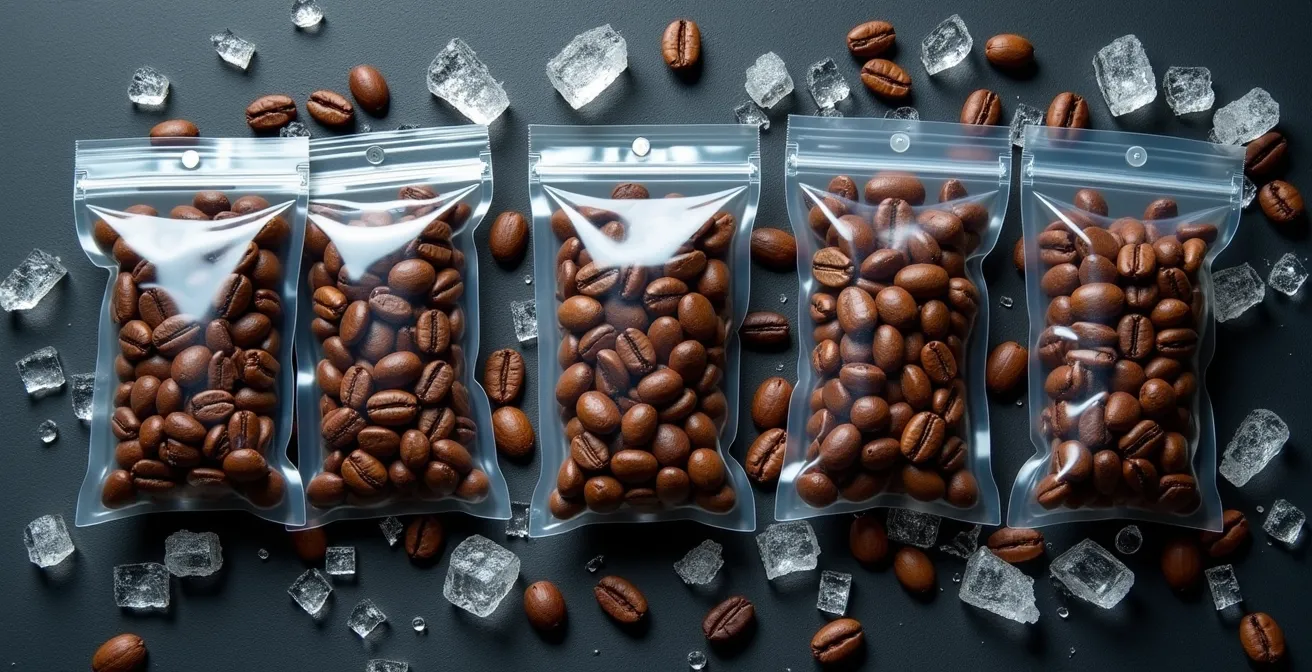
The timing of this process is also critical. Coffee needs a short period to “de-gas” after roasting, allowing CO2 to escape. Freezing too early can trap these gases and mute the flavors. The ideal window is when the coffee has reached its peak flavor. While this can vary, many specialty roasters recommend consuming or freezing micro-lot coffee within 3 weeks from the roast date. By freezing it at this peak, you effectively press “pause,” allowing you to enjoy that exceptional cup weeks or even months later as if it were freshly roasted.
Why Only $0.10 of Your $4 Latte Goes to the Farmer?
Part of the justification for a micro-lot’s high price is the promise of better returns for the farmer. But the reality of the conventional coffee market, known as the “C-market,” is grim. In a standard supply chain, the money is spread thin across exporters, importers, shippers, roasters, and retailers. The result? The person who did the most labor-intensive work—the farmer—receives a tiny fraction of the final price. The traditional model often sees farmers receiving as little as 1% of the price of a latte.
Even in the case of whole bean sales, the numbers can be shocking. According to some analyses of the commodity market, for every cup of coffee sold, the farmer might only receive a few cents. While specialty coffee aims to improve this, even a higher price doesn’t guarantee fairness. Some reports suggest that even within more direct trade models, farmers may still only get a small portion of the retail value. For example, one analysis from the International Trade Center suggests farmers might receive only 10% of the retail price, which, while better, still highlights a major disparity.
This is where true micro-lot sourcing, with its direct-trade relationships and transparent pricing, makes a tangible difference. It bypasses many of the middlemen, allowing roasters to pay a significant premium directly to the producer based on quality, not on the volatile C-market price. This is another key component of your investment: you are supporting a more equitable economic model.
A New Model: Torque Coffee’s Proportional Pricing
Pioneering roasters like Torque Coffee are revolutionizing this system with models like “Proportional Pricing.” Instead of the farmer getting whatever is left over, Torque guarantees that a fixed percentage—in their case, 20%—of the final retail price stays at origin. This transparent model directly links the producer’s earnings to the coffee’s full value as appreciated by the consumer. It’s a radical shift from a system where farmers get pennies on the dollar to one where a fair share is guaranteed upfront, rewarding them for the exceptional quality they produce.
The Grade 4 Mistake: Buying Commercial Grade Thinking It’s Specialty
The term “specialty coffee” isn’t just a marketing buzzword; it’s a technical standard based on a rigorous grading process. Making a purchasing mistake here means you could be paying a premium for what is, by definition, a lower-quality product. The most common error is buying a coffee marketed with fancy packaging that is actually commercial grade (Grade 3 or 4) and not true specialty grade (Grade 1 or 2).
The quality of green, unroasted coffee is assessed on a 100-point scale by certified Q Graders. To even qualify as “specialty,” the coffee must meet a strict set of criteria. As the Specialty Coffee Association (SCA) requires, a coffee must score 80 points or higher on a 100-point scale and have zero “Category 1” (primary) defects, like sour beans or fungus damage, in a 350g sample. Coffees scoring below 80 are considered commercial grade. Most exceptional micro-lots that command high prices score well above this threshold, typically in the 87-92 point range.
How can you avoid this mistake? Look for transparency. A roaster selling a true specialty micro-lot will be proud to display its credentials. The packaging or website should list the cupping score. If you see a score of “88,” you know you are buying a coffee that is objectively high quality. If the score is absent, and the description relies on vague, romantic language instead of hard data (like varietal, altitude, and processing method), you should be suspicious. You could be looking at a Grade 4 coffee in a Grade 1 package.
Key Takeaways
- A micro-lot’s value is in its specificity—a single day’s harvest isolated for peak quality, not just its rarity.
- Treat a micro-lot purchase as an investment in sensory education and a verifiable story, confirmed via QR codes and transparent data.
- Use freezing to preserve your investment. Portion beans into airtight containers upon purchase to lock in the delicate terroir for months.
Why Anaerobic Coffee Tastes Like Wine and Who Should Drink It?
Once you’ve mastered the fundamentals of micro-lots, you can begin to explore the cutting edge of flavor: experimental processing. Among the most exciting and divisive of these is anaerobic fermentation. This is where a coffee’s flavor profile moves from the familiar to the extraordinary, often developing notes more commonly associated with natural wine. In this process, coffee cherries are fermented in a sealed, oxygen-free environment, often in tanks filled with carbon dioxide. This controlled, oxygen-deprived fermentation dramatically alters the microbial activity, producing different acids and aromatic compounds than traditional methods.
The result is a flavor profile that is intense, complex, and often “boozy.” You might find notes of red wine, sour cherry, cinnamon, or even mulled spices. The comparison to wine is not just a tasting note; it’s rooted in the process itself. As noted by industry publication Sprudge in their analysis, the most common technique, carbonic maceration, is historically famous for its use in producing the fruity Gamay wines of Beaujolais. This method yields a cup that is vibrant and fruit-forward, an entirely new dimension of coffee flavor.
The Championship Coffee: Saša Šestić and Carbonic Maceration
This once-obscure method was thrust into the global spotlight in 2015 when Australian barista Saša Šestić won the World Barista Championship. He used a Colombian coffee that had undergone carbonic maceration. The controlled fermentation in CO2-rich tanks produced the intense floral and wine-like aromatics that captivated the judges, firmly establishing anaerobic processing as a legitimate and game-changing technique in the world of specialty coffee.
So, who should drink it? This coffee is for the adventurous palate. If you are a fan of natural wines, sour beers, or kombucha, you will likely be fascinated by the tangy, fermented complexity. If you prefer a classic, clean, and balanced cup, this might be too challenging. Buying an anaerobic coffee is the final step in your journey as an informed consumer—it’s a deliberate choice to invest in a truly avant-garde sensory education, pushing the very boundaries of what you thought coffee could taste like.
Now that you are equipped with a buyer’s perspective, the next time you face that wall of coffee, you won’t just see prices; you’ll see a spectrum of value. Apply these principles to your next purchase and begin your journey into a more transparent and flavorful world of coffee.
Frequently Asked Questions About Are Micro-Lot Coffees Worth 3x the Price of Blends?
What’s the difference between specialty and commercial grade scoring?
Specialty grade requires a score of 80 points or higher on the SCA’s 100-point scale, with zero primary defects found in a 350g sample of green coffee. Commercial grade coffee scores between 60-80 points and is permitted to have multiple defects, which can negatively impact the final taste.
How can I identify specialty grade on packaging?
Look for specific, verifiable data. True specialty packaging will often display the cupping score (80+), the specific coffee varietal (e.g., Gesha, Pacamara), the elevation at which it was grown, and the exact processing method (e.g., washed, honey, anaerobic). Commercial grade coffee rarely provides this level of detailed information, relying instead on broader origin names.
What percentage of coffee achieves 90+ points?
An exceptionally small amount. Less than 1% of all specialty coffee produced globally achieves a score of 90 points or higher. These coffees, often referred to as Presidential Award winners, represent the absolute pinnacle of quality and are among the rarest and most expensive in the world.