
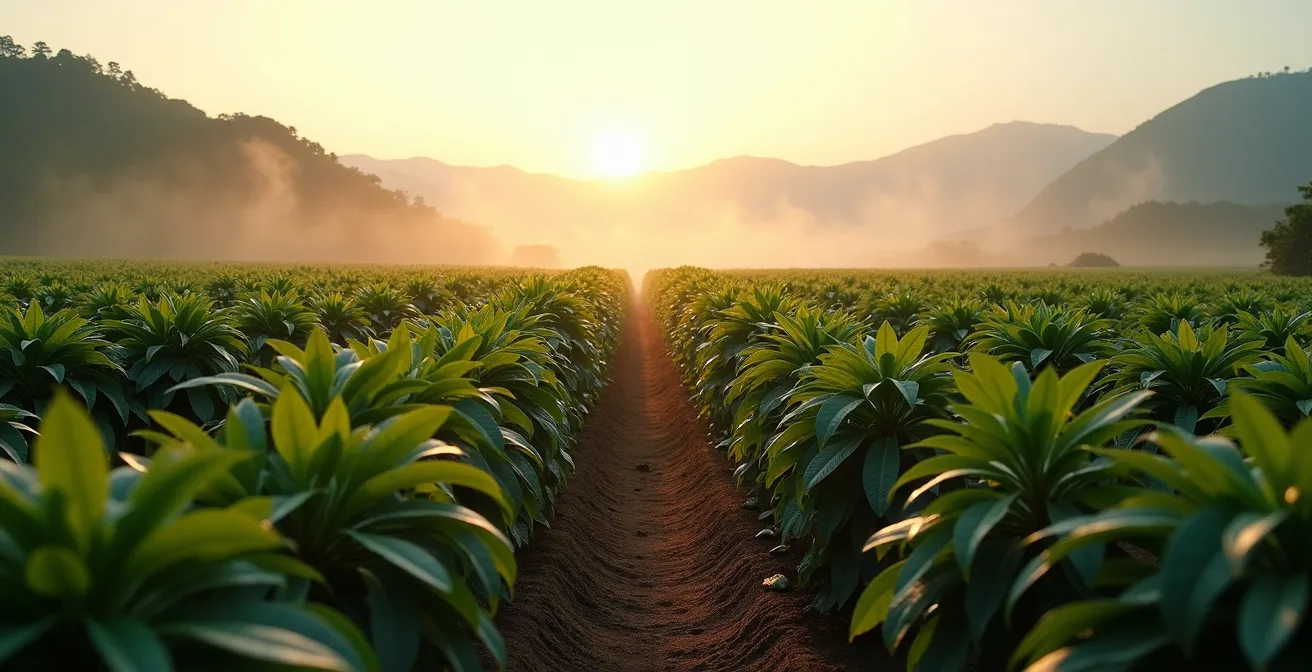
The common debate over whether Castillo has ‘worse’ flavor than Caturra is fundamentally flawed; cup quality is not determined by variety alone.
- Scientific blind cuppings show no significant overall score difference, though flavor profiles are distinct: Castillo often presents fruity/chocolate notes while Caturra is more floral/caramel.
- Agronomic factors like soil health, processing methods, and harvest timing have a greater impact on the final cup than the cultivar’s name.
Recommendation: Evaluate coffees based on the specific farm and processing lot, not a preconceived bias against a variety. The farmer’s skill is the primary driver of quality.
The conversation around Colombian coffee varietals is often distilled into a simplistic showdown: the traditional, high-quality Caturra versus the modern, rust-resistant Castillo. For many in the specialty coffee world, this is a narrative of compromise, where disease resistance is perceived to have been achieved at the cost of cup complexity and flavor. This debate frames Castillo as a necessary evil, a tool for economic stability for farmers but a step back for the discerning palate. It’s a viewpoint that suggests a coffee’s destiny is sealed by its genetic code alone.
This article challenges that oversimplified premise from an agronomist’s perspective. The real story of coffee quality is far more nuanced, written not just in the plant’s DNA but also in the soil, the climate, and, most importantly, the hands of the farmer. While the introduction of Castillo was a critical response to a devastating agricultural crisis, judging it solely on its name is a form of “snobbery” that ignores the science of sensory analysis and the art of coffee production. True quality is an expression of an entire ecosystem, not just a label on a bag.
We will dissect the genetic origins of these cultivars, compare their performance in controlled sensory trials, and explore the economic realities that drive farmer decisions. By examining the complete picture—from the threat of climate change to the unique advantages of Colombia’s harvest cycles—a more accurate conclusion emerges. The question is not whether Castillo killed flavor, but rather, what conditions allow any coffee varietal to achieve its maximum potential.
This analysis will guide you through the key agronomic and sensory factors that define this complex relationship. The following sections provide a detailed examination of the history, science, and economics shaping Colombian coffee today.
Summary: An Agronomic Analysis of Colombian Coffee Varietals
- Why Colombia Switched to Resistant Hybrids in the 80s?
- How to Distinguish Castillo from Caturra in a Blind Cupping?
- High Yield vs High Cup Score: The Farmer’s Dilemma
- The Snobbery Mistake: Rejecting Castillo Without Tasting It
- When is the “Mitaca” Crop: Colombia’s Secondary Harvest Advantage
- The Temperature Threat: Will Arabica Survive 2050?
- Why Arabica Has Half the Caffeine of Robusta Beans?
- Why Ash-Rich Volcanic Soil Creates Higher Acidity Coffee?
Why Colombia Switched to Resistant Hybrids in the 80s?
The widespread adoption of resistant hybrids in Colombia was not a choice driven by flavor trends, but a strategic response to an existential threat: coffee leaf rust, or *roya*. The arrival of this devastating fungus in the 1980s decimated plantations of traditional, susceptible varieties like Caturra and Typica. The economic impact was catastrophic. For instance, research shows that production in Colombia fell by 31% on average during the peak epidemic years compared to pre-rust levels. For countless farmers, this wasn’t an abstract number; it was the loss of their livelihood.
In response, Colombia’s national coffee research center, Cenicafé, accelerated its breeding program. The goal was to develop cultivars that combined the productivity and cup profile of Arabica with robust disease resistance. This work culminated in the release of various hybrids, with Castillo, released in 2005, being the most prominent. It is the result of a sophisticated cross-breeding process, not simple genetic modification. As MTPak Coffee reports, Castillo is a hybrid of Caturra and the Timor Hybrid. The latter is itself a natural cross between Arabica and Robusta, which is where the rust resistance originates.
Therefore, the switch was a calculated decision to ensure the economic viability of the entire Colombian coffee industry. It was about creating a sustainable agricultural model that could withstand disease pressure, guaranteeing that farmers could continue to produce coffee and that Colombia could maintain its status as a leading global supplier. The focus was survival and stability, with the challenge of optimizing cup quality becoming the next frontier.
How to Distinguish Castillo from Caturra in a Blind Cupping?
The assertion that Castillo is inherently inferior in the cup is not consistently supported by scientific sensory analysis. While geeks and baristas may claim to easily identify them, controlled blind cuppings reveal a more nuanced reality. The primary difference lies not in a “good vs. bad” score but in distinct flavor profiles. Both varieties can produce exceptional coffee, but they express themselves differently. This visual shows the careful setup required for such a professional evaluation.
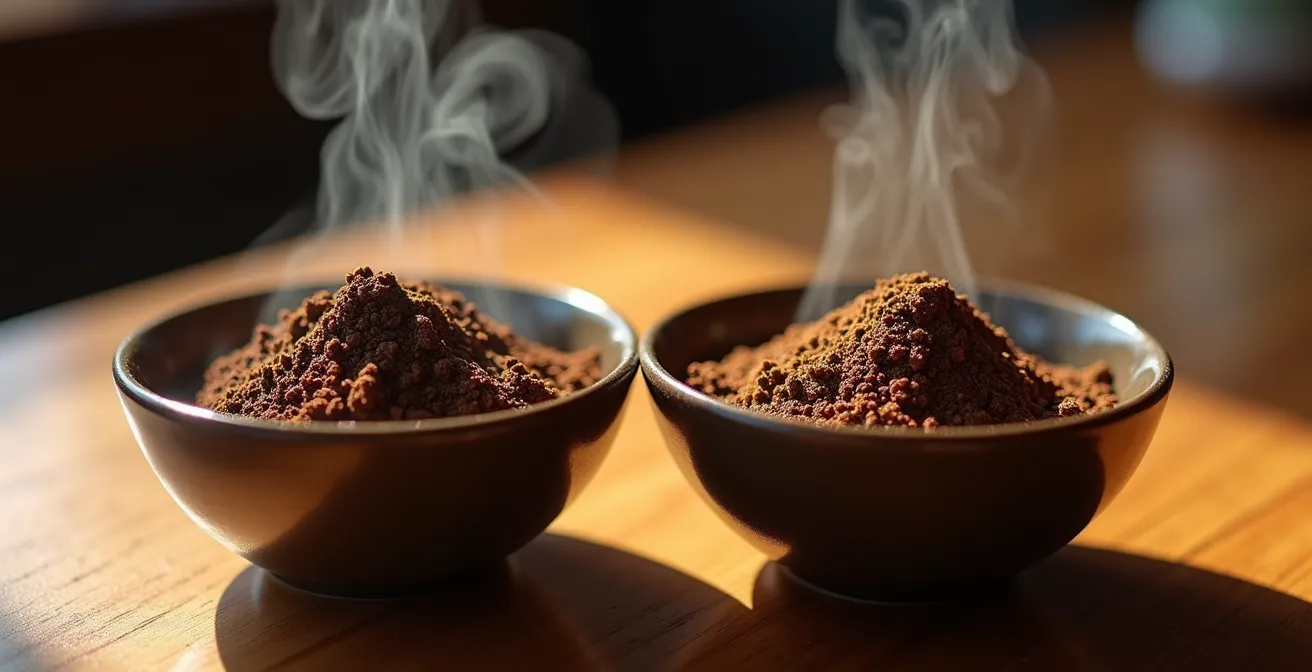
A comprehensive sensory trial conducted by Catholic Relief Services and Kansas State University provides clear data on this. The analysis found that while the two cultivars earned similar overall scores, their organoleptic characteristics were distinct. A high-quality Castillo was noted for being fruity but not citric, with a profile leaning towards dark chocolate and roasted nuts. In contrast, a good Caturra presented more floral aromatics with notes of cocoa and caramel. This demonstrates that they are not interchangeable, but one is not definitively “better” than the other; they simply offer different sensory experiences.
Furthermore, the notion that Castillo cannot achieve elite scores is a misconception. In various controlled studies and competitions, well-grown and processed Castillo lots have performed exceptionally well. It is not uncommon for some Castillo samples to be cupped at 90+ points, placing them firmly in the highest tier of specialty coffee. This proves that the genetic potential for high quality exists; unlocking it is a function of agronomy and post-harvest processing.
High Yield vs High Cup Score: The Farmer’s Dilemma
For a coffee farmer, the choice of which cultivar to plant is a complex economic calculation, not just a matter of taste. This decision balances potential income from high cup scores against the risk of catastrophic crop loss. Caturra, when grown under ideal conditions and processed meticulously, can fetch premium prices in the specialty market. However, its extreme vulnerability to coffee leaf rust makes it a high-risk, high-reward proposition. A single outbreak can wipe out a significant portion of a year’s income.
Castillo, on the other hand, offers a crucial safety net: high resistance to rust and a consistently high yield. This reliability provides economic stability, which is the primary concern for the vast majority of producers. The numbers speak for themselves. Today, an estimated 87 percent of Colombia’s coffee area is planted with rust-resistant varieties like Castillo. This overwhelming majority reflects a pragmatic choice by farmers to prioritize stable, predictable production over the volatile specialty market.
The following table, based on data from coffee research organizations, illustrates the core trade-offs a farmer faces between these two prominent varieties. It clearly shows why a high-yield, disease-resistant option is an attractive proposition for ensuring a stable livelihood.
| Variety | Yield (kg/tree) | Rust Resistance | Cup Score Potential |
|---|---|---|---|
| Castillo | 17.6 | High | 80-90+ |
| Caturra | Variable | Very Low | 82-92+ |
Ultimately, the dilemma is not as simple as choosing between quality and quantity. A farmer who loses their crop to rust has no quality to sell. Castillo and other resistant hybrids allow farmers to stay in business, providing a foundation from which they can then invest in better processing and agronomic practices to elevate the cup quality of their harvest.
The Snobbery Mistake: Rejecting Castillo Without Tasting It
One of the most significant barriers to a fair assessment of Castillo is a form of cognitive bias within the specialty coffee community: varietal snobbery. The simple presence of the name “Castillo” on a bag can lead buyers and roasters to approach the coffee with lower expectations, or to reject it outright without even cupping it. This preconception ignores the most fundamental principle of sensory evaluation: judging the coffee that is actually in the cup.
This bias is not supported by objective data. As research from the Borderlands Coffee Project by Catholic Relief Services highlights, the perceived gap in quality often vanishes under blind conditions. Their findings are a direct challenge to this snobbery:
There was no significant difference in the average scores the two varieties earned during a blind cupping.
– Catholic Relief Services, Borderlands Coffee Project Research
This demonstrates that when preconceptions are removed, Castillo performs on par with Caturra in terms of overall quality score. The “mistake” is thus attributing a coffee’s quality to its varietal name rather than to the skill of the producer and the quality of the terroir. The innovation doesn’t stop with Castillo, either. Cenicafé’s ongoing research has led to new varieties like Cenicafé 1, which is also rust-resistant and has been described by cupping panels as a specialty coffee with excellent notes of cocoa, honey, and hazelnut. Rejecting hybrids as a category means missing out on these continuous improvements.
Ultimately, a name is not a flavor profile. A poorly grown and processed Caturra will always be inferior to a meticulously cultivated and processed Castillo. The focus should be on the entire value chain—from farm management to roasting—rather than on a single genetic data point.
When is the “Mitaca” Crop: Colombia’s Secondary Harvest Advantage
Colombia possesses a unique agricultural advantage due to its diverse topography and proximity to the equator: it has two distinct coffee harvests per year. The main harvest, or *cosecha principal*, varies by region but is generally the larger of the two. However, the secondary harvest, known as the *mitaca* or *traviesa*, provides a crucial secondary stream of income for farmers and a year-round supply of fresh coffee to the market. This bimodal harvest pattern is a significant factor in the country’s coffee economy.
The timing of the mitaca depends on the region’s specific rainfall patterns. In some areas, it occurs roughly six months after the main harvest, while in others, the two harvests can be closer together or even blend into a nearly continuous picking season. This staggered production schedule helps mitigate risk; a poor main harvest due to adverse weather can potentially be offset by a better mitaca crop. It also allows for more consistent cash flow for farming families throughout the year.
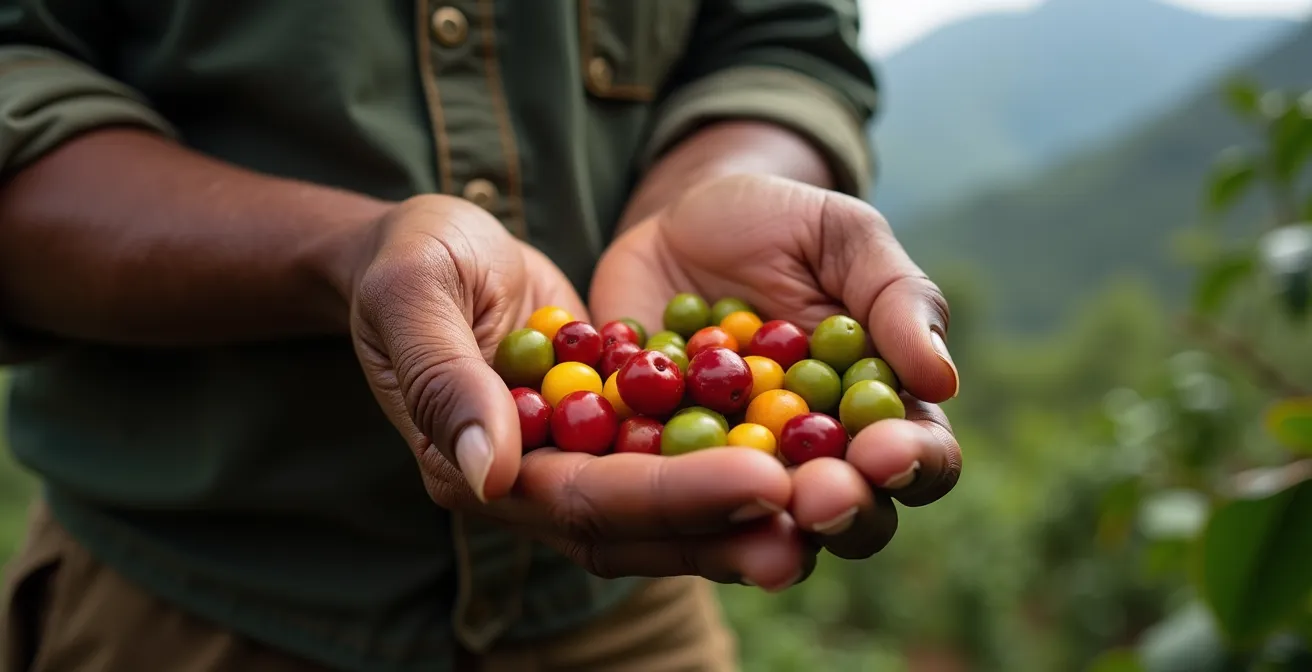
From a quality perspective, the mitaca is sometimes considered to produce slightly different cup profiles due to the different climatic conditions during the cherry’s maturation and drying period. However, with skilled farm management and selective picking, as shown by the farmer above, high-quality lots can be produced from either harvest. The presence of disease-resistant varieties like Castillo is particularly vital in this system. Having a resilient crop that can reliably produce during both harvests ensures the stability of this dual-income model, protecting farmers from the volatility of both climate and disease.
The Temperature Threat: Will Arabica Survive 2050?
The original threat of coffee leaf rust was just the beginning. Today, the entire Arabica species faces a much larger, more complex challenge: global climate change. Rising global temperatures pose a direct threat to Arabica coffee, which thrives in a very specific band of cool, high-altitude climates. As temperatures increase, the land suitable for growing high-quality Arabica is projected to shrink dramatically by 2050, pushing farms to ever-higher, and scarcer, elevations.
The threat is twofold. First, higher temperatures directly impact the plant’s physiology. An expert from the Colombian Coffee Growers Federation (FNC) explains the danger clearly:
Temperature increases can stunt Arabica coffee, reducing its yield, and also make it more sensitive to coffee pests.
– Hernando Duque, Perfect Daily Grind Interview
Second, a warmer climate creates a more favorable environment for diseases and pests. Coffee leaf rust, for example, proliferates more rapidly in warmer, more humid conditions. Even with resistant varieties, the pressure is immense. According to recent data from Cenicafé, while the use of cultivars like Castillo has been effective, the fight is ongoing. The current national average prevalence rate for coffee leaf rust is still around 5.7 percent, a testament to the persistent environmental pressure. This makes continued investment in climate-resilient cultivars not just an option, but an absolute necessity for the future of coffee.
In this context, the development of hybrids like Castillo is not the end of the story, but a critical chapter in an ongoing saga of adaptation. The genetic diversity and resilience they bring are essential tools in the fight to ensure that Arabica coffee can not only survive but thrive in the challenging decades to come.
Why Arabica Has Half the Caffeine of Robusta Beans?
The difference in caffeine content between Arabica and Robusta (Canephora) is not a matter of taste but of evolutionary biology. Caffeine is a powerful natural insecticide and antifungal agent. Robusta plants, which evolved in harsher, lower-altitude environments with more pest and disease pressure, developed a high caffeine content (2.5% or more) as a primary defense mechanism. Arabica, evolving in the milder, high-altitude climates of Ethiopia, faced fewer threats and thus developed a lower caffeine content, typically around 1.2% to 1.5%.
This lower caffeine level is a key reason for Arabica’s superior flavor complexity, but it is also its greatest weakness: it makes the plant far more vulnerable to pests and diseases like coffee leaf rust. This is where the genetic lineage of Castillo becomes so important. As mentioned earlier, Castillo’s resistance comes from the Timor Hybrid, which is a natural cross between Arabica and Robusta. This heritage means that Castillo carries some of Robusta’s genetic markers for resilience, effectively re-introducing a more robust natural defense system into an Arabica framework.
This genetic inheritance is a fascinating example of leveraging nature’s own solutions. While it may slightly influence the final cup profile, its primary role is to provide the plant with the tools it needs to survive. Understanding this interplay is key for any coffee professional.
Action Plan: Understanding Caffeine’s Role in Coffee Defense
- Recognize caffeine as nature’s pesticide; higher levels in Robusta provide natural pest and disease resistance.
- Understand that Arabica’s lower caffeine content is a primary factor in its vulnerability to diseases like leaf rust.
- Note that Castillo’s parentage from the Timor Hybrid introduces Robusta genetics, enhancing its defensive capabilities.
- Consider how this genetic background affects both the plant’s agronomic resilience and its potential flavor expression in the cup.
Therefore, the caffeine difference is not an arbitrary detail. It is central to understanding the vulnerabilities of traditional Arabica varieties and the scientific rationale behind developing resistant hybrids like Castillo.
Key Takeaways
- The shift to Castillo was a necessary economic response to the devastating coffee leaf rust epidemic, not a flavor-driven choice.
- Blind cuppings show no significant score difference between Castillo and Caturra; they have distinct but equally high-potential flavor profiles.
- Agronomic management (soil, processing, harvest) has a greater impact on final cup quality than the varietal name alone.
Why Ash-Rich Volcanic Soil Creates Higher Acidity Coffee?
The final element in the quality equation is terroir—the unique environmental fingerprint of a growing region. In Colombia, this is dominated by the Andes mountain ranges, characterized by high altitudes and incredibly fertile, ash-rich volcanic soil. This soil is not a passive medium; it is an active contributor to the final flavor in the cup, particularly the bright, complex acidity for which Colombian coffee is famous.
Volcanic soils are rich in essential minerals like phosphorus, potassium, calcium, and magnesium, which are vital for healthy plant development and cherry maturation. The specific chemical composition and porous structure of this soil allow for excellent water drainage while retaining necessary moisture, preventing root rot and promoting deep root systems. This environment enables the coffee plant to efficiently absorb nutrients, which are the precursors to the organic acids—such as citric, malic, and phosphoric acids—that create the perception of acidity in coffee.
However, this incredible terroir is only a potential. It must be unlocked by the farmer. This is where the entire debate comes full circle. A Caturra plant in poor soil, harvested incorrectly, will not produce an acidic cup. A Castillo plant in rich volcanic soil, with meticulous agronomic care and precise post-harvest fermentation, can express that terroir beautifully. As research from sensory trials has concluded, the environment and how it’s managed are paramount. The focus on varietal is often misplaced when other factors are so influential. This is perhaps the most crucial takeaway for any coffee professional.
The final flavor is a symphony, not a solo. The soil provides the foundation, the climate sets the rhythm, and the varietal offers the instrument. But it is the farmer who acts as the conductor, and their skill in managing these elements is what ultimately determines the quality of the music. To focus only on the instrument’s brand is to miss the artistry of the performance entirely.
The logical next step for any true coffee geek is to put this knowledge into practice. Consciously cup these varieties side-by-side, not to ask “which is better,” but to identify the distinct expressions of their origin, processing, and the farmer’s craft.