
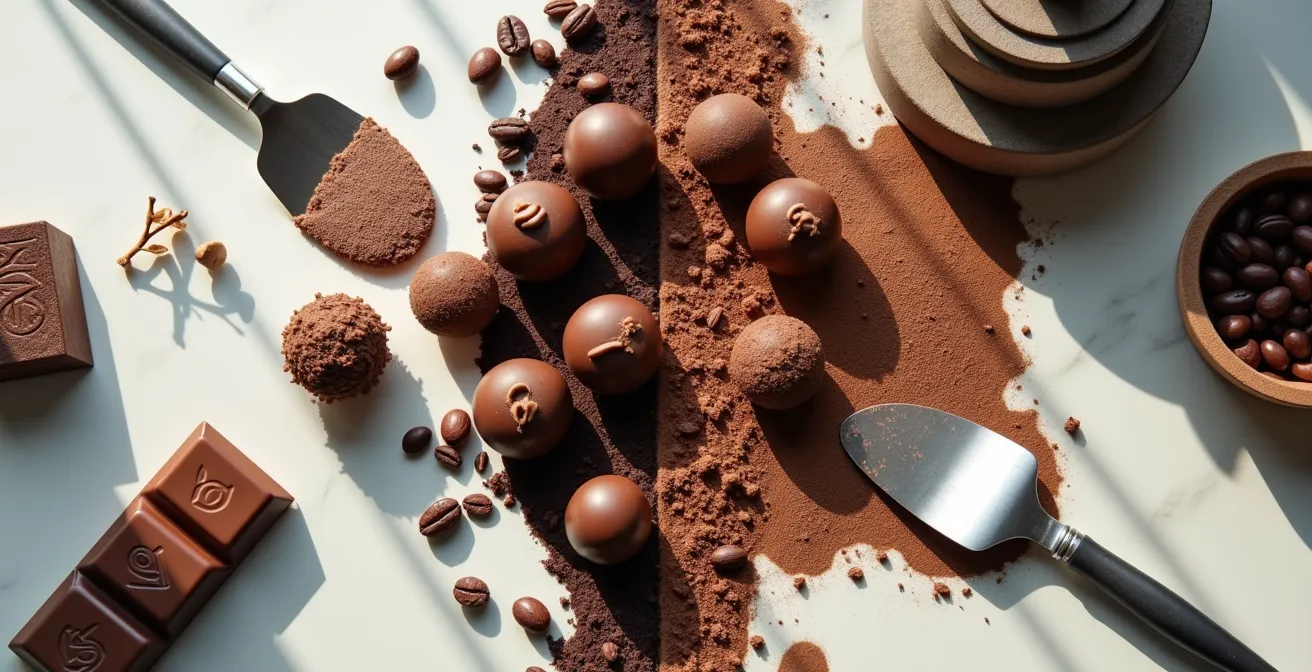
The common belief that a maker creates chocolate and a chocolatier simply uses it is a profound oversimplification.
- A Chocolate Maker is a raw material processor, transforming agricultural cacao beans into stable, finished chocolate bars through industrial and agricultural science.
- A Chocolatier is a culinary artist and scientist who takes that finished chocolate (couverture) as a starting point, elevating it into complex confections that require a separate universe of mastery in chemistry, physics, and design.
Recommendation: To truly appreciate the craft, recognize the maker as the master of the bean, and the chocolatier as the master of the final, edible art form. They are not sequential roles, but parallel worlds of expertise.
In the world of fine food, precision in language is a mark of respect for the craft. Yet, one of the most common faux pas I hear, even among dedicated foodies, is the interchangeable use of “chocolatier” and “chocolate maker.” It’s an understandable error, especially as the craft chocolate movement has exploded. Indeed, the number of bean-to-bar chocolate makers has grown rapidly in the past 15 years, bringing the chocolate-making process into the public eye like never before. This has led to the simple, but misleading, definition: the maker creates from the bean, the chocolatier creates from the bar.
As a chocolatier, I can tell you this definition barely scratches the surface. It’s like saying a master winemaker merely uses grapes. The real distinction lies not in the starting ingredient, but in the fundamentally different universes of science, artistry, and business each professional must command. A chocolate maker tames a raw agricultural product, battling fermentation, roasting profiles, and conching times to create a stable block of chocolate. Their job is done. For us, the chocolatiers, that block of chocolate—what we call couverture—is merely the blank canvas. Our work, a delicate dance of chemistry, physics, and aesthetics, is just beginning.
This guide will deconstruct the simplistic narrative and reveal the true professional distinctions. We will explore the specific scientific challenges, the essential tools, and the unique business models that define our respective crafts, so you can speak about chocolate with the confidence of an insider.
Summary: The True Divide Between Chocolate Maker and Chocolatier
- Why Tempering is Only 10% of a Chocolatier’s Job?
- How to Calculate the Water Activity to Prevent Mold?
- Polycarbonate Molds vs Silicone: Which Gives a Professional Shine?
- The Pricing Mistake That Bankrupts New Chocolate Shops
- When to Switch from Callebaut to Valrhona: The Cost Benefit
- Why Direct Trade Pays Farmers 3x More Than Fair Trade?
- Why Beta V Crystals Are Essential for the Snap?
- Valrhona vs Callebaut: Which Grand Cru for Tempering?
Why Tempering is Only 10% of a Chocolatier’s Job?
The public’s fascination with tempering—that magical process of heating and cooling chocolate to achieve a glossy finish and satisfying snap—has mistakenly defined the chocolatier’s role. For us, tempering is not the main event; it’s the warm-up. It is a fundamental, non-negotiable skill, like a chef knowing how to sharpen a knife. But it represents a mere fraction of our daily focus. A perfectly tempered shell is useless if what’s inside is unstable, uninspired, or unsafe.
The true heart of a chocolatier’s work lies in the creation and stabilization of fillings. This is where we move from being technicians to being chemists and artists. Crafting a ganache, a caramel, or a praliné that is not only delicious but will also remain fresh and safe to eat for weeks requires a deep understanding of food science. This is a world away from the chocolate maker’s focus on roasting and grinding. We are specialists within the broader patisserie world, focusing exclusively on the complex interactions between fat, sugar, and water in a confectionary context.
Our craft is a trinity of skills: the science of preservation, the mastery of chocolate’s physical state, and the art of presentation. To reduce our work to the single act of tempering is to miss the entire performance. The real expertise is demonstrated in the delicate balance of these three demanding disciplines.
Action Plan: The Pillars of a Chocolatier’s Craft
- Master the chemistry of chocolate and sugar: Understand how sugar acts as a preservative by binding to active water in confections for shelf-stability.
- Perfect the tempering curves: Develop working knowledge of different tempering curves for dark, milk and white chocolates, with variations within each type.
- Create chocolate artwork: Design and execute artistic chocolate sculptures and showpieces that demonstrate technical mastery.
How to Calculate the Water Activity to Prevent Mold?
Here we enter the invisible science that truly separates the chocolatier from the maker: the management of water activity (aW). While both professionals are concerned with moisture, they operate in completely different contexts. For a chocolate maker, the enemy is moisture in the raw cacao bean. For a chocolatier, the enemy is free water within our delicate ganaches and fillings. A ganache is an emulsion of chocolate and liquid (like cream), creating a perfect environment for microbial growth if not managed.
Water activity is not the same as water content. It measures the amount of “free” water available for microorganisms to grow. To create a shelf-stable bonbon that doesn’t need refrigeration, a chocolatier must precisely calculate and control the aW to be below a certain threshold, typically under 0.85 aW. We achieve this by manipulating sugar concentrations, adding specific ingredients like invert sugar or alcohol, and perfecting our emulsion techniques. This is a constant, high-stakes chemical balancing act.
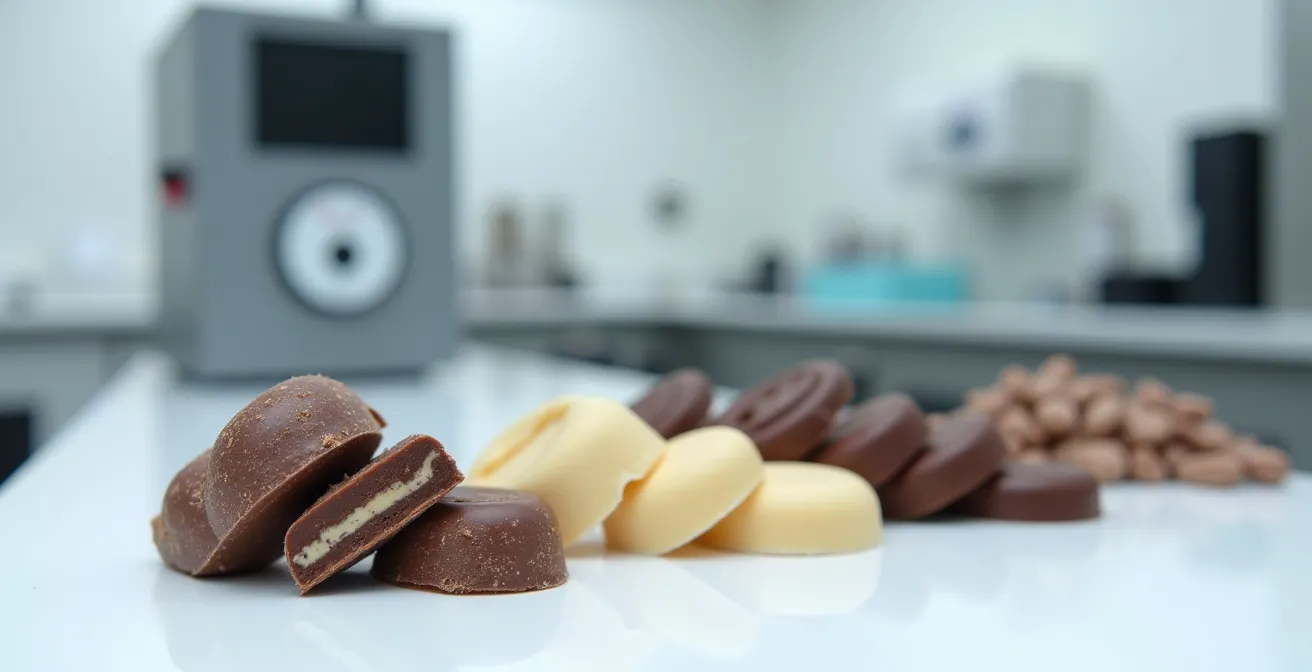
This challenge is entirely different from that of the chocolate maker. As an example, chocolate makers face water activity challenges at the bean level. Improperly dried or stored cacao beans with high water activity can develop mold, potentially ruining entire batches and representing massive financial losses before a single bar is produced. This demonstrates how water activity management is critical throughout the entire chocolate supply chain, from bean processing to our final confection creation. One deals with an agricultural threat; the other, a culinary one.
Polycarbonate Molds vs Silicone: Which Gives a Professional Shine?
The tools a professional uses are an extension of their expertise. For a chocolatier, the choice of molds is not a trivial matter of shape; it is a fundamental decision that dictates the quality of the final product. While hobbyists often reach for flexible silicone molds, the professional standard is rigid, crystal-clear polycarbonate. The reason is pure physics.
That coveted mirror-like shine on a high-end bonbon is not from a glaze or spray. It is a direct impression of a perfectly polished mold surface. Polycarbonate can be polished to a flawless finish that silicone, by its very nature, cannot achieve. Furthermore, as tempered chocolate cools, it contracts slightly. In a rigid polycarbonate mold, this contraction causes the chocolate to pull away cleanly from the sides, facilitating easy release and a perfect, unblemished surface. Silicone is too flexible to allow for this clean separation, often resulting in a dull or uneven finish.
While silicone is easy to de-mold, it’s inefficient for professional production. Polycarbonate molds are designed for high-volume workflow: they are durable, stackable, and can be ‘tapped’ aggressively to release air bubbles.
– Industry Analysis, Professional Chocolate Making Standards
The following table, based on extensive professional experience and industry analysis, breaks down the critical differences that make polycarbonate the only choice for serious production work.
| Feature | Polycarbonate Molds | Silicone Molds |
|---|---|---|
| Surface Finish | Mirror-like professional shine | Matte to semi-gloss finish |
| Thermal Properties | Excellent – enables perfect contraction | Poor – inconsistent cooling |
| Professional Workflow | High-volume production ready | Hobbyist/small batch only |
| Durability | Extremely durable, stackable | Flexible but less durable |
| Air Bubble Removal | Can tap aggressively | Too flexible for proper tapping |
| Best Use Case | Geometric shapes, production | Complex 3D artistic shapes |
The Pricing Mistake That Bankrupts New Chocolate Shops
The financial models of a chocolatier and a chocolate maker are worlds apart, and confusing them is a recipe for disaster. A common mistake for new chocolatiers is to price their products based on the cost of ingredients alone. They forget that their primary value-add is not the chocolate, but their skilled labor, artistry, and the overhead of a commercial kitchen. A chocolate maker’s price, on the other hand, is dominated by the cost of raw materials (cacao beans) and expensive, heavy industrial equipment like roasters, grinders, and conches.
This leads to a significant difference in both pricing and business structure. It is not uncommon that bean-to-bar chocolate prices are double or triple that of chocolatier shops. This isn’t because one is “better” but because the cost structures are fundamentally different. The maker invests heavily in processing machinery and direct-sourcing beans. The chocolatier invests in specialized tempering machines, molds, and the significant time required for hand-crafting each individual piece. A maker sells a high-margin bar; a chocolatier sells a box of lower-margin, labor-intensive creations.
A new chocolate shop that tries to compete on price with a simple chocolate bar will fail. They cannot match the economies of scale of a maker. Their path to profitability is through the perceived value of their artistic creations—the unique flavors, textures, and designs that no machine can replicate. Failing to account for this artistic labor in the final price is the single most common reason new chocolate shops go bankrupt.
When to Switch from Callebaut to Valrhona: The Cost Benefit
For a chocolatier, the choice of couverture is the most important decision after deciding to open shop. It’s a strategic choice that balances cost, workability, and flavor profile. Brands like Callebaut are the workhorses of the industry. They are consistent, reliable, have excellent viscosity for a wide range of applications, and are cost-effective. For a business focused on high-volume production, enrobed items, or confections where other flavors are the star, Callebaut is an intelligent and profitable choice.
However, there comes a point in a chocolatier’s journey where the goal shifts from mere production to true artistry. This is where a premium brand like Valrhona enters the picture. Valrhona is renowned for its complex, terroir-driven flavor profiles. Using a Valrhona single-origin couverture from Madagascar with its bright, red-fruit notes isn’t just a technical choice; it’s an artistic statement. It’s for when the chocolate itself is the main flavor, not just a carrier for other ingredients.
The switch is a cost-benefit analysis. The significantly higher price of Valrhona must be justified by a corresponding increase in the final product’s price and its story. A chocolatier switches when their brand and clientele are sophisticated enough to appreciate—and pay for—the nuance of a Grand Cru chocolate. It’s a signal that the business has matured from a candy maker to a purveyor of fine chocolate experiences. This is a business decision a chocolate maker, who creates their own flavor profiles from the bean, never has to make.
Why Direct Trade Pays Farmers 3x More Than Fair Trade?
Now, let’s step completely into the world of the chocolate maker. Their primary relationship is not with a kitchen, but with agriculture and the global supply chain. A key distinction in the modern craft chocolate movement is the rise of Direct Trade sourcing, which stands in contrast to the more widely known Fair Trade certification.
Fair Trade is a certification system that ensures a minimum price is paid for cacao. While well-intentioned, it is a third-party system that adds administrative layers and often only guarantees a small premium over the volatile commodity market price. Direct Trade, on the other hand, is a relationship. The chocolate maker works directly with the farmer or cooperative, cutting out intermediaries. This allows them to pay a significantly higher price—often two to three times the Fair Trade minimum—in direct exchange for higher quality beans.
This model benefits both parties. The farmer is rewarded for meticulous harvesting and fermentation practices, which are essential for creating fine-flavor cacao. The chocolate maker gains access to superior raw materials and has complete transparency and control over their supply chain. They know the farm, the farmer, and the specific post-harvest processes used. This is a level of sourcing involvement a chocolatier rarely, if ever, experiences. Our focus is on the finished couverture; theirs is on the agricultural origin story of the bean itself.
Why Beta V Crystals Are Essential for the Snap?
We return to the science that unites both professions, but which we, as chocolatiers, must manipulate daily with far greater versatility: crystallization. The “magic” of tempering is, in fact, the controlled formation of a specific crystal structure within the cocoa butter. Cocoa butter is polymorphic, meaning it can solidify into six different crystal forms (Types I-VI). Only one of these is desirable: the Beta V crystal (Type V).
Why is this specific crystal so important? The Beta V crystal is a stable, tightly packed structure. When chocolate is properly tempered, the cocoa butter fat molecules align predominantly into this formation. This tight packing is what gives chocolate its essential qualities: a high-gloss shine, a firm texture that “snaps” cleanly when broken, and a pleasing melting point just below body temperature, which provides a smooth, non-waxy mouthfeel. It also ensures the chocolate contracts properly in the mold.
When tempering fails, it’s because unstable crystals (like Type IV) have formed instead. This results in a dull, soft, or crumbly chocolate that melts on your fingers. Over time, these unstable crystals will rearrange themselves into the more stable Beta VI form, but they do so in a chaotic way, pushing fat to the surface and creating the dreaded greyish-white streaking known as fat bloom. While chocolate makers must temper their chocolate to form the final bar, chocolatiers must master this science for a dozen different applications—molding, enrobing, decorating, each requiring slight adjustments to the tempering curve.
Key Takeaways
- The roles of chocolatier and chocolate maker are not a linear progression but parallel professions, each requiring a distinct set of scientific, artistic, and business skills.
- A chocolatier’s primary challenge is culinary chemistry: managing water activity for shelf-stability in fillings and mastering the physics of tempering for various applications.
- A chocolate maker’s focus is on agricultural science and industrial processing: sourcing quality beans, roasting, and grinding to develop the intrinsic flavor of the cacao.
Valrhona vs Callebaut: Which Grand Cru for Tempering?
We arrive at the chocolatier’s final frontier: artistic expression through flavor. Having moved past the business decision of which brand to use, the true artist must ask: which specific chocolate will best serve my creation? This is where the concept of “Grand Cru” chocolate becomes essential. Much like in wine, a Grand Cru chocolate is made from beans from a specific region or even a single plantation, possessing a unique, identifiable flavor profile or “terroir.”
Choosing between a Valrhona “Manjari” 64% from Madagascar and a Callebaut “Arriba” 39% from Ecuador is not about which is “better.” It is about intent. The Manjari, with its sharp, red fruit acidity, might be the perfect choice to cut through a rich, nutty praliné or to create a striking contrast in a dark chocolate mousse. The Arriba milk chocolate, with its pronounced hazelnut and banana notes, might be the ideal partner for a coffee-infused ganache or a caramel filling. These are the decisions of a chef, a flavor architect.
This level of selection is the culmination of a chocolatier’s journey. It demonstrates a mastery that transcends technique and enters the realm of art. We are not just melting chocolate; we are curating an experience, pairing the complex flavor notes of a specific couverture with other ingredients to create something that is more than the sum of its parts. This is our ultimate value, and it is a world away from the (equally respectable) craft of turning a bean into a bar.
Now that you understand the profound differences in skill, science, and artistry, you can appreciate each craft for the demanding profession it is. The next time you enjoy a piece of fine chocolate, take a moment to identify its creator: was it a maker who mastered the bean, or a chocolatier who elevated the bar into art?