
The perfect coffee and chocolate pairing isn’t about matching intensity, but about building a deliberate molecular architecture.
- Shared compounds like pyrazines create “flavor bridges,” while mismatched acidity leads to sensory clashes.
- Fats and sugars in chocolate physically block bitterness receptors on your tongue, fundamentally changing the taste of espresso.
Recommendation: Move beyond simple rules and start tasting with a chemist’s mindset—focus on balancing acidity, bridging roasted notes, and managing bitterness for a truly transcendent experience.
There’s a unique disappointment that comes from pairing a premium, single-origin espresso with an expensive craft chocolate bar, only for the combination to fall flat. One flavor obliterates the other, or a strange, sour note emerges from the mix. We’ve all been told the conventional wisdom: “pair dark with dark” or “match the intensity.” This advice is simple, but it’s also the reason so many gourmet pairings fail. It treats two of the most chemically complex foods on the planet like simple blocks of color.
The truth is, a successful pairing has less to do with broad categories like “dark” or “light” and more to do with the intricate dance of molecules. It is an act of sensory engineering. But what if the key wasn’t in matching strength, but in understanding the underlying chemical architecture? What if you could learn to see, and taste, the molecular bridges, the acidic clashes, and the way lipids physically reshape your perception of bitterness?
This is not a simple guide of what to pair with what. This is a flavor chemist’s look under the hood. We will deconstruct the experience, from the volatile aromatic compounds that first hit your nose to the lingering aftertaste shaped by psychoactive alkaloids. By understanding the *why* behind the harmony (or dissonance), you can move from guessing to deliberately constructing a perfect, memorable pairing every single time.
To navigate this deep dive into flavor science, this article breaks down the core chemical principles one by one. The following summary outlines the key interactions we will explore to master the art of pairing espresso and chocolate.
Summary: Espresso and Dark Chocolate: The Chemical Romance Behind a Perfect Pairing
- Why a Light Roast Disappears Behind 80% Dark Chocolate?
- How to Use Orange Zest to Bridge Coffee and Chocolate?
- Sweet Milk Chocolate vs Bitter Espresso: Is Contrast Better than Harmony?
- The Acidity Mistake: Pairing Sour Coffee with Sour Chocolate
- When to Sip the Coffee: Before or After the Chocolate Melt?
- The Flavor Pairing Mistake That Ruins a Gourmet Dessert Platter
- Why Finding a Common Note Links Coffee and Chocolate?
- Why Does the Smell of Vanilla Trigger Childhood Memories?
Why a Light Roast Disappears Behind 80% Dark Chocolate?
The common advice to “match intensity” is a dramatic oversimplification. The real reason a delicate, light-roast coffee is obliterated by a high-cacao chocolate is a matter of specific molecular concentration. The magic words are pyrazines. These are a class of aromatic compounds created during the Maillard reaction and caramelization—the browning processes central to both roasting coffee beans and cacao. Pyrazines are responsible for the coveted nutty, roasted, and earthy flavors.
When you pair a dark-roast espresso with an 80% dark chocolate, you are creating a powerful synergy. Both have been roasted to a point where pyrazine development is high. Their shared chemical signature creates a resonant harmony, a “molecular bridge” where the roasted notes in one amplify the roasted notes in the other. A light-roast coffee, by contrast, has far fewer of these deep, roasty pyrazines. Its flavor profile is dominated by brighter, more acidic, and floral compounds. When faced with the pyrazine-heavy profile of a very dark chocolate, its delicate notes aren’t just masked; they are chemically overwhelmed. It’s like trying to hear a violin concerto during a fireworks display.
Therefore, the rule isn’t “dark with dark.” It’s “match the pyrazine profile.” A medium-roast coffee with nutty notes will pair beautifully with a 65% chocolate that also expresses nutty characteristics, because they are speaking the same chemical language.
How to Use Orange Zest to Bridge Coffee and Chocolate?
Sometimes, even with careful selection, a coffee and chocolate pairing can feel disjointed, like two distinct flavors happening in your mouth at the same time rather than one cohesive experience. This is where a “flavor bridge” comes in. With coffee containing over 800 aromatic compounds, and chocolate not far behind, the potential for sensory clashes is high. A bridging ingredient introduces a new, dominant aromatic note that connects the two.
Orange zest is a classic and chemically brilliant choice. Its power lies in its essential oils, which are rich in a compound called limonene. This intensely fragrant molecule is highly volatile, meaning it easily becomes airborne and is detected by our olfactory system (our sense of smell). When you twist a fresh orange peel over an espresso and chocolate, you are releasing a cloud of limonene.
This powerful citrus aroma acts as a unifying theme. It provides a bright, high note that cuts through the deep, bass notes of both the coffee and chocolate, forcing them into a new relationship. The fruity acidity of the orange can complement the inherent fruit notes in a single-origin coffee while providing a stark, pleasant contrast to the richness of the chocolate. The zest doesn’t just add a flavor; it chemically re-contextualizes the other two, creating a culinary trio where each element is enhanced. This principle also works with other strong aromatics like fresh mint, cinnamon, or cardamom.
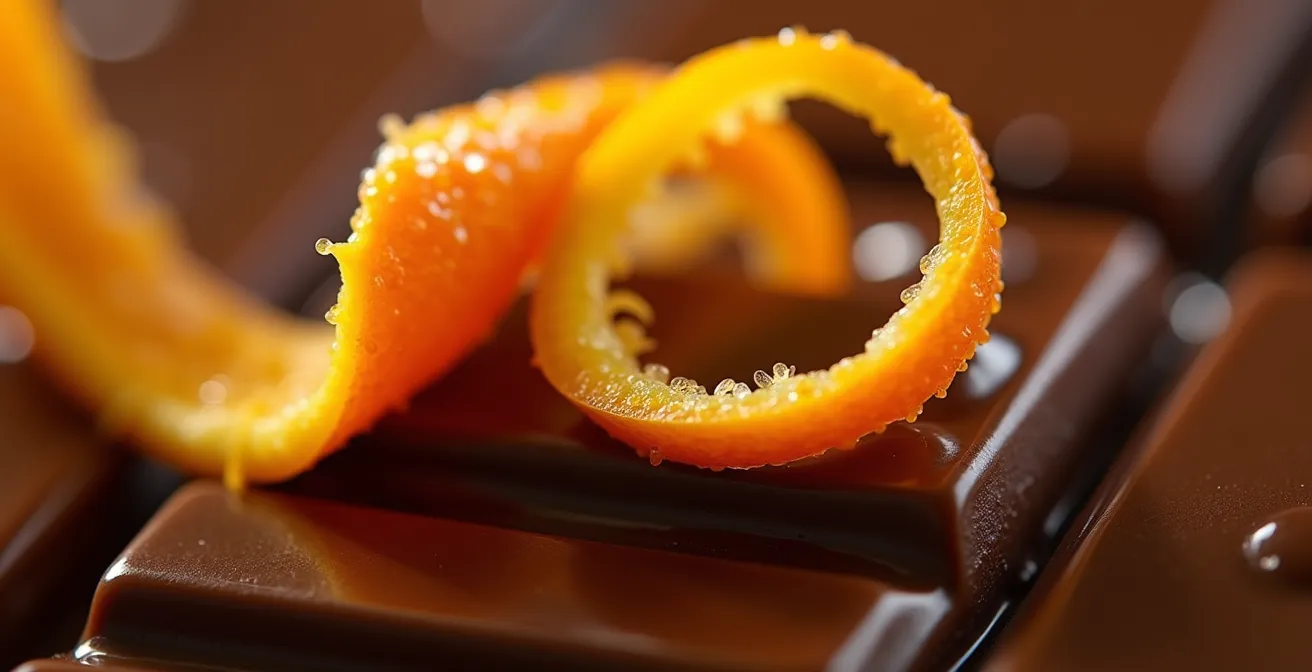
As you can see, the bridge isn’t a mixture but a third, distinct element that creates a new sensory context. It’s a testament to the fact that pairing is not just about the primary ingredients, but the entire aromatic environment you create.
Sweet Milk Chocolate vs Bitter Espresso: Is Contrast Better than Harmony?
Pairing a bitter espresso with a sweet, fatty milk chocolate might seem like a simple contrast, but the interaction is a fascinating lesson in sensory science. It’s not just about sweetness masking bitterness; it’s a physical intervention happening on your tongue. Our perception of bitterness is mediated by a family of taste receptors known as TAS2Rs. When compounds in coffee, particularly caffeine and others, bind to these receptors, they send a “bitter” signal to the brain.
Here’s where milk chocolate performs its magic. It contains two key components: sugar and lipids (milk fats). The sugar provides a straightforward sweet contrast, but the lipids are the secret weapon. They physically coat the tongue. This coating acts as a barrier, preventing many of the espresso’s bitter compounds from reaching and activating the TAS2R bitterness receptors. The result is a dramatically smoother, less aggressive espresso experience.
This molecular-level insight is highlighted by experts in the field. As one leading researcher on these receptors explains, the effect is quite direct:
The lipids and sugar molecules in milk chocolate physically bind to the tongue’s bitterness receptors (like TAS2Rs), preventing them from sending a full ‘bitter’ signal to the brain.
– Bryan L. Roth, MD, PhD, University of North Carolina School of Medicine Study on TAS2R14
So, is contrast better than harmony? In this case, contrast isn’t just a flavor preference; it’s a tool for bitterness modulation. You are actively engineering the tasting experience by using the fat in the chocolate to turn down the volume on the espresso’s bitterness. This allows other, more subtle flavors in the coffee—fruity, floral, or nutty notes—to come forward.
The Acidity Mistake: Pairing Sour Coffee with Sour Chocolate
Perhaps the most common and unpleasant pairing failure is the “acidity clash.” This happens when you combine a coffee and a chocolate that are both high in acidity, resulting in an overwhelmingly sour, tart, and often astringent experience. This isn’t a matter of taste; it’s a simple case of compounding pH levels on your palate. Light-roast coffees are particularly known for their high acidity, containing significant levels of citric, malic, and chlorogenic acids that give them their characteristic bright, fruity, or wine-like notes. A 2023 study on coffee acids demonstrated that these compounds are much more present in lighter roasts than in dark roasts, where the roasting process breaks them down.
Similarly, chocolate made from “natural” (non-alkalized) cocoa and certain fruit-forward cacao beans can also have a noticeable acidity. When you pair a bright, lemony Ethiopian coffee with a tart, raspberry-noted Madagascan chocolate, you’re not getting a symphony of fruit; you’re getting a cacophony of acid. The combined effect lowers the pH in your mouth so much that it triggers a strong sour response, eclipsing all other nuanced flavors.
To avoid this, you must balance acidity. A high-acidity coffee needs a low-acidity chocolate to provide a rich, grounding bass note. This is where Dutch-processed cocoa, which is alkalized to neutralize its acidity, or chocolates known for their earthy, nutty profiles (like many from Brazil or Ecuador) become invaluable. The goal is balance, not amplification.
This comparative table clearly illustrates the pH differences you need to manage for a successful pairing.
| Product Type | pH Range | Acidity Level |
|---|---|---|
| Light Roast Coffee | 4.85-5.13 | High |
| Dark Roast Coffee | 5.2-5.8 | Medium |
| Natural Cocoa | 5.3-5.8 | Medium |
| Dutch Process Cocoa | 6.8-8.1 | Low/Neutral |
When to Sip the Coffee: Before or After the Chocolate Melt?
The sequence and timing of your tasting can completely transform the pairing experience. It’s not just about getting both coffee and chocolate in your mouth; it’s about creating the perfect moment of interaction. The goal is to achieve an “in-mouth emulsion”—a temporary, blended state where the melted cocoa butter from the chocolate and the liquid coffee combine to create a new, unified texture and flavor. Getting this right is a matter of physics and temperature.
Sipping the espresso first serves to warm the palate. This prepares your mouth and heightens its sensitivity to the flavors that are about to be introduced. Placing the chocolate on your tongue next and allowing it to melt for a few seconds is the critical step. As the chocolate’s temperature rises, its cocoa butter begins to liquefy, releasing its full spectrum of volatile aromatic compounds. This is the moment of maximum flavor potential.
Sipping the hot espresso *while* the chocolate is in this semi-liquid state is the key. The heat and liquid from the coffee accelerate the melting and help emulsify the coffee with the cocoa butter, coating your entire palate with the combined flavors. If you drink the coffee first and then eat the chocolate, you get two separate experiences. If you swallow the chocolate before sipping the coffee, you miss the magic of the emulsion. The sequence is everything.
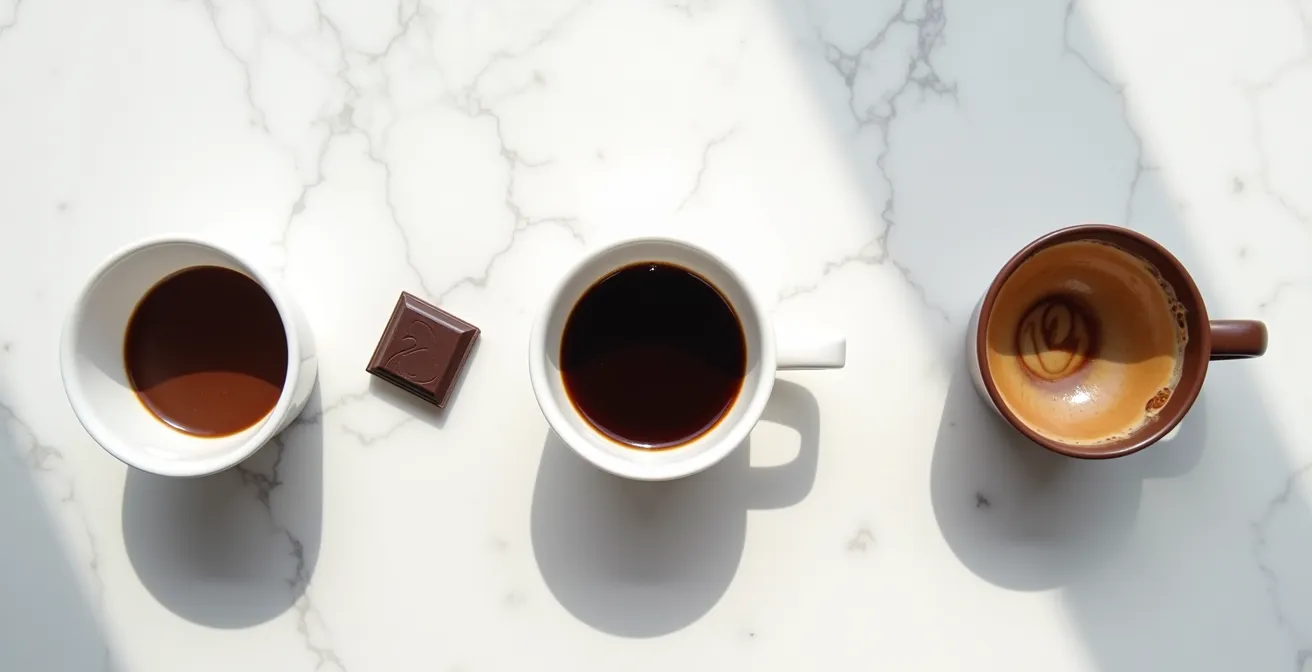
This deliberate process ensures that you are not just tasting two things in succession, but creating a third, unique flavor profile directly on your palate.
Your Action Plan: The Optimal Coffee-Chocolate Tasting Sequence
- Let chocolate reach room temperature (20-22°C) before tasting to ensure its aromatic compounds are ready for release.
- Take a small sip of espresso first to warm the palate and prepare your taste receptors.
- Place a piece of chocolate on your tongue and let it begin melting for 3-5 seconds without chewing.
- Sip the espresso while the chocolate is still melting to create a rich, in-mouth emulsion.
- Allow the combined flavors and textures to coat your entire palate before swallowing to fully assess the pairing.
The Flavor Pairing Mistake That Ruins a Gourmet Dessert Platter
Beyond the core principles of matching notes and balancing acidity, several simple, often-overlooked mistakes can completely sabotage a carefully planned pairing. These errors are not about chemistry but about physics and preparation, and they are the leading cause of disappointment on a gourmet dessert platter. The most common culprit is temperature.
Chocolate served straight from the refrigerator is a flavor disaster. The cold temperature locks the cocoa butter into a hard, solid state. When cocoa butter is solid, the volatile aromatic compounds responsible for the chocolate’s nuanced flavors (floral, fruity, spicy) are trapped. A cold piece of chocolate will taste waxy, dull, and one-dimensional. For optimal flavor release, chocolate must be served at room temperature (20-22°C / 68-72°F). At this temperature, the cocoa butter is just on the cusp of melting, ready to release its full aromatic bouquet the moment it hits the warmth of your tongue.
Another subtle mistake involves the type of cocoa used in accompanying baked goods. As cookbook author Susan Purdy discovered, the chemistry of cocoa can have unexpected consequences. She notes an instance where switching to Dutch-process cocoa, which is alkalized and less acidic, ruined a batch of biscotti: “The batter was no longer acidic enough for the eggs to set, resulting in a chocolate puddle instead of biscotti.” This demonstrates how a seemingly small chemical change (altering the pH) can cascade into a total structural failure. It’s a powerful reminder that in flavor pairing, every chemical detail matters.
Why Finding a Common Note Links Coffee and Chocolate?
The most successful and profound pairings are built on a foundation of shared flavors. This principle, known as “flavor bridging,” relies on identifying a common dominant note in both the coffee and the chocolate, which acts as a link to unify the two. While this can be a fruity or floral note, the most fundamental bridge between coffee and chocolate is their shared roasted and nutty character.
This commonality is no accident; it is a direct result of their shared chemistry. As we’ve discussed, both coffee and cacao beans undergo the Maillard reaction during roasting, which creates a family of compounds called pyrazines. These are the molecules that our brain interprets as “roasted,” “nutty,” “toasted,” or “earthy.” According to research, both coffee and chocolate contain pyrazines, which give them their signature roasted flavors. When you pair a nutty Brazilian coffee with a nutty Madagascan chocolate, you are creating a powerful resonance. The pyrazines in the coffee amplify your perception of the pyrazines in the chocolate, and vice versa, creating an experience that is richer and more complex than either element alone.
To find these common notes, you must taste each element individually first. Identify the dominant flavor in your espresso. Is it roasty? Fruity? Earthy? Then, taste the chocolate and search for that same note. When you find a match, you have discovered your molecular bridge. This is the secret to creating pairings that feel not just complementary, but deeply and intrinsically connected.
Key Takeaways
- Build Molecular Bridges: The best pairings are based on shared flavor compounds, especially pyrazines, which create the “roasted” and “nutty” notes common to both coffee and chocolate.
- Manage Acidity and Bitterness: Avoid pairing high-acidity coffee with high-acidity chocolate. Use the lipids in sweeter chocolates to physically block bitterness receptors and smooth out an intense espresso.
- Control the Physical Experience: The sequence of tasting and the temperature of the chocolate are not minor details; they are critical variables that control flavor release and the creation of an in-mouth emulsion.
Why Does the Smell of Vanilla Trigger Childhood Memories?
The question of why vanilla triggers memories speaks to the profound connection between our sense of smell (olfaction) and the memory centers of our brain. The olfactory bulb has direct pathways to the amygdala and hippocampus, which are strongly implicated in emotion and memory. A single whiff can transport us. While vanilla is a powerful example, the experience of pairing coffee and chocolate is also deeply influenced by chemistry that goes beyond taste and aroma to directly affect our physiological and mental state.
Chocolate contains a fascinating alkaloid called theobromine. Unlike caffeine, which is a potent central nervous system stimulant, theobromine is primarily a smooth muscle relaxant and vasodilator (it widens blood vessels). This is why a good piece of dark chocolate can feel calming and centering, rather than jittery. According to neurological research, theobromine in chocolate causes blood pressure to decline, contributing to a sense of relaxation that beautifully counterbalances the sharp alertness from an espresso’s caffeine.
Another famous compound is phenethylamine (PEA), often touted as the “love drug” because the brain releases it during infatuation. While chocolate does contain PEA, its reputation is largely a myth, as experts from the National Institute of General Medical Sciences clarify:
Chocolate does have significant amounts of phenethylamine that causes brain cells to release dopamine, a neurotransmitter with a feel-good effect. However, when we ingest phenethylamine, our bodies break it down before it can reach our brains.
– National Institute of General Medical Sciences, The Chemistry of Chocolate
This understanding of the true psychoactive effects—the calming theobromine, not the mythical PEA—adds another layer to your pairing. You are not just combining flavors; you are orchestrating a combined physiological experience, balancing the energetic peak of caffeine with the sustained, gentle lift of theobromine.