
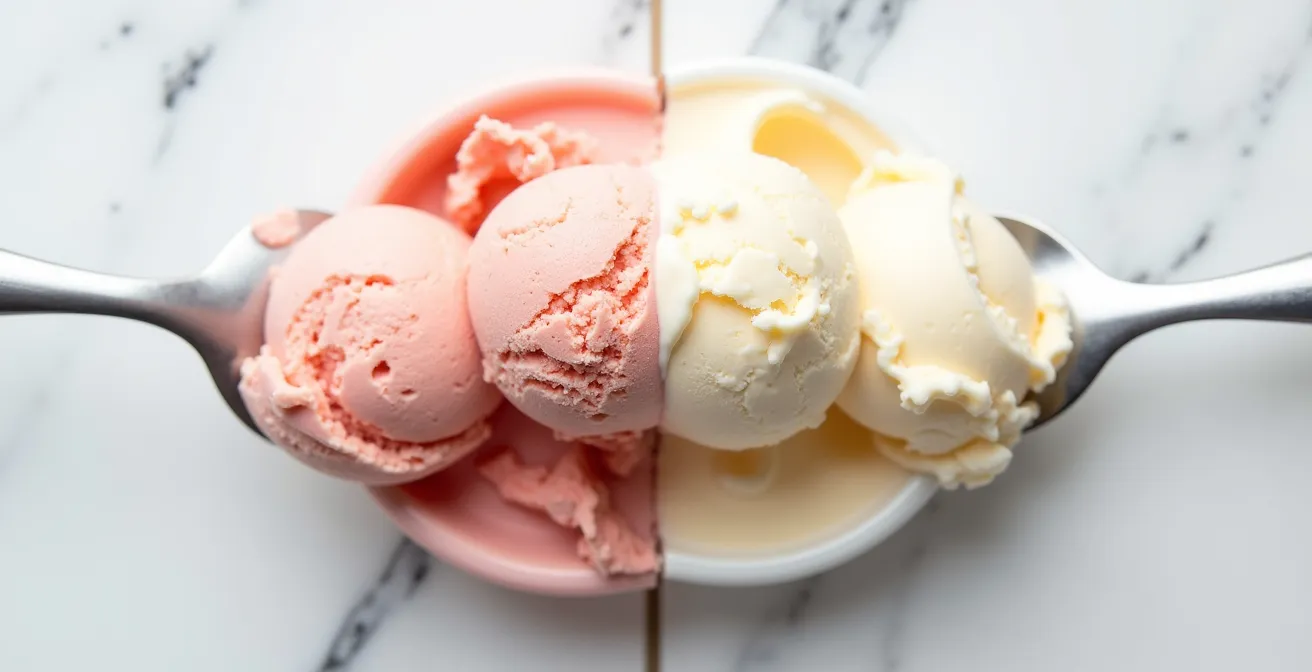
Contrary to popular belief, gelato’s superior creaminess and intense flavor aren’t a mystery—they are the direct result of a meticulous craft that intentionally uses less fat and less air than ice cream.
- Gelato’s density, achieved through slower churning, delivers more flavor per spoonful.
- Its higher serving temperature unmasks flavor molecules that ice cream’s coldness suppresses.
Recommendation: To truly appreciate the difference, learn to identify authentic gelato by its natural colors and dense structure, and understand the precise temperature control needed to maintain its texture at home.
Walk down any frozen dessert aisle, and the confusion is palpable. Side-by-side, tubs of “ice cream” and “gelato” promise a creamy, satisfying experience. Yet, if you’ve ever tasted true, artisanal gelato in Italy, you know they are worlds apart. Many dismiss gelato as just a “fancy Italian word for ice cream,” a low-fat alternative, or a marketing gimmick. This could not be further from the truth. The differences are not superficial; they are baked into the very science and craft of how each is made.
The common understanding is that ice cream is rich with cream and eggs, while gelato uses more milk. While true, this is only the beginning of the story. The real distinction lies in a trio of interconnected factors: fat, air, and temperature. As artisans, we don’t just mix ingredients; we engage in a form of texture engineering. The goal is not simply to create a frozen sweet, but to craft a specific mouthfeel—dense, silky, and elastic—that delivers flavor with an intensity ice cream cannot match. Forget the idea that less fat means less flavor. We are about to demonstrate why, in the world of gelato, the opposite is true.
This guide will take you behind the counter and into the churning machine. We will explore the science that governs flavor perception, the common mistakes that ruin texture, and the visual cues that separate a true master’s work from a factory imitation. By the end, you will not only understand the difference but appreciate the deliberate artistry required to achieve gelato perfection.
To navigate this deep dive into the craft of frozen desserts, here is a breakdown of the key principles we will cover. Each section builds on the last, revealing the scientific and artisanal secrets that define authentic gelato.
Summary: Unlocking the Secrets of Gelato’s Creamy Texture
- Why Gelato Has More Intense Flavor Than Ice Cream Despite Less Fat?
- How to Store Gelato at Home Without It Turning into a Rock?
- Artisanal vs Industrial: How to Spot Fake Gelato in 3 Seconds?
- The Churning Mistake That Fills Your Gelato with Ice Crystals
- Milk or Cream: The Right Ratio for a Silky Italian Texture
- Why Low-Fat Cream Fails to Hold Air When Frozen?
- Why Does Hot Espresso Cause Gelato to Crystallize If Poured Wrong?
- Why Frozen Cream Bases Separate and How to Stabilize Them?
Why Gelato Has More Intense Flavor Than Ice Cream Despite Less Fat?
The most common misconception is that fat equals flavor. In a steak, perhaps. In a frozen dessert, fat can actually be a barrier. The core difference lies in the composition: authentic Italian gelato’s fat content is significantly lower. Nutritional analysis shows that gelato typically contains 4-9% fat, whereas American-style ice cream can range from 10% to as high as 25%. This isn’t a diet choice; it’s a deliberate decision to prioritize flavor clarity.
High percentages of butterfat coat the tongue, creating a rich, lingering sensation that can dull the taste buds and mask the primary flavors of the ingredients, be it pistachio, hazelnut, or strawberry. With less fat in the way, the true character of the base ingredients shines through with greater intensity. This is the first secret to gelato’s powerful flavor punch. But it’s only half the equation.
The second, and equally crucial, factor is serving temperature. As an NPR food science report highlights, gelato is typically served at 7 to 12 degrees Fahrenheit, a full 10 to 15 degrees warmer than ice cream. Extreme cold numbs the palate. By serving gelato at a warmer temperature, we allow the flavor molecules to become more volatile and accessible to your taste receptors. Your tongue isn’t frozen into submission, so it can fully perceive the complex notes of the ingredients. The result is a flavor experience that is brighter, cleaner, and far more immediate.
How to Store Gelato at Home Without It Turning into a Rock?
Bringing a pint of artisanal gelato home often ends in disappointment. After a day in a standard home freezer, the once-silky dessert becomes an icy, un-scoopable brick. This isn’t a flaw in the gelato; it’s a failure of environment. The problem is, again, rooted in temperature. Your home freezer is designed for deep-freezing, typically operating at 0°F (-18°C) or colder. This is far too cold for gelato’s delicate structure.
Gelato is formulated with a lower fat content and less air, making it denser. This also means it has a higher freezing point than ice cream. Storing it at sub-zero temperatures causes the small, desirable ice crystals within the gelato to merge and grow into large, crunchy ones—the enemy of a smooth mouthfeel. As gelato storage experts recommend, the ideal holding temperature is between 10 to 22°F (-12 to -6°C), a range most home freezers cannot maintain.
To combat this at home, you must create a buffer. First, use a proper storage container. The best option is a shallow, flat, airtight container that minimizes air exposure. When you store the gelato, press a piece of plastic wrap or parchment paper directly onto the surface before sealing the lid. This prevents air contact, which leads to freezer burn and further crystallization.
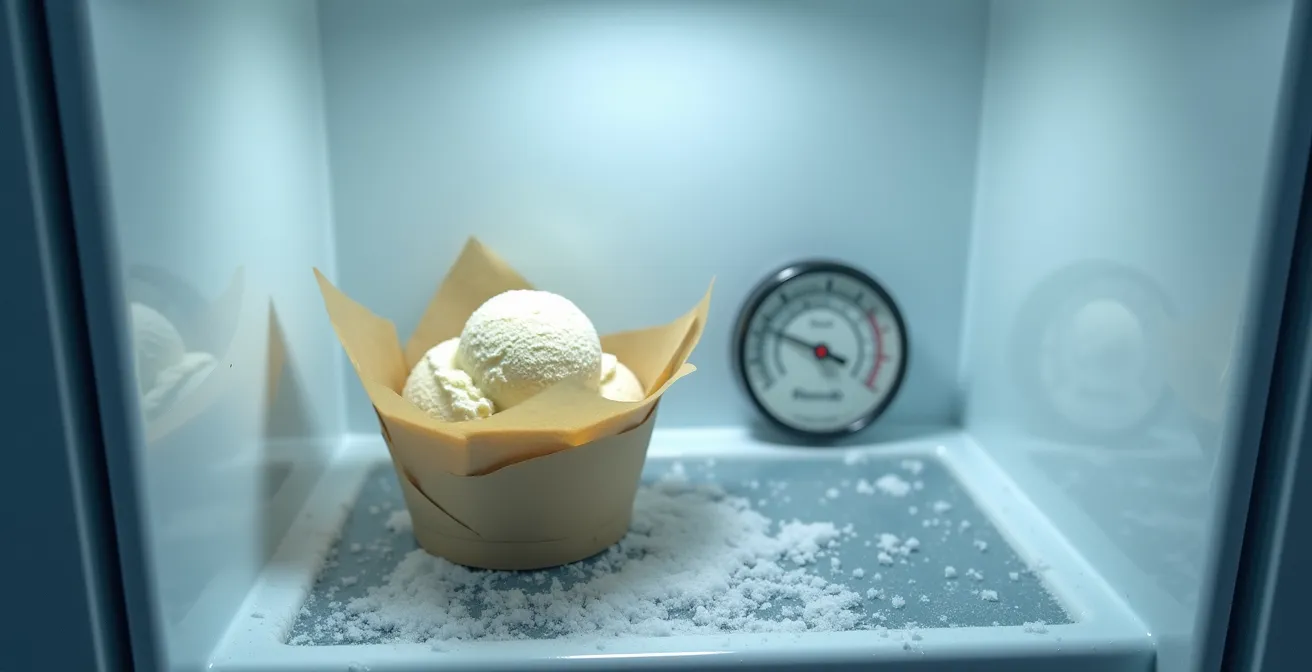
As the image above illustrates, proper storage is about insulation and minimizing temperature shock. If your freezer has a “door” compartment, it’s often slightly warmer and a better choice than the back wall. Before serving, let the container sit at room temperature for 5-10 minutes. This isn’t just to make it scoopable; it’s to bring it back closer to its ideal serving temperature, reawakening the texture and flavor we worked so hard to create.
Artisanal vs Industrial: How to Spot Fake Gelato in 3 Seconds?
The word “gelato” is not protected, so many industrial products use it to sound more premium. As an artisan, this is frustrating. However, a trained eye can instantly distinguish authentic gelato from a cheap imitation. You don’t need to taste it; you just need to look for three key signs.
First, observe the presentation. Authentic gelato is dense. It should be stored in deep, often metal, containers and served with a flat spade or spatula, not a round ice cream scoop. If you see gelato piled high in fluffy, gravity-defying mounds, be skeptical. This is a tell-tale sign of a product with a very high overrun (air content) and likely a lot of chemical stabilizers to hold its shape. As a key density test reveals, authentic gelato contains 25-30% air, while industrial ice cream can contain up to 50% or more. That extra volume is just air you’re paying for.
Second, look at the colors. Nature’s colors are rarely neon. Pistachio gelato should be a muted, brownish-green, not a vibrant emerald. Banana should be a grayish-white, not bright yellow. Strawberry should be a soft pink or deep red, not a shocking fuchsia. Overly bright, synthetic colors are a clear indicator of artificial flavorings and additives, not the fresh, natural ingredients that define true artisanal gelato.
Third, check the ingredient list if possible. An authentic gelato recipe is beautifully simple: milk, a small amount of cream, sugar, and the main flavoring ingredient (like fruit puree or nut paste). The list should be short and understandable. If you see a long list of chemical-sounding names like mono- and diglycerides, polysorbate 80, or carrageenan, you’re looking at an industrial product designed for long shelf life, not for pure flavor.
The Churning Mistake That Fills Your Gelato with Ice Crystals
For the aspiring home gelato maker, nothing is more disheartening than a final product that’s grainy and icy instead of smooth and silky. This failure almost always traces back to one critical phase: the management of temperature during churning. The goal of churning is to freeze the base quickly while continuously breaking up ice crystals as they form, keeping them microscopically small. Any delay or temperature fluctuation can trigger a crystallization cascade.
The most common mistake is churning a base that isn’t cold enough. Pouring a lukewarm or even room-temperature base into a home churning machine overloads its freezing capacity. The machine can’t cool the mixture fast enough, giving large ice crystals ample time to form. For a truly silky texture, your base must be thoroughly chilled—not just cool, but aged—in the refrigerator for at least 4 hours, and ideally overnight. This aging process allows the milk proteins to fully hydrate and the fat to solidify, which results in a smoother final product.
Furthermore, the extraction temperature is non-negotiable. Pulling the gelato from the machine too soon (when it’s still soupy) or too late (when it’s too hard for the motor) compromises the structure. You are aiming for the consistency of thick, soft-serve ice cream. From there, it must be transferred immediately to a pre-chilled container and moved to the freezer for “hardening,” a static freezing phase that firms it up to the perfect serving consistency without the destructive motion of the churn.
Action Plan: Preventing Ice Crystals
- Pre-chill the base: Cool your mix to 7.2°C (45°F) or below, ideally using an ice bath before refrigerating.
- Age the base: Let the chilled base rest in the fridge for a minimum of 4-12 hours to allow proteins to hydrate and fats to crystallize properly.
- Monitor extraction temperature: Extract the gelato from the machine when it reaches a thick, soft-serve consistency, typically between -10°C and -12°C (14°F and 10.4°F).
- Harden rapidly: Immediately transfer the gelato to a pre-frozen, airtight container and place it in the coldest part of your freezer for 1-2 hours to firm up to its serving temperature of around -14°C (7°F).
- Minimize air exposure: Press plastic wrap directly onto the surface of the gelato before sealing the container to prevent freezer burn and surface crystallization.
Milk or Cream: The Right Ratio for a Silky Italian Texture
The fundamental difference in the recipe for gelato versus ice cream lies in the dairy foundation. While ice cream often champions heavy cream as its primary ingredient, we artisans build our gelato on a base of whole milk. This is a conscious choice that directly influences the final texture and flavor delivery. The goal is not richness in the fatty sense, but density and smoothness.
Ice cream, especially in the U.S., must legally contain at least 10% milkfat. To achieve this, it relies heavily on cream. Gelato has no such requirement, and its formula flips the ratio, prioritizing milk over cream. This results in a lower overall fat content, which, as we’ve discussed, allows the primary flavors to emerge more vividly. The higher proportion of milk also means more water and milk solids (lactose and proteins) and less fat.
This formulation is key to achieving gelato’s characteristic dense and elastic texture. The lower fat content and slower churning speed mean less air is incorporated. The higher concentration of milk solids helps to bind the water, contributing to a smoother mouthfeel and smaller ice crystals. It’s a delicate balancing act of emulsion stability, where the goal is to create a stable, smooth structure without the heavy, insulating properties of high-fat cream.
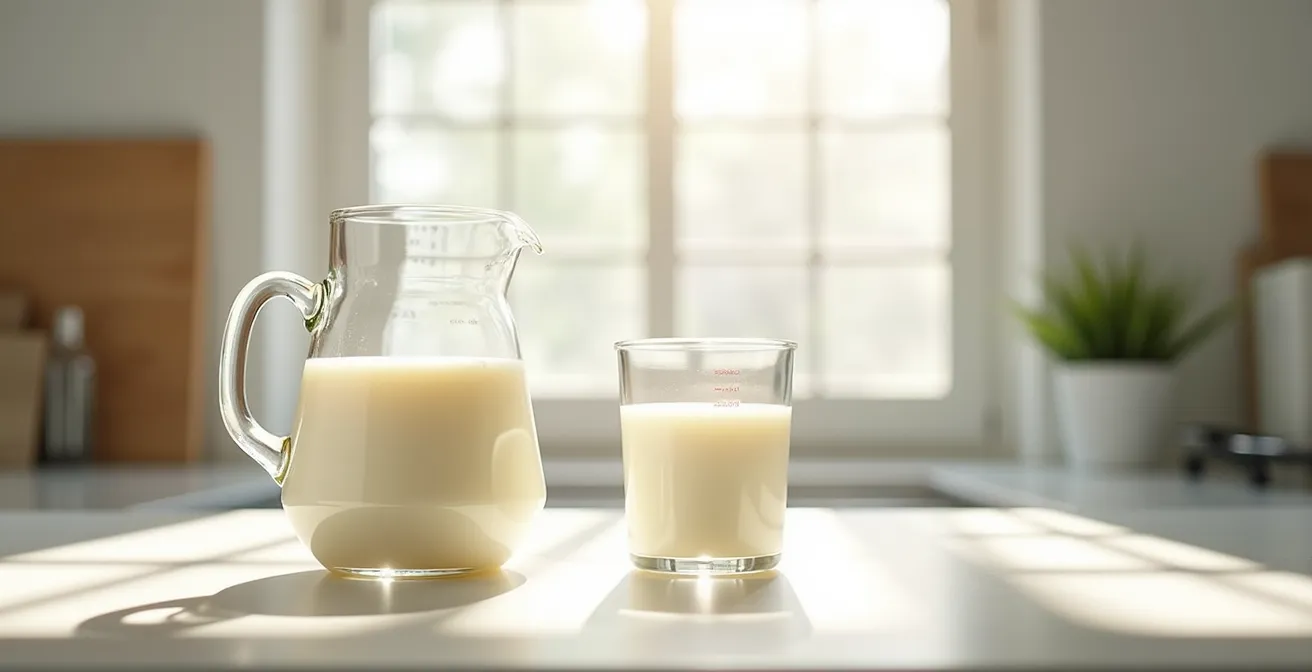
This table illustrates the fundamental divergence in dairy philosophy between the two desserts, with data sourced from a comparative analysis of frozen dessert standards.
| Dessert Type | Milk Fat % | Primary Base |
|---|---|---|
| Italian Gelato | 4-8% | Whole Milk |
| US Ice Cream | 10-25% | Heavy Cream |
| FDA Minimum (for Ice Cream) | 10% | Cream + Milk |
Why Low-Fat Cream Fails to Hold Air When Frozen?
Anyone who has tried to make whipped cream with low-fat cream knows the result: a watery, disappointing mess. The same principle applies, magnified, in a frozen environment. The ability of a dairy base to incorporate and hold onto air—a quality known as overrun—is almost entirely dependent on its fat content. This is the scientific reason why ice cream and gelato are structurally so different.
Fat globules in cream perform a crucial mechanical role during churning. As the base is agitated and frozen, these tiny spheres of fat partially break down and link together, forming a complex network. This network acts like a scaffold, trapping the air bubbles that are being whipped into the mixture and preventing them from escaping. A higher fat content creates a stronger, more stable scaffold, allowing for more air to be held. This is why rich American ice creams, with 14-25% fat, can have an overrun of 50% or even 100%, making them light and airy.
This is because a lower fat content, like that in gelato, simply lacks the molecular structure to trap and hold a large volume of air. For us, this is not a bug; it’s a feature. We churn our base slowly specifically to *minimize* air incorporation. We are not building a fluffy, airy scaffold. Instead, we are creating a dense, compact structure where flavor, not air, is the star. The minimal fat present is there to ensure smoothness, not to create volume.
Why Does Hot Espresso Cause Gelato to Crystallize If Poured Wrong?
The affogato—a scoop of gelato “drowned” in a shot of hot espresso—is a classic Italian dessert of beautiful contrasts. But it can also be a disaster of texture if prepared incorrectly. Pouring hot liquid over a frozen dessert is a race against thermal shock. When done wrong, the espresso instantly melts the outer layer of the gelato, and the refreezing process that follows creates large, unpleasant ice crystals on the surface.
The science behind this lies in the extreme temperature difference. As temperature science indicates, there is a massive 75-80°C temperature differential between hot espresso (around 60-70°C) and serving-temperature gelato (around -12°C). This violent clash of temperatures forces the water molecules in the melted gelato to refreeze chaotically and rapidly, forming the dreaded crunchy crystals instead of the smooth structure it once had.
The proper technique is all about mitigating this shock. A true affogato is not a flood; it’s a gentle pour. Here is the artisanal method to preserve texture:
- First, use a pre-chilled glass or cup to help the gelato maintain its cold temperature for as long as possible.
- With a spoon, create a small well or indentation in the center of the gelato scoop.
- Pour the hot espresso slowly and directly into the well. This concentrates the initial thermal shock in one area and allows the hot liquid to pool and then gently overflow, rather than hitting the entire surface at once.
- Serve immediately. An affogato is a fleeting pleasure, meant to be consumed as the hot and cold elements swirl together.
Key Takeaways
- Gelato’s intense flavor comes from less fat and a warmer serving temperature, which unmasks flavor molecules.
- Proper home storage requires airtight containers, surface protection (parchment paper), and allowing the gelato to temper for 5-10 minutes before serving.
- Authentic gelato is identified by its dense structure, muted natural colors, and storage in flat metal tins, not by fluffy, bright-colored mounds.
Why Frozen Cream Bases Separate and How to Stabilize Them?
The final pillar of gelato craftsmanship is achieving a stable emulsion. A gelato base is fundamentally an emulsion of fat globules and water, with sugars and proteins suspended within it. If this emulsion is unstable, the fat and water can separate during the freezing or storage process, resulting in a greasy or icy texture. Stabilization is the art of keeping everything perfectly bound together.
In high-fat ice creams, this is often easier. The sheer volume of fat, along with the lecithin from egg yolks, acts as a powerful emulsifier and stabilizer. Industrial products take this further by adding gums and other agents that bind water and prevent separation. As an artisan, we prefer to rely on technique and natural ingredients. The key is pasteurization and aging. Properly heating the base to around 85°C (185°F) and then cooling it rapidly helps to break down fat globules and allows milk proteins to unravel and bind more effectively with water molecules. According to Italian gelato makers, a pasteurization cycle followed by rapid cooling to 4-5°C (39-41°F) is critical to prevent separation.
This process, combined with the aging period we discussed earlier, creates a homogenous and stable base where every element is perfectly integrated before it ever enters the churn. This meticulous preparation is what ensures the final product remains smooth and consistent, without resorting to a litany of artificial additives.
Egg yolks can add fat and act as a stabilizer. Commercial ice cream can also include other stabilizers, such as guar gum. These help bind the water and fat in the ice cream batter.
– Healthline Nutrition Science Team, Healthline Gelato vs Ice Cream Analysis
While we may sometimes use natural stabilizers like locust bean gum in certain recipes (especially for fruit sorbetti), the primary method of stabilization remains process control. It is the mastery of these thermal processes that ultimately guarantees the structural integrity of the final product.
Now that you understand the science and craft behind true gelato, you are equipped to not only choose a superior product but also to appreciate the artistry involved. The next step is to apply this knowledge in your own kitchen or at your local gelateria.