
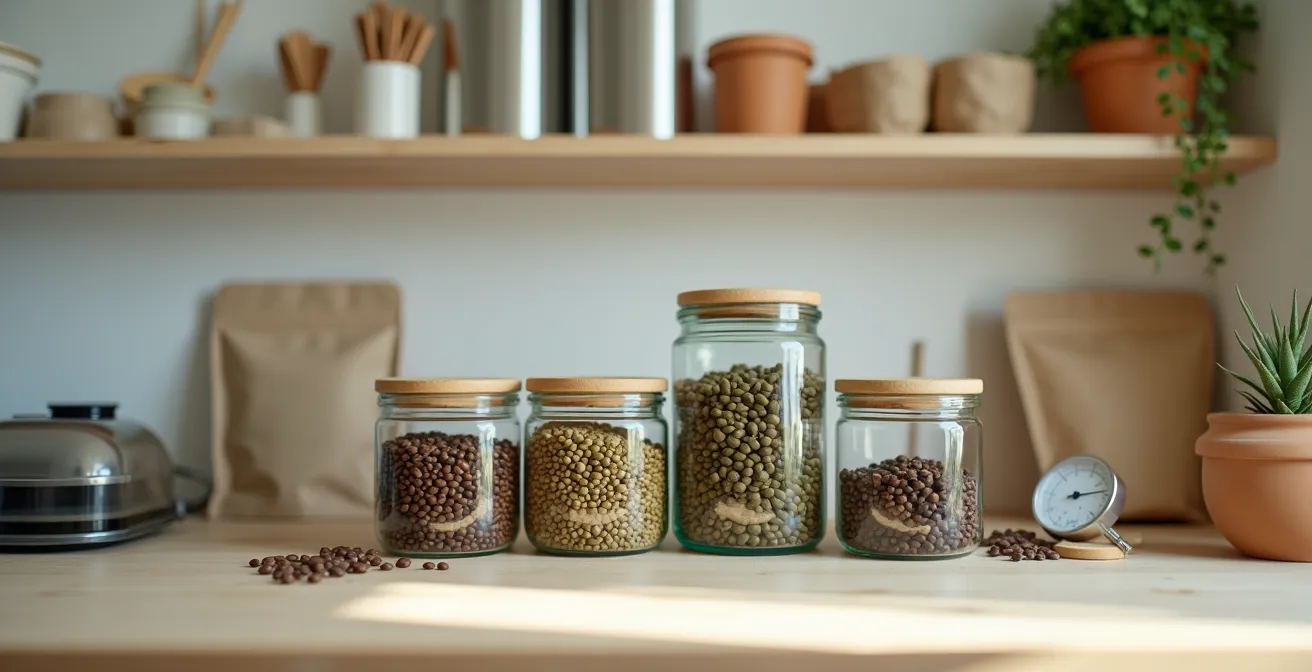
The key to long-term green coffee storage isn’t just a dark closet; it’s actively managing the four primary vectors of degradation: moisture, pests, oxidation, and cross-contamination.
- Moisture is the main catalyst for mold. Maintaining a stable environment below a specific water activity threshold is more critical than just keeping beans “dry.”
- Beans are hygroscopic, meaning they absorb environmental odors (like garlic or cleaning supplies) and require hermetic sealing to protect their flavor profile.
Recommendation: Immediately transfer bulk beans from burlap sacks into multi-layer, hermetically sealed bags or containers and establish a consistent inspection protocol to prevent spoilage and preserve quality for over a year.
For the home roaster, buying green coffee in bulk is a savvy economic move. It unlocks access to a wider variety of origins and lowers the cost per pound. Yet, this investment comes with a significant risk: spoilage. You’ve heard the standard advice—store beans in a cool, dark, dry place. But this platitude is dangerously incomplete. It fails to address the active forces working to degrade your coffee from the moment it arrives at your door.
Simply finding a spot in a pantry is a passive approach to a dynamic problem. Green coffee is a raw agricultural product, susceptible to environmental changes that can strip it of its vibrant acidity and complex aromas, leaving you with a flat, woody, or even moldy cup. Protecting your investment requires a shift in mindset from simple storage to active preservation management, just as we do in professional import logistics.
But what if the real secret wasn’t about the location, but about controlling the four key vectors of degradation: moisture, pests, oxidation, and contamination? Understanding the “why” behind spoilage allows you to implement a professional-grade storage system at home. This guide will deconstruct each of these threats and provide a systematic framework to ensure the beans you roast in month twelve are nearly as vibrant as they were in month one.
This article provides a complete logistics framework for the home roaster. We will explore the science of moisture, the best materials for protection, inspection protocols, and how a bean’s origin dictates its shelf life, equipping you with the knowledge to store your green coffee with confidence.
Summary: A Logistics Expert’s Guide to Storing Green Coffee Beans
- Why Green Beans Mold if Humidity Exceeds 12%?
- GrainPro vs Burlap: Which Bag Protects Flavor Better?
- How to Check Raw Beans for Broca Beetle Damage?
- The Storage Error That Makes Your Coffee Taste Like Garlic
- When Does “Past Crop” Become Noticeable in the Cup?
- When to Ship Naturals: Humidity Risks in Containers
- How to Spot High-Grade Arabica Beans by Shape and Color?
- The Coffee Belt: Why Latitude Determines Flavor Profile?
Why Green Beans Mold if Humidity Exceeds 12%?
The most immediate threat to your green coffee is not heat or light, but moisture. While a moisture content of 10-12% is considered ideal for green beans, this metric alone is insufficient. The real driver of mold growth is “water activity” (aW), a measure of the unbound water available for microorganisms to use. Even if the total moisture content seems acceptable, high ambient humidity can increase the water activity on the bean’s surface, creating a breeding ground for mold.
This distinction is critical. Professional analysis shows that mold proliferation becomes a significant risk once a bean surpasses the critical water activity threshold of 0.61 aW. Below this level, mold spores remain dormant. Above it, they begin to multiply, leading to musty off-flavors and potentially rendering your entire batch unusable. This is why a “dry place” is not enough; a stable humidity environment is what truly matters.
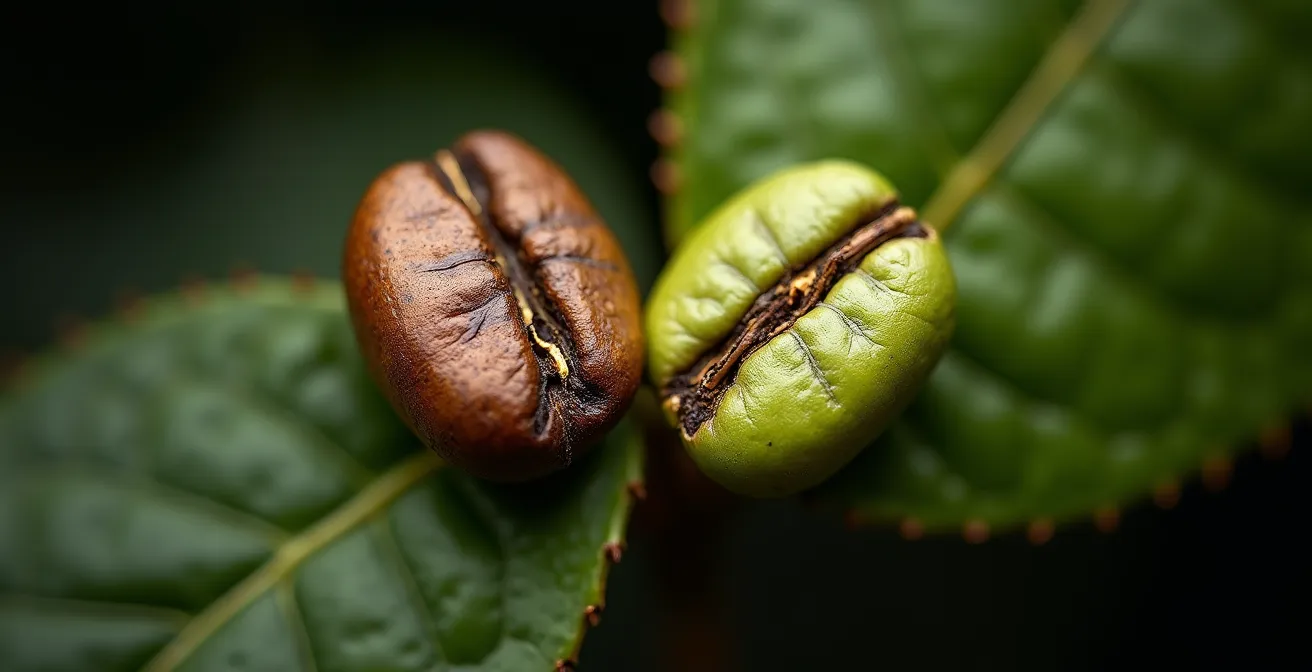
As the image above illustrates, the initial signs of mold can be subtle, appearing as a fine, white webbing on the bean’s surface. By the time it’s easily visible, the damage to the coffee’s flavor profile is already done. The goal of proper storage is to prevent the environmental conditions that allow this process to ever begin. Controlling the atmosphere around the beans is the first and most important step in long-term preservation.
GrainPro vs Burlap: Which Bag Protects Flavor Better?
Your green coffee likely arrived in a classic burlap or jute sack. While iconic, these bags offer minimal protection against the elements. They are fully permeable to air and, more importantly, moisture. For short-term transit, this is acceptable, but for long-term home storage, it’s a liability. The superior solution used in professional logistics is a hermetic, multi-layer plastic bag, such as those made by GrainPro or Ecotact.
These bags are engineered to create a sealed environment that is impermeable to both water vapor and oxygen. This serves two crucial functions. First, it isolates the beans from fluctuations in ambient humidity, keeping their internal water activity stable. Second, it limits oxygen, which slows the natural aging process (oxidation) that dulls a coffee’s vibrant acidity and aromatic compounds over time. While a burlap bag lets the coffee “breathe,” this is precisely what you want to avoid for long-term storage, as it accelerates degradation.
For the home roaster, this professional technology is accessible and essential. Transferring your beans from porous burlap to a hermetic liner immediately upon receipt is the single most effective action you can take to protect their flavor. This creates a stable micro-environment, effectively pausing the degradation clock and preserving the coffee’s origin characteristics for months, not weeks.
Your Action Plan: Home Storage Adaptation Strategy
- Transfer beans from burlap to a food-grade plastic liner or a dedicated multi-layer barrier bag (like Ecotact) immediately upon receipt.
- Place the liner inside a rigid container, such as a plastic bucket or large glass jar, for physical protection against pests and punctures.
- For very long-term storage (12+ months), consider vacuum-sealing smaller, roast-sized portions using a FoodSaver-type system to maximally reduce oxygen exposure.
- Monitor the storage environment to ensure it remains within a stable range of 60-70°F (15-21°C) and 50-60% relative humidity.
- Use multi-layer barrier bags for any portions you plan to store for over three months, as they provide the best defense against environmental exchange.
How to Check Raw Beans for Broca Beetle Damage?
The second major vector of degradation is pest infestation, most notably from the Coffee Berry Borer, or Broca beetle. While most commercial importers have strict quality control, an occasional infestation can slip through. The damage isn’t just cosmetic; the beetle bores into the bean to lay its eggs, creating pathways for moisture and mold to enter. A severe infestation can lead to a significant loss of bean mass; studies show that coffee weevils can reduce a bean’s weight by one-third within six months.
Therefore, every new bag of green coffee should undergo a thorough intake inspection. This is a standard operating procedure in any professional coffee warehouse and should be adopted by the serious home roaster. The primary sign of Broca damage is a tiny, perfectly round pinhole on the surface of the bean. This is the entry point of the female beetle. Finding one or two damaged beans in a large bag is not uncommon, but discovering a significant number warrants immediate action.
Quarantining new acquisitions is a crucial preventative measure. By sealing the new beans in a clear container for a few weeks, you can monitor for any signs of live pests before introducing them to your main storage area. This simple step prevents a small problem from contaminating your entire inventory. An intake protocol protects not just the new purchase, but your entire collection of green coffee.
- Inspect for Broca Damage: Spread a sample of beans on a light-colored surface and look for tiny, perfectly round entry holes.
- Check for Defects: Screen for broken beans, quakers (unripe, pale beans), and any foreign objects like twigs or stones.
- Assess for Mold: Look for any discoloration, white webbing, or smell for musty, earthy odors that indicate microbial activity.
- Quarantine New Beans: Store new acquisitions in separate, sealed transparent containers for 2-4 weeks to monitor for any emerging pest activity.
- Perform a Float Test: If you suspect a heavy infestation, place a small sample of beans in water. Heavily damaged, hollowed-out beans will often float, giving you an idea of the severity.
The Storage Error That Makes Your Coffee Taste Like Garlic
Green coffee beans are highly porous and hygroscopic, a scientific term meaning they readily absorb moisture and aromas from their surrounding environment. This is the third critical vector of degradation: cross-contamination. Storing your beans near aromatic items—even in what seems like a separate container—can irreversibly taint their flavor. The most common mistake is storing coffee in a kitchen pantry next to spices, onions, or garlic. Within weeks, those aromas will migrate and bind to the oils in the coffee, resulting in a roasted cup that tastes bizarrely of its former neighbors.
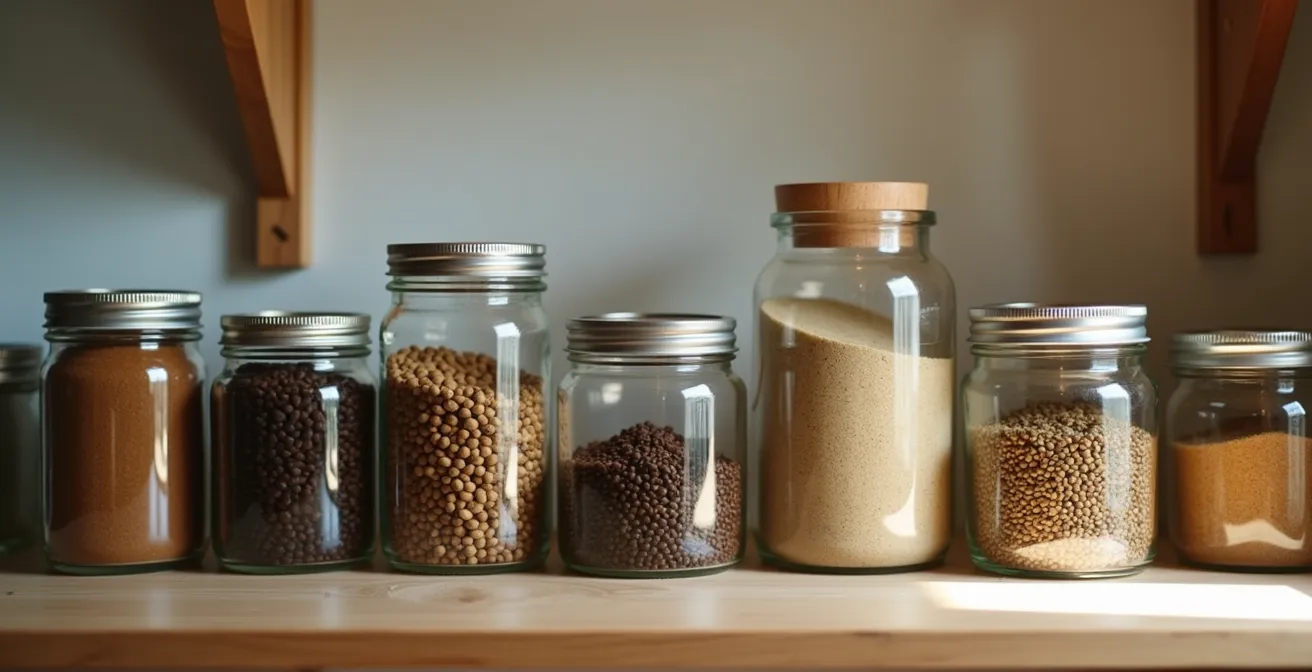
This isn’t limited to food items. Garages with vehicle fumes, basements with musty odors, or laundry rooms with fragrant detergents are all “Red Zones” for coffee storage. The only way to combat this is through physical isolation in a truly hermetic container made of non-porous material like glass or high-density polyethylene (HDPE #2) plastic. This creates a physical barrier that environmental odors cannot penetrate.
A common question is whether to refrigerate or freeze green beans. This is a high-risk strategy. While cold temperatures slow oxidation, moving beans from a cold environment to a warmer one creates condensation on their surface. This sudden increase in moisture is a major trigger for mold and can accelerate flavor degradation. For this reason, professional logistics avoid refrigeration unless a highly controlled, gradual re-acclimatization process is possible. For home use, a stable, room-temperature environment is far safer and more effective.
When Does “Past Crop” Become Noticeable in the Cup?
The final vector of degradation is time itself. As green coffee ages, its organic compounds slowly break down. This process, known as oxidation, causes the vibrant, “green” notes and bright acidity to fade, replaced by woody, papery, or “baggy” flavors. When these characteristics become dominant, the coffee is referred to as “past crop.” The speed of this process is directly related to storage conditions. A study on Bolivian coffee, for example, showed that beans stored in hermetic bags retained higher frequencies of desirable ‘cocoa’ and ‘sweet acidity’ notes compared to those stored in traditional jute bags, which aged differently.
For the home roaster, there is no single date when a coffee becomes “past crop.” It’s a gradual decline. The best way to manage this is to establish a sensory baseline. When you first receive a new coffee, roast a small sample and take detailed notes on its acidity, sweetness, body, and key flavor notes. This becomes your reference point. By roasting and cupping a small sample every few months, you can track the evolution of the coffee’s flavor profile.
This systematic tracking allows you to make informed decisions. You might notice a high-acidity Kenyan starting to lose its brightness at month nine, signaling that it’s time to roast it more frequently. Conversely, a dense, high-grown Central American coffee might remain stable for well over a year. A sensory tracking protocol transforms you from a passive consumer into an active manager of your coffee inventory.
- Month 0 (Baseline): Roast a 100g sample. Cup and score its acidity, sweetness, body, and key aroma/flavor notes. This is your benchmark.
- Month 3 (First Check): Roast another sample. Note any subtle reduction in brightness or the emergence of faint papery notes in the aroma or finish.
- Month 6 (Mid-Point Assessment): Look specifically for the development of “baggy,” woody, or straw-like flavors that indicate the beginning of significant degradation.
- Month 9 (Critical Evaluation): At this point, assess if the beans still meet your quality standards. Some delicate coffees may begin to show prominent past crop characteristics.
- Month 12 (Final Assessment): Most normally stored green coffees will show noticeable past crop characteristics by this point, though high-density, well-preserved beans can last longer.
When to Ship Naturals: Humidity Risks in Containers
Not all green coffees are created equal when it comes to storage, and processing method is a key variable. Natural (or dry-processed) coffees, where the cherry is dried whole around the bean, present unique challenges. This process is much longer than washed processing; research shows that natural processing can take 3-5 weeks compared to only 8-10 days for washed coffees. During this extended drying time, the bean is in contact with the fermenting fruit pulp, which imparts the classic fruity, winey flavors but also creates a higher risk of inconsistent drying and greater susceptibility to moisture reabsorption.
This makes naturals inherently less stable for long-term storage than their washed counterparts. Their complex, fruit-forward flavors are more volatile and can fade or morph into undesirable fermenty notes more quickly if not stored in exceptionally stable, hermetic conditions. This is a critical consideration for the home roaster buying in bulk. While a high-grown washed coffee might store well for over a year, a natural process Ethiopian might be best enjoyed within 6-8 months to preserve its peak character.
As a home buyer, you can empower yourself by acting like a professional importer and asking your supplier key questions about the coffee’s journey. Understanding its history—from harvest date to shipping conditions—provides crucial context for its storage potential. A coffee that spent six weeks in a non-hermetic container crossing the ocean has a much shorter shelf life than one that was shipped quickly in a GrainPro bag.
- What was the harvest date of these beans? (Tells you the absolute age)
- When were the beans shipped from origin? (Indicates time in transit)
- Were the beans transported in hermetic packaging (GrainPro or similar)?
- What was the moisture content at the time of export?
- How long did the shipping voyage take?
How to Spot High-Grade Arabica Beans by Shape and Color?
Before you even begin the storage process, a quick visual inspection can tell you a great deal about a coffee’s quality and potential longevity. High-grade Arabica beans, especially those grown at high altitudes (Strictly Hard Bean – SHB), possess physical characteristics that are proxies for quality and durability. These beans are typically denser, harder, and have a more uniform appearance.
One of the most telling indicators is color. Fresh, high-quality green beans often have a bluish-green or jade-like hue. As beans age or if they are of lower quality, this color fades to a pale green, yellowish, or even brownish tint. Another key feature is the center cut or fissure. In high-grade beans, this line is typically clean, tight, and well-defined. A wide, frayed, or irregularly shaped center cut can be a sign of a softer, lower-grown bean or potential processing defects. Density is harder to judge by eye, but high-quality beans will feel heavier and harder in the hand.
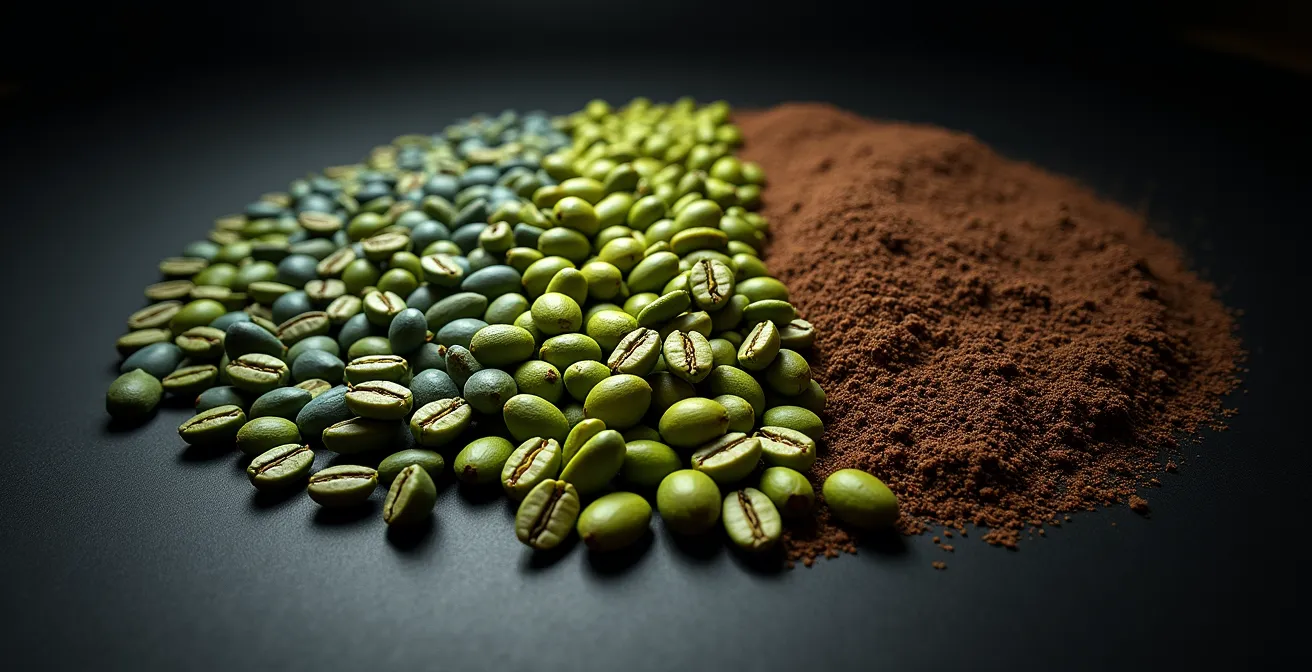
These visual cues are valuable because they often correlate with storability. The dense cell structure of a high-altitude, bluish-green bean makes it more resilient to the effects of oxidation and environmental changes. A softer, paler bean is more porous and will likely degrade more quickly. Learning to recognize these signs helps you set realistic expectations for a coffee’s shelf life from the moment you open the bag.
This table provides a quick reference for assessing bean quality visually, a critical first step in the intake process. Based on data from industry best practices, it helps correlate physical appearance with potential quality in the cup.
| Quality Indicator | High-Grade Characteristics | Lower-Grade Signs |
|---|---|---|
| Color | Bluish-green, uniform | Mottled, brownish, faded |
| Center Cut | Clean, tight, well-defined | Wide, frayed, irregular |
| Density | Heavy, hard (high-altitude SHB) | Light, soft texture |
| Aging Signs | Fresh green hue maintained | Pale, yellowish, whitish |
Key Takeaways
- The four primary threats to green coffee are moisture, pests, odor contamination, and oxidation.
- Hermetic storage (like GrainPro or Ecotact bags) is non-negotiable for long-term preservation as it controls moisture and oxygen exchange.
- A coffee’s origin, processing method, and density are primary determinants of its inherent storability, with high-grown washed coffees being the most durable.
The Coffee Belt: Why Latitude Determines Flavor Profile?
Finally, a coffee’s origin—its place within the “Coffee Belt”—is a master variable that dictates its inherent storability. Factors like altitude, latitude, and local processing traditions create beans with different physical densities and chemical compositions. A high-altitude, washed Central American coffee is dense and durable, built to withstand the journey and store for extended periods. In contrast, a low-altitude natural-processed Brazilian may be softer and more prone to rapid aging.
Wet-hulled coffees, like those from Sumatra, present a particularly stark example. This process leaves the beans with a higher moisture content at export (up to 15%). As a case in point, one study tracked a Sumatran coffee arriving at 15% moisture which then rapidly dried to a stable 9% once placed in a controlled environment. While it stabilized, this initial volatility means such coffees are best used sooner rather than later, typically within 4-6 months, to capture their unique earthy and spicy character before it fades.
This knowledge allows you to build a strategic inventory. You can confidently stock up on durable washed Colombians or Kenyans for the long haul, while treating more delicate naturals or wet-hulled Sumatrans as coffees to be enjoyed in the nearer term. Understanding these origin-based characteristics is the final piece of the puzzle, moving you from simply storing coffee to curating a cellar with a strategic, long-term perspective.
This index offers a general guideline for the storage potential of coffees from different origins and processing methods. It’s a crucial tool for planning your bulk purchases and managing your roasting schedule.
| Origin Type | Processing | Storage Potential | Optimal Duration |
|---|---|---|---|
| High-Altitude Central American | Washed | Excellent (SHB density) | 12+ months |
| Ethiopian Highland | Washed | Very Good | 10-12 months |
| Colombian High-Grown | Washed | Very Good | 10-12 months |
| Brazilian Low-Altitude | Natural | Moderate | 6-8 months |
| Sumatran | Wet-Hulled | Use Sooner | 4-6 months |
By implementing these professional-grade logistics principles—controlling the four vectors of degradation and understanding your coffee’s inherent characteristics—you can confidently protect your investment and ensure every cup you roast is a true expression of its origin.