A professional tasting workshop is less a class and more a career accelerator, transforming your subjective taste into an objective, valuable skill.
- Hands-on training is essential for building an “olfactory memory palace,” something books and videos can’t replicate.
- Certifications like SCA and CQI provide clear career paths and a tangible return on your investment in the specialty coffee industry.
Recommendation: View the cost not as an expense, but as a strategic investment in your professional sensory toolkit.
You love coffee. You’ve mastered your home brewing setup, you can tell an Ethiopian from a Colombian, and now you’re eyeing that $100+ professional sensory workshop. The question looms: is it a fun weekend activity, or is it a legitimate career investment? Many enthusiasts believe that developing a palate is simply a matter of tasting more coffee or reading tasting notes. They focus on the tools, like the ubiquitous flavor wheel, without understanding the engine that drives it: a calibrated sensory memory.
The reality is, a professional workshop transcends simple tasting. It’s about systematically training your brain and palate to work in unison. It’s about sensory calibration. This isn’t just about identifying a “hint of blueberry”; it’s about being able to do it consistently, objectively, and under pressure. The true value of such a course lies in shifting your perception from a subjective preference (“I like this”) to an objective evaluation (“This coffee displays these specific attributes”).
This article will deconstruct the real return on investment (ROI) of a professional tasting workshop. We will explore why physical training is non-negotiable, how to prepare like a professional, what the leading certifications mean for your career, and how to integrate this skill into a lifelong practice. This is your guide to understanding if you’re ready to move from enthusiast to expert.
For those who prefer a visual summary, the following video offers insights into what it takes to become an authorized trainer in the specialty coffee world, a goal that starts with mastering sensory skills.
To help you navigate this deep dive into professional sensory development, we’ve structured this guide to walk you through every critical aspect of the investment, from foundational principles to advanced application. The following summary outlines the key stages we will cover.
Summary: Deconstructing the Value of Professional Sensory Training
- Why You Can’t Learn Smell Recognition from a Book?
- How to Prepare Your Palate Before a Tasting Class?
- SCA vs CQI: Which Certification Carries More Weight?
- The Perfume Mistake: Why You Must Wear Neutral Scents
- When to Practice Tasting: Incorporating Mindfulness into Breakfast
- How to Set Up a Triangular Cupping Session in Your Kitchen?
- How to Train Your Palate to Detect Fruit Notes in Coffee?
- From Detecting Notes to Building a Career: The Real ROI of Sensory Training
Why You Can’t Learn Smell Recognition from a Book?
The single most compelling reason to invest in a professional workshop is something a book or video can never provide: building an olfactory memory palace. Tasting notes on a bag of coffee are just words until you can connect them to a real, physical scent memory. A workshop provides a controlled environment with aroma kits, real fruit, and spices, allowing you to smell, taste, and discuss in a structured format. This physical act of association is the foundation of sensory analysis. It’s the difference between reading a description of “lychee” and having that specific aromatic compound locked into your brain for instant recall.
This isn’t just theory; it’s a quantifiable advantage. Research consistently shows that hands-on, guided practice creates a measurable leap in skill. For example, evidence suggests that structured sensory training can boost your flavour detection by 50-70%. This isn’t a marginal improvement; it’s a fundamental transformation of your sensory capabilities. You are literally re-wiring your brain to perceive more accurately and with greater detail.
Case Study: The World Coffee Research Study
A 2024 study from World Coffee Research starkly illustrates this point. It revealed that trained tasters could identify twice as many flavour notes with 63% better accuracy than untrained individuals. This demonstrates the transformative power of the hands-on sensory calibration that workshops provide. It’s the process of turning a subjective experience into an objective, repeatable, and data-driven skill, which is impossible to achieve through passive learning alone.
The investment, therefore, is not for information but for transformation. You are paying for a guided, accelerated process of building a reliable internal library of scents and tastes, a process that could take years of unstructured, trial-and-error tasting to even partially replicate.
How to Prepare Your Palate Before a Tasting Class?
Attending a professional sensory workshop is like preparing for an athletic event. You wouldn’t run a marathon without training, and you shouldn’t attend a cupping without priming your sensory apparatus. The goal is to arrive with a neutral, heightened state of awareness, free from interference. This preparation begins at least 24 hours before the class and is a non-negotiable part of a professional’s discipline. It signals a shift from casual consumption to focused analysis.
The primary objective is to eliminate “palate noise.” This includes avoiding spicy or intensely flavored foods, strong minty toothpaste, and even chewing gum. Your palate should be a blank canvas. Start your sensory priming 24-48 hours before by mindfully smelling common household items like spices, fruits, and herbs. This simple act wakes up your olfactory system and prepares it for the focused work ahead. The image below illustrates the kind of simple, neutral items that are your best friends before a tasting session.
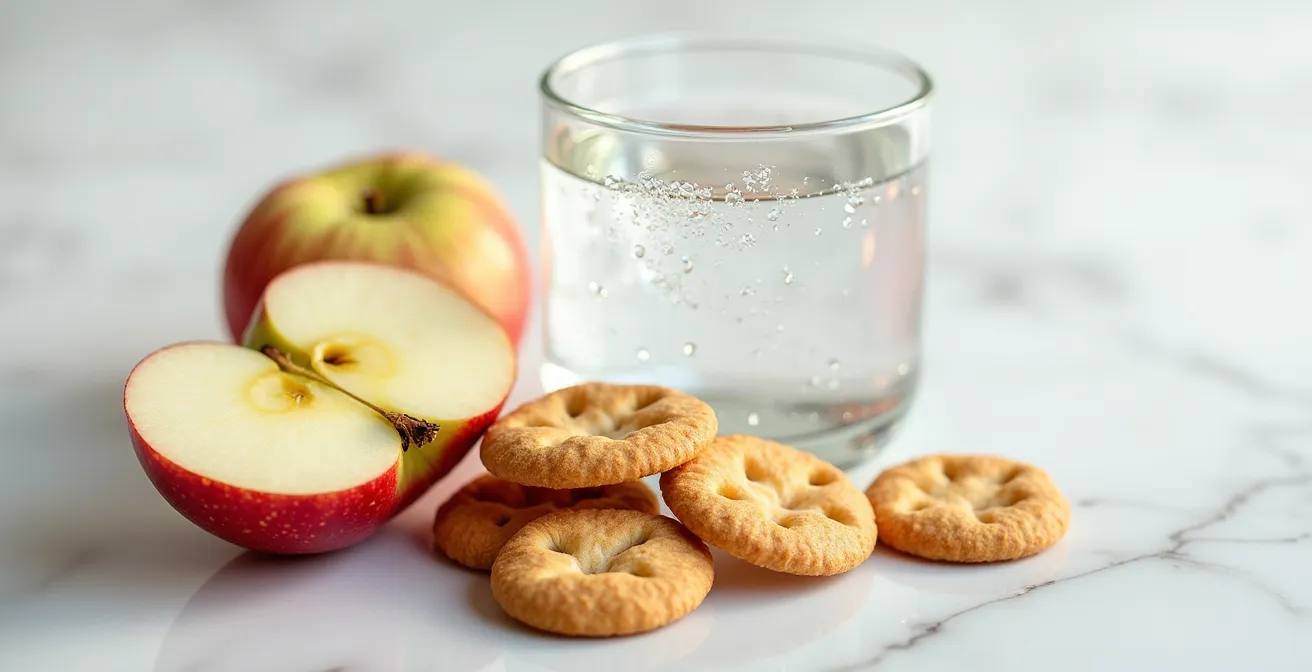
As you can see, simplicity is key. Plain water, simple crackers, and fresh, non-astringent fruits like apples help cleanse the palate without introducing competing flavors. During this preparation phase, it’s also crucial to practice isolating taste from texture. When you eat an apple, consciously separate the sweetness and acidity from the crispness and crunch. This mental exercise trains your brain to deconstruct sensory inputs, a foundational skill in professional cupping.
A full sensory fast is the gold standard. This means avoiding all scented products, including lotions, hairspray, and even fabric softener. These external aromas can fatigue your senses before you even enter the classroom, dulling your ability to perceive the subtle nuances in coffee.
SCA vs CQI: Which Certification Carries More Weight?
Once you’ve decided to invest in sensory training, the next logical question is: “Which certification provides the best professional ROI?” The two dominant forces in the specialty coffee world are the Specialty Coffee Association (SCA) and the Coffee Quality Institute (CQI). Understanding their different philosophies is crucial to aligning the investment with your career goals. They are not interchangeable; they represent distinct professional pathways.
The SCA’s Coffee Skills Program is a modular system, ideal for those on a practitioner path—baristas, roasters, or cafe managers. It focuses on quality execution at the point of service. As the SCA itself notes, their programs are designed to prove readiness for specific roles. This perspective is highlighted in their program guide:
Certificate Programs are individual courses that teach specific skills – like how to make espresso or roast coffee. Skills Diplomas prove you’re job-ready for specific coffee careers
– SCA Education, SCA Skills Diploma Program Guide
In contrast, the CQI’s Q Grader certification is an intensive, single-event examination designed for those on a global assessor path, such as green coffee buyers, quality control managers, or exporters. Its focus is on the objective evaluation of green coffee against universal quality standards. Becoming a Q Grader means you are calibrated to a global standard, able to communicate quality in a way that is understood from farm to roastery, anywhere in the world.
The following table breaks down the core differences to help you assess which path aligns with your long-term ambitions. The data is based on an analysis of the program structures provided by the organizations themselves, including insights from the SCA’s Coffee Skills Program overview.
| Aspect | SCA Certification | CQI Q Grader |
|---|---|---|
| Career Path | Practitioner Path (barista, roaster) | Global Assessor Path (green buyer, quality control) |
| Focus | Execution and quality at point of service | Objective evaluation against universal standards |
| ROI Timeline | Immediate, tangible (better local job prospects) | Long-term investment for senior/international roles |
| Evaluation Philosophy | Coffee within its own context | Coffee against universal quality metrics |
| Training Duration | Modular system, self-paced | Intensive 6-day course |
Ultimately, the choice is not about which is “better,” but which is “right for you.” The SCA offers a faster, more tangible ROI for roles focused on the finished product, while the Q Grader is a long-term investment that unlocks senior, internationally-focused opportunities in green coffee evaluation.
The Perfume Mistake: Why You Must Wear Neutral Scents
One of the first and most strictly enforced rules in any professional tasting environment is the absolute ban on perfumes, colognes, and any scented products. To an enthusiast, this might seem like an overly fastidious detail. To a professional, it’s a fundamental requirement for maintaining the integrity of the sensory space. The reason is simple: your nose can’t multitask effectively when it’s being bombarded by competing aromas. This isn’t just a matter of courtesy; it’s a matter of science.
A single coffee bean is a universe of aromatic complexity. Research has identified that coffee contains over 800 volatile aromatic compounds. These delicate molecules are what create the notes of fruit, chocolate, or flowers that we seek. A synthetic perfume or even a strongly scented hand lotion introduces a powerful, monolithic cloud of its own volatile compounds into the air. This “aromatic noise” overwhelms the subtle notes of the coffee, making accurate detection impossible not only for you but for everyone else in the room. It’s the equivalent of trying to listen to a string quartet next to a roaring jet engine.
This principle of sensory neutrality is a cornerstone of professional discipline. It demonstrates respect for the product, the process, and your fellow tasters. Adhering to this protocol is a clear signal that you are approaching the task with the seriousness it deserves. To ensure you are fully prepared and respectful of the tasting environment, a comprehensive checklist is essential.
Your Sensory Neutrality Checklist
- Avoid all perfumes and colognes 24 hours before the tasting session.
- Switch to unscented deodorant, soap, and hand sanitizers the day before.
- Skip all hair products with fragrance, such as hairspray or scented oils.
- Use unscented laundry detergent for the clothes you will wear to the class.
- Remove any strongly scented lip balms or glosses before the session begins.
Embracing this level of preparation is a crucial part of the mental shift from hobbyist to professional. It ensures that your sensory tools are sharp and that you contribute to, rather than detract from, the collective focus of the group.
When to Practice Tasting: Incorporating Mindfulness into Breakfast
A professional workshop is the catalyst, not the conclusion. The skills you acquire—olfactory recognition, taste modulation, sensory vocabulary—are like muscles. Without consistent practice, they will atrophy. The most common mistake aspiring tasters make is assuming their development ends when the class does. True professionals integrate sensory practice into their daily lives, transforming routine moments into training opportunities.
The ideal time for practice is in the morning. Your palate is at its most neutral and your mind is less cluttered with the sensory inputs of the day. Your morning cup of coffee, therefore, is not just a caffeine delivery system; it’s your daily gym session. This doesn’t require a full cupping setup every day. It’s about a shift in mindset towards mindful tasting. Instead of drinking your coffee while scrolling through emails, take the first five minutes to sit with it. Smell it. Slurp it. Think about what you’re perceiving and, most importantly, write it down.
This act of documentation is critical. As the experts at Perfect Daily Grind emphasize, formalizing your perceptions solidifies learning:
Taking notes while cupping, using a industry standard form or an internal format tailored for your business, is an excellent way to build sensory perception
– Perfect Daily Grind, Coffee Tasting Exercises That Will Improve Your Palate
Consistency trumps intensity. You don’t need to spend an hour a day. Research on palate development shows that short, frequent sessions yield the best results. A focused 10-15 minute session, performed 2-3 times per week, is more effective than a single, lengthy session once a month. This regular practice builds and maintains the neural pathways you started to form in your workshop, ensuring your investment continues to pay dividends long after the class is over.
How to Set Up a Triangular Cupping Session in Your Kitchen?
As you progress beyond basic tasting, you’ll need to employ more advanced techniques to challenge and refine your palate. The gold standard for quality control and sensory skill assessment in the coffee industry is triangulation. This exercise consists of three cups, two of which are identical coffees and one of which is different. The taster’s job is to identify the “odd one out.” It’s a powerful tool for honing your ability to detect subtle differences and is a core component of the Q Grader exam.
While it sounds simple, setting up a proper triangulation requires meticulous precision. Any variation in the preparation can create false differences, invalidating the exercise. This is where professional discipline is paramount. You must control every variable, from water temperature to grind size to brew time. The goal is to ensure that the only difference you are tasting is the coffee itself. The setup below showcases the clean, controlled environment you should aim for, even in a home kitchen.
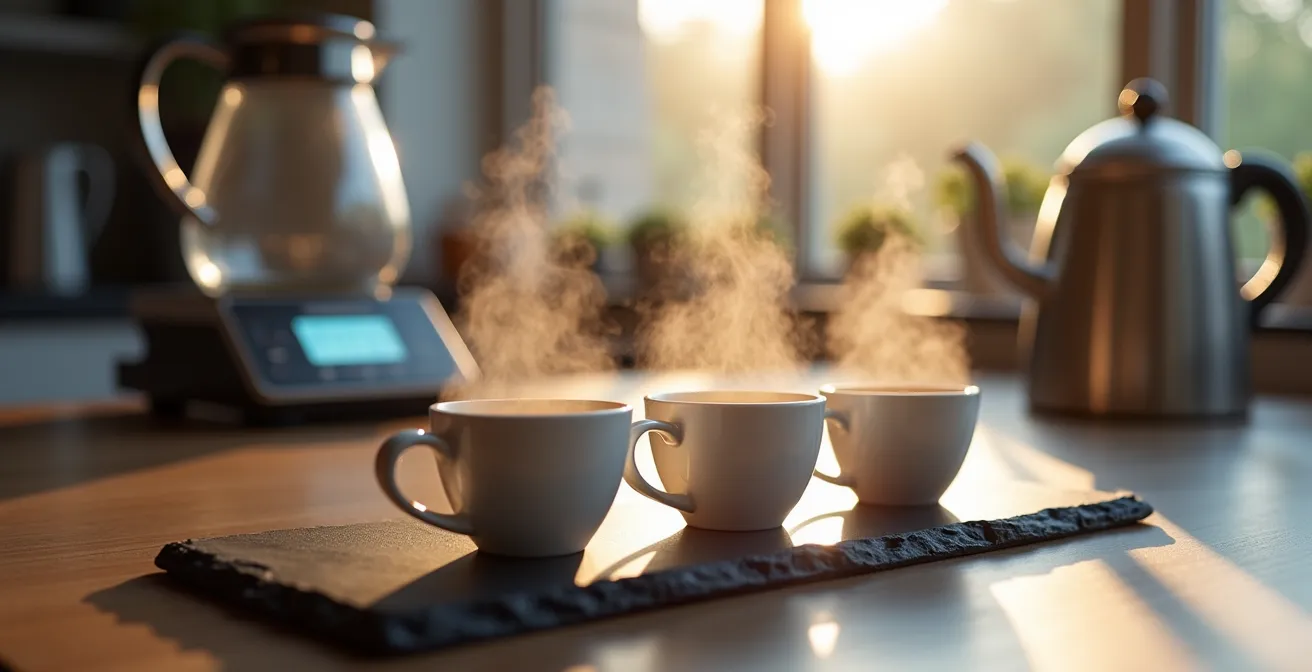
Executing a triangulation is a test of both your palate and your process. The protocol is exacting for a reason. Using a gram scale for dosing, a timer for extraction, and identical vessels for brewing removes any doubt that what you’re tasting is real. Follow these steps for a professional-grade setup:
- Use a gram scale to measure exactly 14g of coffee for each of the three cups. Dose precision is critical.
- Grind a small amount of coffee first to prime the grinder and remove any old grounds.
- Heat your water to a precise temperature, ideally 200°F (93°C), using a thermometer.
- Use three identical ceramic or glass vessels to ensure even heat retention.
- Pour 150g of water into each cup at the same rate, starting a timer as you begin.
- At exactly 4 minutes, “break the crust” on each cup by pushing the grounds down with the back of a spoon. Be sure to rinse the spoon between cups.
- Allow the coffee to cool for 8-10 minutes before you begin tasting.
- Evaluate all three cups, taking careful notes, before you make your final decision on which is the different coffee.
Mastering this exercise is a significant milestone. It proves you can move beyond broad flavor calls and into the realm of precise, comparative analysis—a truly marketable professional skill.
How to Train Your Palate to Detect Fruit Notes in Coffee?
One of the most sought-after and often elusive skills for an aspiring coffee taster is the ability to consistently identify specific fruit notes. How does a professional confidently declare “red grape” while a novice tastes only “sour”? The secret isn’t a magical palate; it’s a systematic training method known as reference-based comparative tasting. This involves tasting a coffee alongside a real-world example of the flavor you are trying to identify.
To train for “strawberry,” for example, you would have a slice of fresh strawberry, a bit of strawberry jam, and perhaps even a dried strawberry on your tasting table. You would first smell and taste the reference items, locking those specific sensory inputs into your short-term memory. Then, you would immediately taste the coffee. This direct comparison helps your brain forge a strong, undeniable link. It bridges the gap between the abstract concept of “strawberry note” and the concrete sensory experience.
This method is backed by extensive research in the field of sensory science. The foundation of modern coffee tasting, the World Coffee Research Sensory Lexicon, was built using this very technique. A groundbreaking lexicon study used 105 coffee samples from 14 countries to have trained panels identify 110 distinct attributes. The panels’ success was rooted in their use of physical reference standards alongside the coffee samples, allowing them to differentiate between highly specific notes like burnt, smoky, acrid, and a wide array of fruit characteristics. This is the scientific backbone of what you learn in a professional workshop.
You can replicate this at home. Start simply. Pick one fruit, like a lemon. Brew a coffee known for its citrus notes (like many from Kenya or Ethiopia). Squeeze a drop of lemon juice into a glass of water. Smell the lemon peel. Taste the lemon water. Then, taste the coffee. Actively search for that same bright, acidic character. By isolating and referencing, you are giving your brain a clear target, transforming a guessing game into a focused search.
Key Takeaways
- A professional workshop is an investment in sensory calibration, not just a tasting experience.
- Career ROI is realized through globally recognized certifications like SCA and CQI, which open different professional doors.
- Consistent, mindful practice and adherence to professional protocols (like sensory neutrality) are what sustain and grow the skills learned in class.
From Detecting Notes to Building a Career: The Real ROI of Sensory Training
We’ve journeyed from the fundamental need for hands-on training to the disciplined protocols of professional practice. The overarching theme is clear: a professional sensory workshop is a calculated investment in building a specialized skill set. It’s the starting point for transforming a passion into a profession. The ability to detect fruit notes is an impressive party trick, but the ability to do so consistently, objectively, and to communicate that quality using a shared global language is a career.
The return on this investment is multi-faceted. In the short term, it’s the confidence to speak about coffee with authority. In the medium term, it’s the certifications that make your resume stand out to a roastery or a quality control lab. In the long term, it’s the development of a highly calibrated sensory apparatus that can guide purchasing decisions worth thousands of dollars, shape the flavor profile of a brand, or even discover the next great coffee.
This journey moves you beyond simply enjoying coffee to fundamentally understanding it. You learn to deconstruct flavor, assess quality, and identify defects with precision. This is the true value proposition of a workshop: it equips you with a framework for lifelong learning and professional growth in the specialty coffee industry.
If you are serious about a career in coffee, view a professional sensory workshop not as a cost, but as the first and most critical investment in your future. The next step is to research accredited SCA trainers or upcoming CQI courses in your area and commit to calibrating your most valuable professional tool: your palate.