
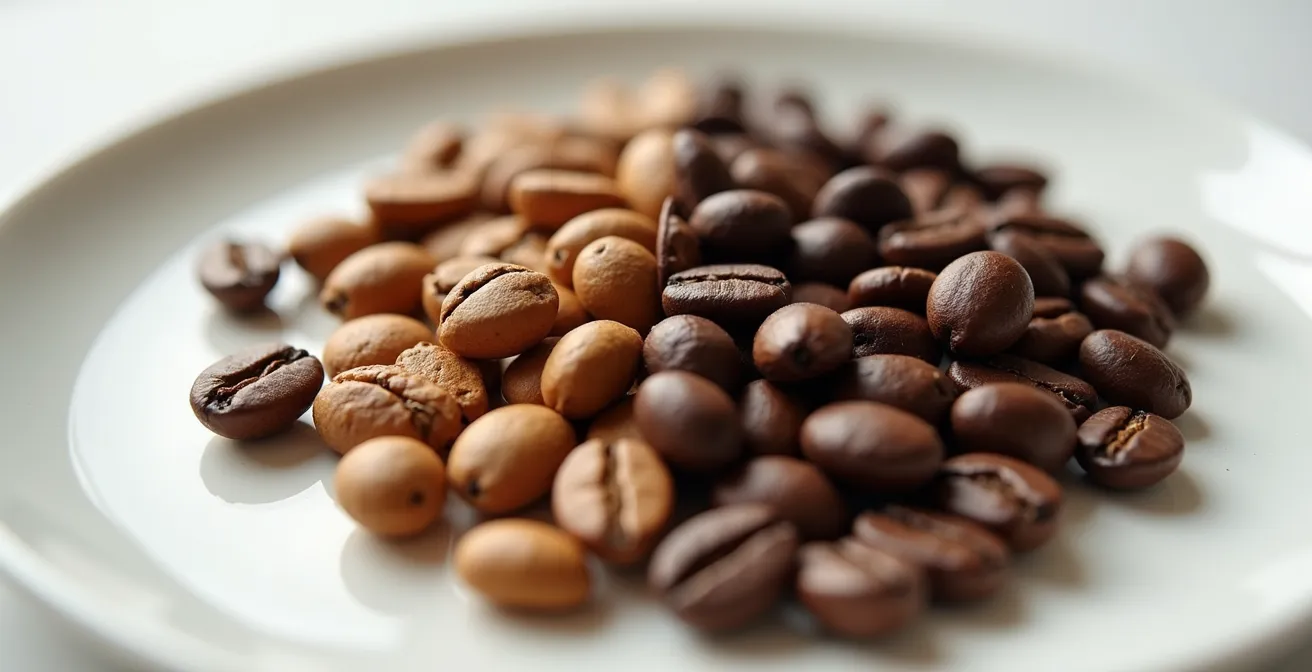
Contrary to popular belief, the choice between light and dark roast has a negligible impact on caffeine content by weight; the real difference lies in flavor.
- Caffeine is highly stable during roasting. A light roast bean has virtually the same amount of caffeine as a dark roast bean from the same batch.
- The debate stems from density: light roast beans are denser, so a scoop of light roast has more caffeine than a scoop of expanded, lighter dark roast beans.
Recommendation: Choose your roast based on the flavor profile you enjoy, not for a perceived caffeine kick. The roaster’s craft, not the final color, dictates the true character of the coffee.
The question echoes in cafes and kitchen aisles everywhere: “Which has more caffeine, light or dark roast?” For the coffee drinker chasing that perfect energy kick, the answer seems vital. The common wisdom often splits into two camps: some swear by the potent, bright kick of a light roast, while others believe the bold, intense flavor of a dark roast must pack a stronger punch. The truth, as is often the case in the world of specialty coffee, is more nuanced and fascinating than a simple yes or no.
While many articles correctly point out the difference comes down to measurement—by scoop (volume) versus by weight (mass)—they often stop there. This simple answer misses the entire story. It overlooks the intricate dance of chemistry and heat that a roaster masterfully conducts. The journey from a green, raw coffee bean to the aromatic treasure in your cup is a story of transformation. The real question isn’t just about caffeine retention; it’s about what is created, and what is lost, in the fire of the roaster.
This isn’t just a debate about stimulation; it’s a window into the very soul of coffee. To truly understand the difference between a light and dark roast, we must look past the caffeine myth and into the heart of the process. We will explore how a roaster manipulates time and temperature to sculpt flavor, transforming simple sugars and amino acids into the complex notes of fruit, flowers, chocolate, and caramel that make each coffee unique. This is where the magic happens—and where your preference for light or dark roast truly finds its meaning.
This guide will walk you through the critical stages of the roasting process, revealing how each decision impacts the final cup. By understanding the science behind the art, you’ll be able to choose your next bag of beans not just for its caffeine, but for the specific flavor journey you wish to experience.
Contents: The Roaster’s Craft Demystified
- Why Longer Roasting Destroys Floral Aromas in Coffee?
- How to Determine Freshness: Is 2 Days Post-Roast Too Soon?
- Drum Roast vs Air Roast: Which Creates a More Even Flavor?
- The “Baked” Taste: How to Recognize Under-Developed Coffee?
- When do Dark Roasts Go Stale Compared to Light Roasts?
- How to Stretch the Maillard Phase to Boost Body and Sweetness?
- The Roasting Mistake That Kills the Lemon Note in Sidamo
- The Science of Sweetness: How Roasting Creates Caramel Notes?
Why Longer Roasting Destroys Floral Aromas in Coffee?
The most delicate and sought-after flavors in coffee, such as the jasmine notes in a Geisha or the bergamot in an Ethiopian Yirgacheffe, are born from highly volatile aromatic compounds. These compounds are fragile. As the roast progresses and the internal bean temperature rises, these delicate structures begin to break down. Think of it like cooking with fresh herbs; their vibrant aroma is most potent when they’re fresh, but it diminishes with prolonged heat. The same principle applies to coffee roasting.
The point of no return for these floral and fruity notes occurs early in the roasting process. A study on coffee amino acids and flavor formation reveals that these desirable compounds are best preserved in light roasts, which undergo less extensive chemical reactions. As beans reach temperatures between 140-165°C (280-330°F), these floral aromas begin to rapidly degrade. A roaster aiming to highlight a coffee’s inherent florality must carefully manage the roast to end it shortly after the “first crack,” ensuring these compounds are preserved rather than roasted away.
As the roast continues toward a medium or dark profile, the Maillard reaction and caramelization processes take over. These reactions create deeper, richer flavors like chocolate, nut, and caramel, but they do so at the expense of the original, delicate notes. A longer roast time fundamentally transforms the coffee’s chemical makeup, replacing the bright, acidic, and floral notes with heavier, more carbony and resinous compounds. Therefore, choosing a dark roast means you are intentionally trading those fleeting floral aromas for a different, more robust flavor experience.
How to Determine Freshness: Is 2 Days Post-Roast Too Soon?
Freshly roasted coffee is not immediately at its best. Immediately after roasting, beans begin to release a significant amount of carbon dioxide (CO2) in a process called degassing. Brewing coffee that is too fresh can lead to an erratic and underwhelming extraction. The trapped CO2 can interfere with the water’s ability to evenly saturate the grounds, creating a cup that tastes sour or sharp and lacks depth.
This degassing period is a critical resting phase where the flavors settle and mature. Attempting to brew espresso with coffee that’s only two days post-roast, for example, often results in a gushing, uneven shot with a weak, foamy crema. The intense release of CO2 creates channels in the coffee puck, preventing proper pressure from building. For methods like pour-over, the effect is also noticeable, often causing an overly aggressive “bloom” that is difficult to control.
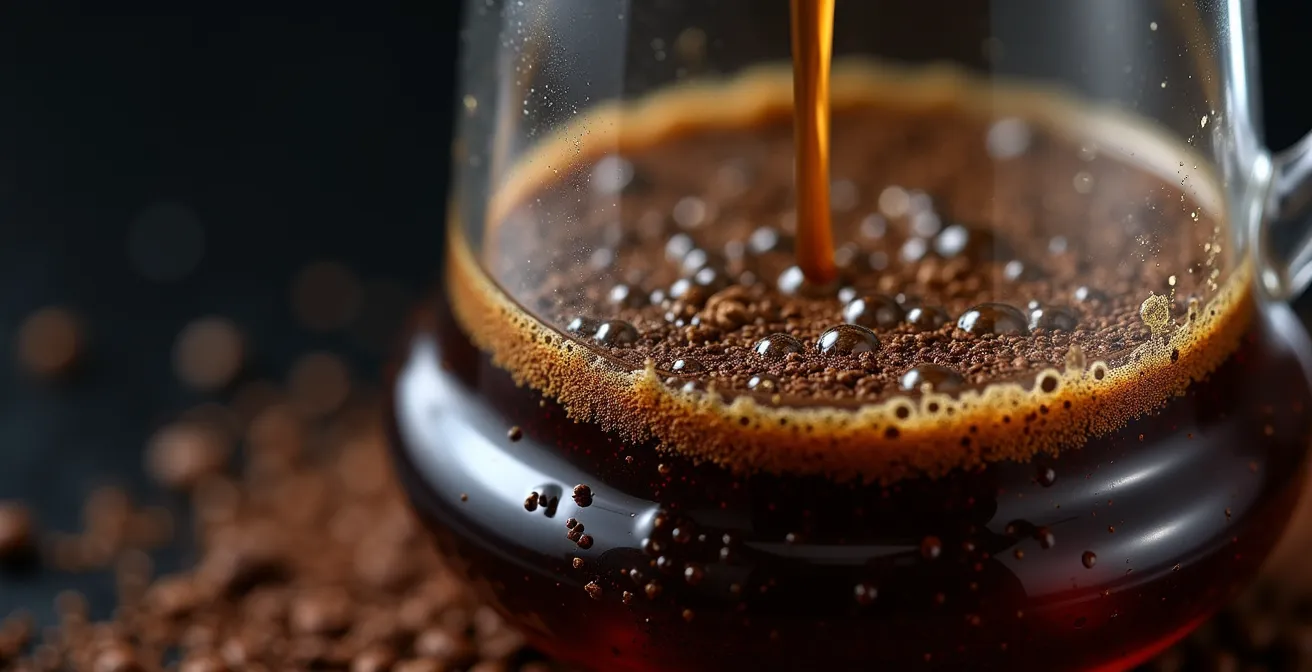
The ideal resting time varies by roast level. Darker roasts, being more porous and developed, degas more quickly and are often ready to brew sooner. Light roasts are denser and release their CO2 more slowly, requiring a longer rest period to reach their peak flavor potential. As a general rule, waiting is always better than rushing. Allowing the beans to rest unlocks the complexity and balance the roaster worked so hard to achieve.
Drum Roast vs Air Roast: Which Creates a More Even Flavor?
The method used to apply heat to coffee beans has a profound impact on the final flavor profile. The two dominant technologies in modern coffee roasting are the traditional drum roaster and the more modern air roaster. Each transfers heat differently, which in turn affects the development of flavors during critical phases like the Maillard reaction.
A drum roaster, the workhorse of the industry, tumbles the beans in a heated metal drum. Heat is transferred through two methods: conduction (direct contact with the hot drum) and convection (contact with the hot air inside the drum). This dual-heating approach tends to slow down the roast, particularly during the Maillard phase. This extended development time is excellent for building body, sweetness, and a rounded, classic coffee profile. However, it requires a skilled roaster to avoid “tipping” or “scorching” where parts of the bean burn from direct contact with the drum.
An air roaster, by contrast, levitates the beans on a bed of hot air. It relies almost purely on convective heat. This method is incredibly efficient and generally produces a faster roast. Because there’s no hot metal surface to touch, the risk of scorching is virtually eliminated, leading to a remarkably “clean” flavor profile. Air roasting excels at highlighting bright, crisp acidity and distinct origin notes, making it a favorite for delicate, light-roasted coffees. The trade-off can sometimes be a lighter body compared to a drum-roasted coffee.
Ultimately, neither method is inherently “better,” but they produce different results. As a recent comparative analysis of heat transfer methods shows, the choice depends on the roaster’s goal for a specific bean.
| Method | Heat Transfer | Maillard Phase | Flavor Profile |
|---|---|---|---|
| Drum Roasting | Conductive + Convective | Extended (slower) | Body, sweetness, rounded profile |
| Air Roasting | Purely Convective | Shorter (faster) | Bright acidity, clean, distinct notes |
The “Baked” Taste: How to Recognize Under-Developed Coffee?
One of the most disappointing flaws in a cup of coffee is a “baked” taste. This is not the same as being over-roasted or burnt. A baked coffee tastes flat, papery, and bready, with a distinct lack of sweetness and a muted, lifeless aroma. It’s the flavor of a roast that has lost its momentum, a sign of under-development where the chemical reactions responsible for creating vibrant flavor were stalled.
This flaw occurs when the roaster fails to maintain a steady and sufficient application of heat throughout the roast. Professional roasters meticulously track the bean’s temperature progression, known as the Rate of Rise (RoR). A healthy roast has a consistently declining RoR. If the RoR flatlines or crashes, especially during the crucial Maillard phase after the beans turn yellow, the roast has “stalled.” Although the beans may reach the correct final color, the internal chemistry hasn’t developed properly. The sugars haven’t caramelized, and the acids haven’t transformed into complex, pleasant flavors.
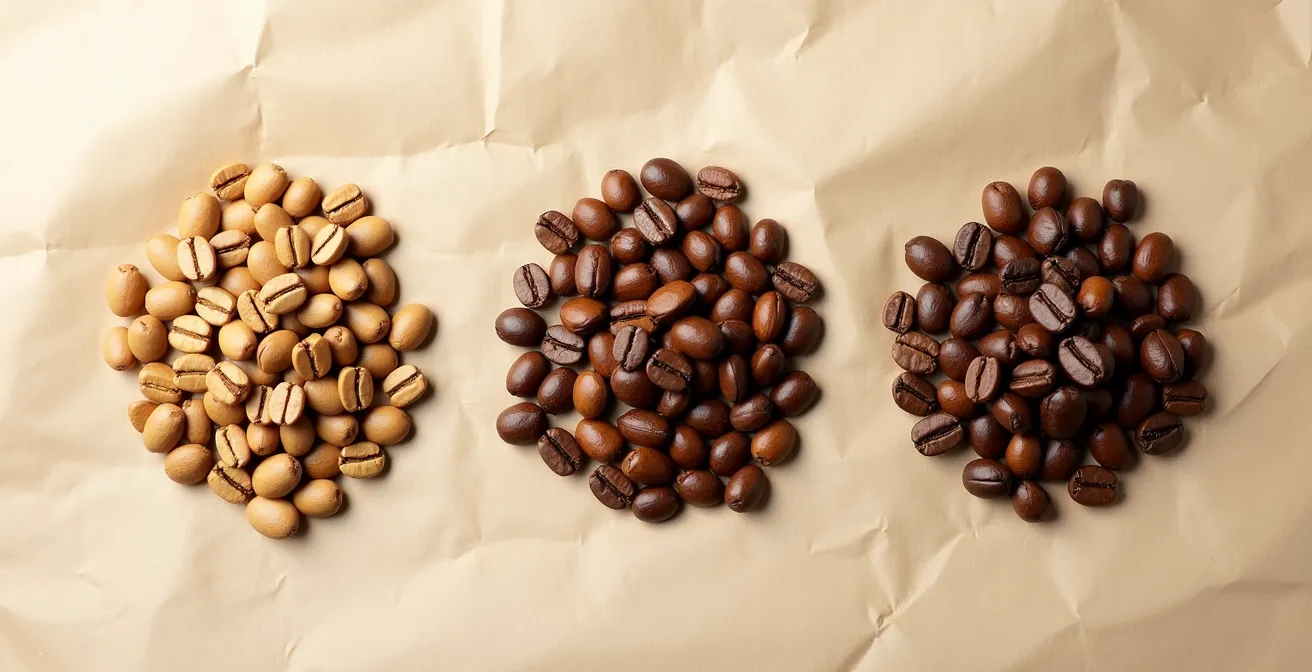
As an expert guide to artisan roasting explains, ensuring the drying stage is uniform is also critical to prevent this outcome. If heat is applied unevenly at the start, some beans will scorch while others lag behind, leading to a mix of under-developed and over-developed beans in the same batch. Visually, baked beans often look dull and lack the healthy sheen of a properly developed bean. Recognizing this flat, empty taste is a key skill in discerning coffee quality.
When do Dark Roasts Go Stale Compared to Light Roasts?
Dark roast coffees go stale significantly faster than light roasts. This accelerated aging is a direct consequence of the physical transformation the beans undergo during a prolonged, high-heat roast. As a coffee is roasted darker, it expands in size and loses moisture, causing its internal structure to become more porous and brittle. This process makes dark beans 15-20% lighter in weight and much more permeable to oxygen.
Furthermore, the intense heat of a dark roast draws the coffee’s natural oils to the surface, giving the beans their characteristic sheen. While visually appealing, this oily layer is a major liability for freshness. These oils are fragile and, when exposed to oxygen, they begin to oxidize and turn rancid. This oxidation process is what creates the stale, bitter, and often cardboard-like flavors in old coffee. Light roast beans, by contrast, are denser and typically retain their oils inside the cellular structure, protecting them from oxygen and dramatically slowing the staling process.
Because of this increased porosity and surface oil, a bag of dark roast coffee has a much shorter window of peak flavor. While a light roast can remain vibrant for up to four weeks after opening, a dark roast often starts to lose its character and develop off-flavors in as little as two weeks. Proper storage is paramount for all coffee, but it is absolutely critical for preserving the fleeting quality of a dark roast.
Action Plan: Storage Guidelines for Maximum Freshness
- Store both roast types in airtight, opaque containers away from direct sunlight and heat. Oxygen and light are the primary enemies of freshness.
- For dark roasts, aim to use the entire bag within two weeks of opening to enjoy the coffee before the surface oils begin to turn rancid.
- For light roasts, you have a longer window. They can maintain excellent quality for three to four weeks after opening if stored correctly.
- If you buy coffee in bulk, portion it into smaller airtight bags and freeze what you won’t use within the month. Only thaw what you need.
- Never store your coffee beans in the refrigerator. The environment is humid, and condensation will accelerate the staling process and introduce unwanted odors.
How to Stretch the Maillard Phase to Boost Body and Sweetness?
The Maillard reaction is arguably the most important chemical process in coffee roasting for flavor development. It’s a complex cascade of reactions between amino acids and reducing sugars that begins around 140°C (284°F). This is the phase where the green, grassy-smelling bean transforms, developing the browning, aromas, and foundational flavors we associate with roasted coffee. A skilled roaster knows that manipulating the duration of this phase is key to sculpting the coffee’s final character, especially its body and sweetness.
To stretch the Maillard phase, a roaster will deliberately slow down the roast’s momentum by reducing the heat application after the beans have turned yellow but before the “first crack” begins. This extended time allows for a more thorough development of melanoidins, the complex polymers created during the Maillard reaction. These compounds are directly responsible for the coffee’s color and, more importantly, its perceived body or mouthfeel. A longer Maillard phase creates more of these compounds, resulting in a cup with a heavier, more viscous texture.
However, this is a delicate balancing act. As a leading voice in the coffee industry, Danilo Lodi, explains in an interview on the Maillard reaction, precision is everything.
Generally speaking, if you reach the Maillard reaction too quickly, you’re going to leave too many organic acids in the cup, which will be unpleasant. But if you take too long in this phase, then you’re going to dissolve too many solubles in the coffee, which could produce more body but with dirty, earthy tones.
– Danilo Lodi, MTPak Coffee Interview on Maillard Reaction
Stretching this phase effectively means finding the sweet spot where you maximize body and the development of sweet, nutty, and chocolatey notes without introducing the “baked” or muddled flavors that come from a stalled or overly long roast. The goal is to build complexity, not to cook the life out of the bean.
The Roasting Mistake That Kills the Lemon Note in Sidamo
Ethiopian Sidamo coffees are celebrated for their distinctive and complex flavor profiles, often featuring bright, sparkling acidity reminiscent of lemon, bergamot, and other citrus fruits. This vibrant character is a hallmark of the region’s heirloom varietals and meticulous processing. However, this delicate acidity is not guaranteed; it can be easily muted or entirely destroyed by a single common roasting mistake: rushing the drying phase.
The roasting process begins with a “drying phase,” where the roaster applies a high amount of energy to evaporate the moisture within the green beans. The goal is to heat the beans thoroughly and evenly to their core before the browning (Maillard) reactions begin. If a roaster applies too much heat too quickly, the outside of the bean can scorch and seal before the inside has had a chance to dry evenly. This creates an uneven roast where the exterior is over-developed and the interior remains under-developed.
This unevenness is disastrous for delicate acids. The citric and malic acids responsible for those bright, lemony notes are transformed and muted by excessive heat. A rushed drying phase effectively “bakes out” this vibrant acidity, replacing it with flat, generic “roasty” flavors. To preserve the signature lemon note of a high-quality Sidamo, a roaster must employ a more gentle and patient approach. By carefully managing the initial heat application and ensuring a steady, even drying process, the roaster sets the stage for the bean to express its full, dazzling potential later in the roast.
Key Takeaways
- Roasting does not significantly reduce caffeine content, but it fundamentally transforms flavor precursors, trading delicate floral notes for deeper caramel and chocolate tones in darker roasts.
- The Maillard reaction is the engine of flavor development, creating the body, sweetness, and browning that define roasted coffee. Its duration is a key variable controlled by the roaster.
- Freshness is paramount. Understanding degassing times and proper airtight storage is as critical to a great cup as the quality of the roast itself.
The Science of Sweetness: How Roasting Creates Caramel Notes?
The perception of sweetness in coffee is a complex sensory experience created by a combination of aromatic compounds and the breakdown of sugars during roasting. While coffee beans contain some natural sugars, the rich, confectionary notes of caramel, toffee, and brown sugar are not present in the raw, green bean. They are created through a specific chemical reaction known as caramelization.
Caramelization is the process of sugar pyrolysis, which occurs at high temperatures. It begins after the Maillard reaction has slowed, typically starting around 160-180°C (320-356°F). During this stage, the larger sucrose molecules within the bean fracture into smaller, simpler sugar molecules (fructose and glucose). As the temperature continues to rise, these simpler sugars begin to brown and form hundreds of new aromatic compounds, including the diacetyls and furans responsible for those rich, buttery, and caramel-like flavors.
The potential for sweetness is also tied to the coffee bean’s origin and varietal. For instance, high-quality specialty coffees are almost exclusively from the Arabica species, in part because Arabica beans contain around 7.5% sucrose, more than double the amount found in Robusta beans. This higher initial sugar content provides more raw material for the caramelization process, giving the roaster a greater potential to develop sweetness. A roaster developing a “caramel bomb” profile will carefully push the roast into this caramelization phase, developing those sweet notes before they tip over into the bitterness of carbonization.
Now that you understand the intricate chemical ballet behind every roast, the choice between light and dark is no longer a simple guess about caffeine. It is an informed decision about flavor. By paying attention to the tasting notes, the origin, and even the roast date, you are engaging with the roaster’s craft on a deeper level. You are choosing a specific expression of a coffee’s potential. The next time you shop for coffee, let your palate, guided by this newfound knowledge, lead the way. You are now equipped to move beyond the caffeine and truly start tasting the science in your cup.