
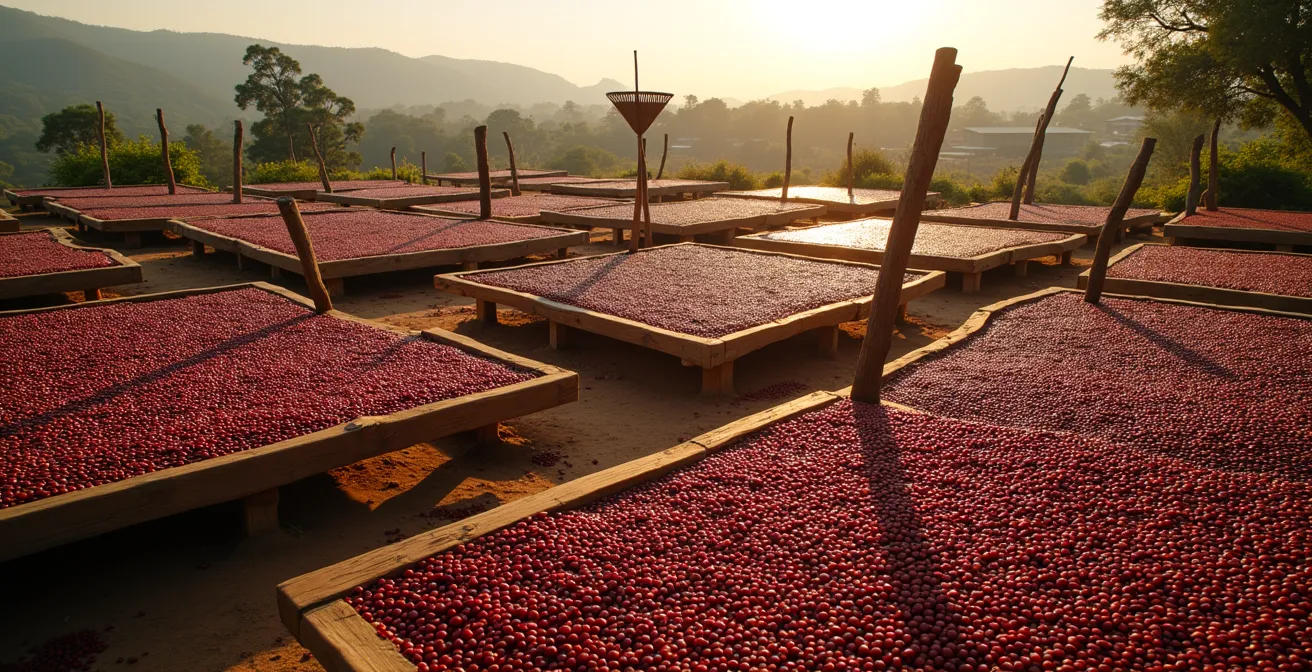
You might notice that natural processed coffees sometimes taste inconsistent. That’s not a flaw; it’s the signature of a farmer’s month-long, high-stakes tightrope walk. We aren’t just drying fruit; we’re conducting a wild fermentation where every hour presents a risk of financial ruin. This article explains the real, on-the-farm challenges that create the unique, and sometimes unpredictable, flavors you experience.
When you taste a natural processed coffee with its explosive fruit notes, it’s easy to appreciate the result. But when a batch tastes “off,” the immediate thought is often of a defect. As producers, we see it differently. That inconsistency is the ghost of a month-long battle we wage against time, humidity, and what we call microbial chaos. The “natural” method is anything but passive; it’s an economic gamble where the line between a prized micro-lot and a failed harvest is razor-thin.
Most explanations stop at the basic differences: washed coffees have the fruit removed before drying, while naturals are dried whole. This is true, but it misses the entire story of risk management. For us, the decision to produce a natural is a commitment to a painstaking, hands-on process that requires constant vigilance. It’s a method born from tradition and, often, water scarcity, but perfected through expertise.
But what if the key to understanding that “funky” or inconsistent flavor isn’t just about the process, but about the specific points of failure we fight to prevent? The real story of natural coffee lies not in the simple description of the method, but in the daily, hourly decisions made on the drying beds. This is the perspective we rarely get to share—the farmer’s view from the ground up.
In this article, we’ll walk you through the critical stages of this gamble. We’ll explain the science behind the long drying time, the manual labor required to prevent mold, the fermentation mistakes that can ruin a batch, and the final hurdles before the coffee ever reaches your cup. By the end, you’ll understand why every successful natural coffee is a small miracle of agriculture.
Summary: The Farmer’s Guide to Natural Processing Risks
- Why Drying Coffee Cherries Whole Takes 30 Days?
- How to Rake Coffee Beds to Prevent Mold Growth?
- Dry Process vs Wet Process: Which Saves More Water?
- The Fermentation Mistake That Tastes Like Medicine
- When to Ship Naturals: Humidity Risks in Containers
- Why Sealed Tanks Create Lactic Acid Notes in Coffee?
- Why Green Beans Mold if Humidity Exceeds 12%?
- Yirgacheffe vs Sidamo: Which Ethiopian Bean for Pour-Over Fans?
Why Drying Coffee Cherries Whole Takes 30 Days?
The 30-day timeline isn’t arbitrary; it’s a necessary vigil against decay. When we dry the cherry whole, we’re not just removing water. We are managing a slow, controlled fermentation inside the fruit, aiming to develop complex sugars while preventing harmful microbes from taking over. This process is a delicate dance of moisture migration from the core of the seed outward. If we rush it with excessive heat, the outside of the cherry will seal, trapping moisture inside and leading to mold. If we are too slow, the entire cherry will begin to rot.
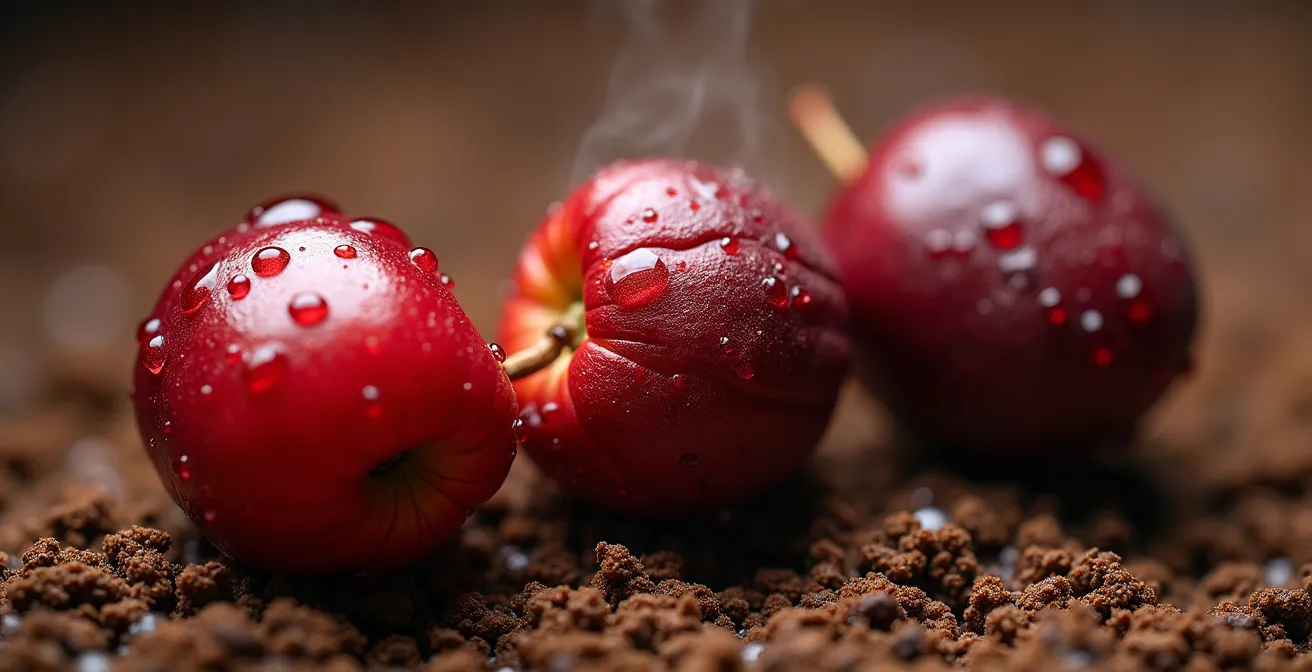
This process happens in distinct phases. The first 3-5 days are the most dangerous. The cherry’s moisture content drops from around 45% to 25%, creating a perfect breeding ground for mold. Our goal is to bring the bean to a stable state where it’s safe from microbial attack. According to coffee processing experts, this means the water activity must be reduced to 0.5 to 0.6 aw, a level at which most bacteria and molds can no longer thrive. Achieving this without defects takes weeks of careful management, not days.
This extended contact time between the bean and the fermenting fruit pulp is precisely what creates the classic “natural” flavor profile. The bean is essentially marinating in the cherry’s sweetness, absorbing the fruity, winey notes. But it’s a double-edged sword; this is also where inconsistencies and defects are born. Every one of those 30 days is a chance for something to go wrong.
How to Rake Coffee Beds to Prevent Mold Growth?
The single most important job during the drying process is raking. It sounds simple, but it is a highly skilled, labor-intensive task that requires constant attention. The goal is to ensure every single cherry dries at an even rate. Pockets of trapped humidity or cherries sticking together are invitations for mold and over-fermentation. We move the coffee constantly to expose all surfaces to air and sun, preventing any single point from remaining damp for too long.
The frequency and intensity of raking change throughout the day and the drying cycle. In the initial hours, when cherries are sticky with mucilage, they must be turned aggressively to stop them from clumping into a rotting mass. As they dry and become leathery, the raking becomes gentler to avoid bruising the fruit, which can also lead to flavor defects. This is not a task you can automate; it requires a human touch and experienced eyes.
Action Plan: A Farmer’s Raking Schedule to Prevent Defects
- Initial Wet Stage (First 6-8 hours): Rake the cherries 2-3 times per hour. The goal is to break up clumps until the cherries no longer stick to the palm of a down-turned hand.
- Mid-Drying Stage (Days 2-10): Continue to spread and turn the fruits with long rakes throughout all daylight hours. Increase frequency if humidity is high to ensure nothing rots.
- Continuous Inspection: During every raking pass, workers must actively inspect and remove any visibly under-ripe, over-ripe, or damaged cherries that could contaminate the entire batch.
- Daily Rotation: Systematically move the coffee across the drying bed throughout the day. This prevents contact bruising and ensures even airflow around every cherry.
- Stabilization Phase (Final days): Even as the coffee nears its target moisture, continue gentle turning to ensure the final moisture level is consistent throughout the entire lot.
Workers continue to inspect the cherries throughout the raking process, removing any defective ones to ensure they don’t negatively impact the entire batch – this detailed approach creates truly exceptional natural coffee.
– Ethiopian coffee farmer, Kafava.com
This constant labor is a major cost factor in producing high-quality naturals. It’s a relentless, manual effort to impose order on what would otherwise be a process of natural decay. Every turn of the rake is an act of quality control.
Dry Process vs Wet Process: Which Saves More Water?
While we talk a lot about the flavor and risk, one of the original and most compelling reasons for using the natural process is water conservation. For many of us in regions like parts of Ethiopia, Yemen, and Brazil, this isn’t an artisanal choice—it’s a necessity driven by water scarcity. When you don’t have access to the vast amounts of fresh water needed for the washed method, the dry process is the only viable path.
The difference in water consumption is staggering. The washed process involves pulping the cherries, washing the beans to remove all mucilage, and then channeling the wastewater. On our farms, we’ve seen how a fully-washed coffee requires up to 92% more water than a natural. In an arid region, that’s not just a statistic; it’s the difference between having a harvest and not.
However, this environmental benefit comes with its own set of trade-offs, which are at the heart of the risk-reward calculation for any farmer. This table breaks down the fundamental differences from our perspective on the ground.
| Aspect | Natural Process | Washed Process |
|---|---|---|
| Water Usage | Little to no water | Requires significant fresh water |
| Environmental Risk | Demands perfect drying conditions | Needs proper wastewater management to avoid pollution |
| Consistency | Riskier, prone to defects if mishandled | More stable and consistent results |
| Time Investment | Takes more time and care | Faster processing overall |
Choosing the natural process solves the water problem but opens the door to a host of other challenges related to consistency and quality control. The washed process, while water-intensive, offers a more stable and predictable outcome, which is why it’s often favored in regions where water is plentiful and the market demands a clean, bright flavor profile.
The Fermentation Mistake That Tastes Like Medicine
The greatest fear for a producer of natural coffee is the development of a “phenolic” defect. This is a catastrophic flavor taint that tastes like medicine, band-aids, or chemicals. Once it’s in a batch, it’s impossible to remove, and it can render an entire harvest worthless. This is the ultimate manifestation of the economic gamble we take. As one roaster notes, the stakes are incredibly high.
Natural processing comes with more risk of defect than other methods, which can be devastating for farms and communities.
– Hermanos Coffee Roasters, Natural? Washed? Honey? Coffee Processing Methods Explained
This defect is a direct result of uncontrolled microbial activity. It often happens when bruised or damaged cherries are allowed onto the drying beds, or when the coffee dries too slowly in humid conditions. The key to prevention starts long before the drying stage: it starts with meticulous cherry selection. We “float” our cherries in water tanks first; healthy, ripe cherries sink, while under-ripe, over-ripe, or insect-damaged fruits float to the top and are skimmed off.
Only the best cherries make it to the drying beds. This sorting is our first line of defense against the phenolic taint. We are vigilant about handling the fruit gently to prevent any bruising, as any break in the cherry’s skin provides an entry point for the wrong kinds of yeast and bacteria. Preventing this one specific defect dictates so many of our actions, from picking to sorting to raking.
When to Ship Naturals: Humidity Risks in Containers
The battle for quality doesn’t end when the coffee leaves the drying beds. The final moisture content is critical, and what happens next is just as important. The goal of the entire drying process is to get the beans to a stable state. For us, that means the ultimate goal of any drying process is to reduce moisture to 10-12% moisture content. Below this, the coffee is too dry and tastes woody; above it, it’s a ticking time bomb for mold and degradation.
Once we hit this target, the coffee is not ready to be shipped. It must go through a crucial “reposo” or resting period. The beans are stored in a cool, stable, and ventilated environment, often still in their protective parchment layer, for anywhere from 30 to 90 days. This period is non-negotiable for quality. It allows the moisture within the beans to stabilize and distribute evenly, strengthens their cellular structure, and extends their shelf life.
Skipping this step is a common cause of inconsistency. A coffee that tasted fantastic on the farm can arrive at a roastery months later tasting flat, faded, or even moldy. This happens because unstable beans age rapidly, especially when exposed to the fluctuating temperature and humidity inside a shipping container. A producer trying to rush their coffee to market might save time, but they sacrifice the quality they worked so hard to achieve. This is another part of the process where there are no shortcuts.
Why Sealed Tanks Create Lactic Acid Notes in Coffee?
Given all the risks of “wild” fermentation in traditional natural processing, some producers are turning to technology to regain control. This has led to the rise of “anaerobic” or “carbonic maceration” processing. Instead of drying on open beds, we place the whole cherries inside sealed, oxygen-free tanks. This controlled environment starves the typical aerobic microbes (which need oxygen) and promotes the growth of different yeasts and bacteria, like those that produce lactic acid.
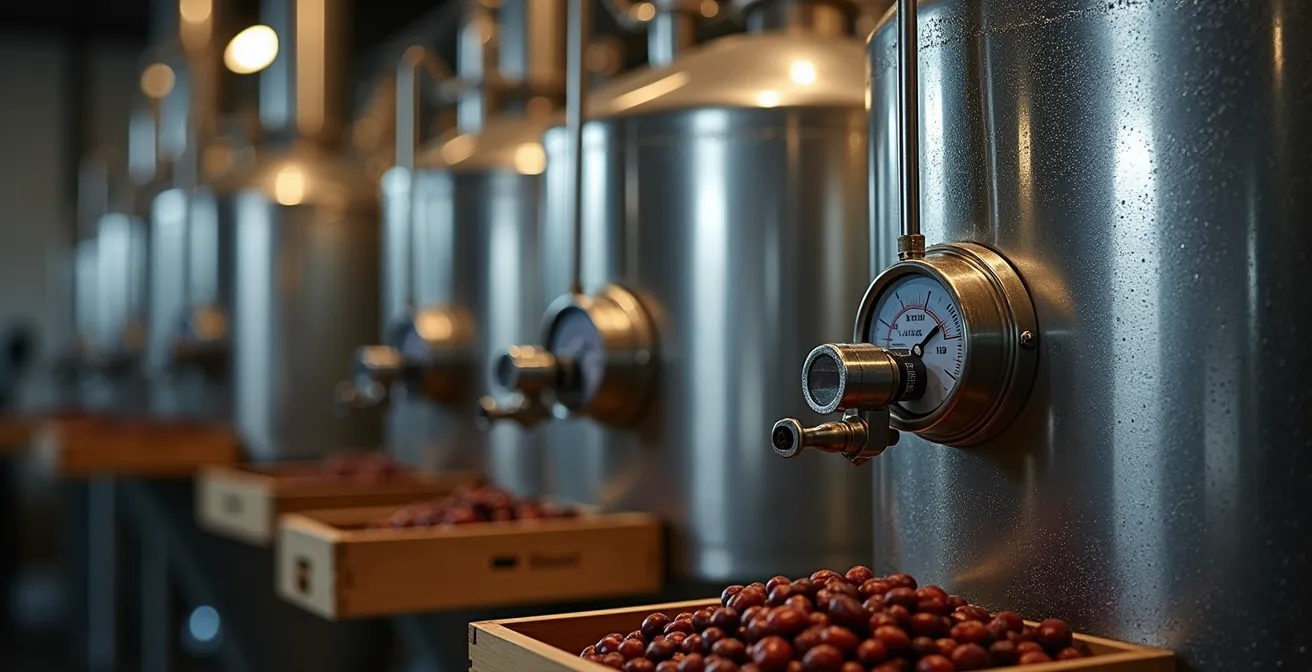
By controlling variables like temperature, time, and pH inside the tank, we can create a more predictable and often exotic sensory blueprint. This is how you get coffees with distinct notes of cinnamon, yogurt, or tropical funk. It’s an attempt to tame the microbial chaos. However, it’s a completely different and highly technical skill set.
Anaerobic coffee processing is done in an oxygen-free environment. This allows the coffee to develop more complex flavors. However, it is also more difficult to control, so it is not as common as other coffee processing methods.
– Bruvi Coffee, Coffee Processing 101
While these methods produce fascinating coffees, they require significant investment in equipment and knowledge. They represent one end of the processing spectrum—total control—while the traditional natural process represents the other—a masterful management of a wild, natural phenomenon. Both paths aim for exceptional flavor, but they get there through very different philosophies of risk and intervention.
Why Green Beans Mold if Humidity Exceeds 12%?
The 12% moisture content figure is a hard limit for a scientific reason: it’s the threshold for life. Mold spores and other microorganisms are present on virtually all agricultural products, including coffee. They remain dormant and harmless as long as the environment is not conducive to their growth. The key factor they need to “wake up” and proliferate is water.
When the moisture content of a green coffee bean rises above 12%, the water activity (aw) inside the bean becomes high enough to support microbial life. Dormant mold spores can begin to grow, feeding on the bean’s nutrients and producing mycotoxins, which are not only harmful but also create musty, moldy flavors that ruin the coffee. This is why a reading of 12.5% humidity on our moisture meters is cause for alarm.
Hitting the target is crucial. Industry research confirms that the environment for microorganisms become inhospitable when coffee reaches 11% moisture. This is the scientific basis for our obsession with drying and resting. We are not just drying a fruit; we are creating a desert inside the bean where mold cannot survive. This ensures the coffee remains stable and clean-tasting during its long journey from our farm to your cup. Any failure to maintain this dryness at any point in the supply chain re-opens the door to spoilage.
This is why high-quality naturals are often packed in special bags (like GrainPro) that create a hermetic seal, protecting the beans from absorbing ambient humidity during shipping and storage. It’s the final lock on a door we’ve spent more than a month trying to close.
Key Takeaways
- The “inconsistency” in natural coffee is a direct result of the high risks farmers manage, including uncontrolled fermentation and mold growth.
- The 30-day drying period is a necessary, labor-intensive process of controlled moisture migration, not passive drying.
- The natural process is often a necessity due to water scarcity, saving immense amounts of water compared to the washed method but introducing significant quality control challenges.
- Final quality depends on reaching a stable 10-12% moisture content and undergoing a crucial 30-90 day resting period to prevent degradation during shipping.
Yirgacheffe vs Sidamo: Which Ethiopian Bean for Pour-Over Fans?
Ultimately, all this risk and hard work on our farms is about one thing: creating a specific and desirable flavor in your cup. The choice of processing method is one of the most powerful tools we have to shape a coffee’s final taste, often having as much impact as the terroir itself. Ethiopia, the birthplace of coffee, provides a perfect example of this.
In Ethiopia, you can find regions side-by-side that have historically specialized in different methods, creating distinct flavor profiles from genetically similar coffees. For a pour-over enthusiast, knowing the region’s typical process is key to finding the right bean. As roaster Stephen Gray explains, the difference is clear in the cup.
Even with similar tasting notes between the two methods, you would find more crisp, fresh fruit and floral flavours in washed coffees, and deeper, ripe, or stewed fruit flavours in natural coffees, with a ‘booziness’ or ‘funk to them.
– Stephen Gray, Perfect Daily Grind
The following table shows how these choices play out in two of Ethiopia’s most famous coffee regions, Yirgacheffe and Sidamo, creating two very different sensory blueprints for pour-over lovers.
| Region | Traditional Process | Pour-Over Profile | Tasting Notes |
|---|---|---|---|
| Yirgacheffe | Washed | Clean, bright, tea-like | Floral, citrus acidity |
| Sidamo/Guji | Natural | Full body, fruit-forward | Blueberry, strawberry, wine-like |
A Yirgacheffe, typically washed, will give you that clean, bright, and floral cup that many associate with high-end specialty coffee. A Sidamo, often naturally processed, delivers the powerful blueberry and strawberry jam notes that define the classic Ethiopian natural. Neither is “better”—they are simply different expressions of the same coffee, shaped by the farmer’s hands and their chosen path of processing.
So, the next time you taste a natural coffee, whether it’s perfectly balanced or a little wild, remember the story behind it. That flavor is the final word in a long, risky conversation between a farmer, their land, and the unpredictable forces of nature. That inconsistency is not a failure; it is the authentic signature of a truly handmade product.