
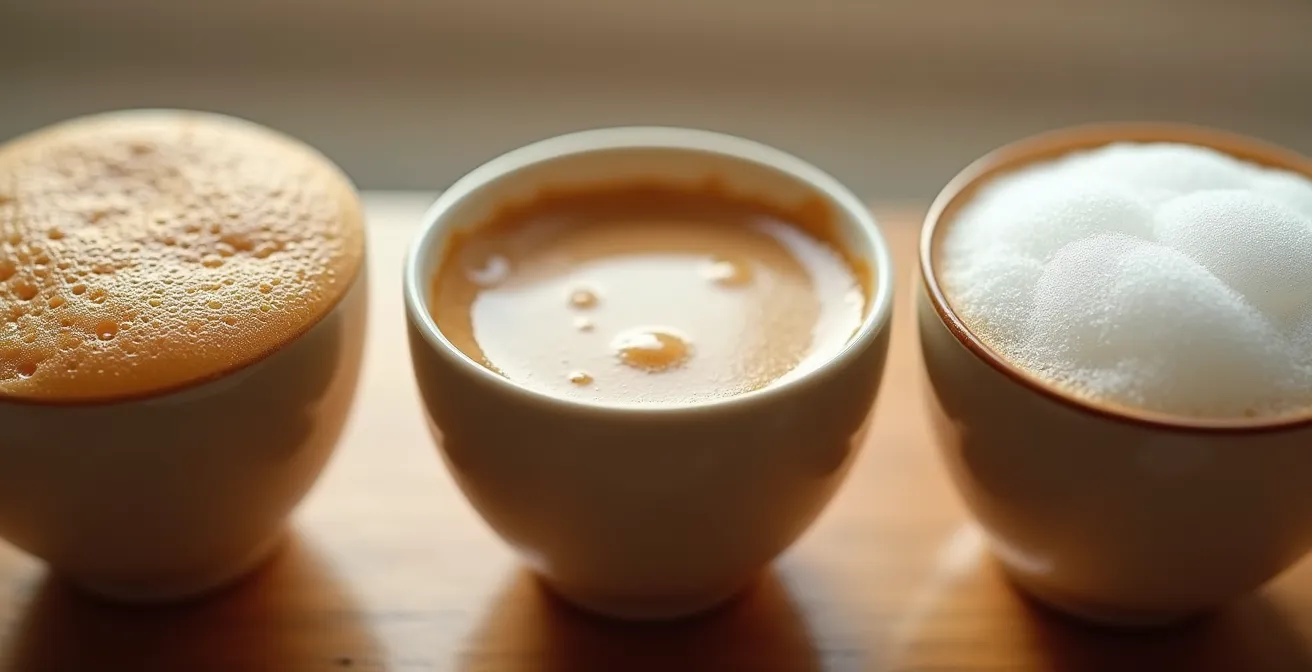
The secret to a perfect vegan latte isn’t finding one “best” milk, but understanding the unique chemistry of each alternative to master heat, air, and acidity.
- Protein structure, not just quantity, is what creates stable, lasting foam.
- Overheating oat milk causes starch gelatinization, resulting in a “porridge-like” texture.
Recommendation: Treat each plant milk as a unique ingredient. Control your steaming temperature precisely for oat milk (below 69°C) and manage coffee acidity for soy milk to prevent curdling.
That moment of anticipation. You’ve ground the beans, pulled the perfect espresso shot, and now it’s time for the crowning glory: the steamed milk. But as you pour, the silky microfoam you envisioned collapses into a sad, bubbly mess, or worse, your soy milk curdles on impact. For any vegan latte lover, this frustration is all too familiar. You’ve tried every brand of almond, oat, and soy milk on the shelf, yet that rich, dairy-like texture remains elusive. The common advice is often to just “pick a barista blend” or “don’t overheat it,” but this rarely solves the underlying problem.
These tips only scratch the surface. They treat all plant milks as if they were simple dairy replacements, ignoring the complex science that makes each one unique. The truth is, achieving that perfect, glossy latte art with a non-dairy base is less about the brand you buy and more about understanding the fundamental chemistry at play. It’s about becoming a kitchen scientist, knowing how the specific proteins, fats, and starches in each milk react under the pressure and heat of a steam wand.
But what if the key wasn’t about endlessly searching for a magic-bullet milk, but rather about mastering the technique for each one? What if you could learn why almond milk foam deflates, why soy milk separates, and why oat milk can suddenly taste like breakfast porridge? This guide moves beyond the surface-level comparisons. We will deconstruct the science behind plant milk performance, transforming you from a frustrated coffee drinker into an empowered home barista who can coax a perfect microfoam from almost any plant-based milk.
This article breaks down the science behind the most common plant milk challenges. We’ll explore the roles of protein, fat, and heat, providing a clear roadmap to finally achieving that cafe-quality, dairy-free coffee at home. The following sections will guide you through each concept.
Summary: Oat vs Almond Milk: Which Plant Base Steams Like Real Dairy?
- Why Almond Milk Foam Collapses Faster Than Soy?
- How to Prevent Soy Milk from Curdling in Light Roast Coffee?
- Almond vs Oat: Which Milk Uses Less Water to Produce?
- The Heating Mistake That Makes Oat Milk Taste Like Porridge
- When to Use Coconut Milk: The Fat Replacement Ratio for Ganache
- Why Low-Fat Cream Fails to Hold Air When Frozen?
- 35% vs 40% Cream: Which Whipped Cream Holds Longer?
- Why Nitro Cold Brew Has a Creamy Head Without Any Dairy?
Why Almond Milk Foam Collapses Faster Than Soy?
The number one reason for a disappointing latte is foam that vanishes before you can even take a sip. This phenomenon highlights the crucial role of protein. When you steam milk, you’re injecting air and using heat and pressure to create a “protein matrix”—a microscopic web of protein molecules that trap air bubbles. The strength of this matrix determines the foam’s stability and texture. Dairy milk is the gold standard because its casein and whey proteins create a highly elastic and robust network.
Plant milks have a much wider variance. Soy milk is often a top performer because it has a relatively high protein content that forms a stable, durable foam, closely mimicking dairy. Almond milk, on the other hand, is notoriously difficult. It’s mostly water and has a very low protein content, resulting in a weak matrix. The bubbles it creates are large and the foam structure is fragile, collapsing almost immediately.

As this visualization suggests, a strong foam relies on an intricate, interconnected web of proteins. Think of it like building with LEGOs: soy milk gives you plenty of strong, interlocking bricks, while almond milk provides just a few, poorly connected ones. While “barista edition” almond milks add gums and other stabilizers to compensate, understanding the fundamental role of the protein matrix is the first step to diagnosing why your foam is failing.
How to Prevent Soy Milk from Curdling in Light Roast Coffee?
You’ve mastered soy milk foam, only to see it curdle the second it hits your coffee, creating an unappetizing, separated mess. This frustrating reaction isn’t your fault; it’s a matter of chemistry, specifically pH levels. Coffee is naturally acidic, especially light roasts, which preserve more of the beans’ original citric and malic acids. Soy milk proteins, meanwhile, are stable within a certain pH range. However, once the acidity reaches a critical threshold, the proteins clump together, or “curdle.”
This tipping point is known as the isoelectric point. For soy protein, this occurs at a pH of around 4.6. Since light roast coffees can have a pH between 4.5 and 4.7, they are the perfect trigger for curdling. The heat of the coffee accelerates this reaction, causing the proteins to denature and coagulate instantly. This explains why the same soy milk might be perfectly fine in a less acidic dark roast coffee or when poured into iced coffee, where the lower temperature slows the reaction.
So, how do you fight chemistry with chemistry? The key is to manage the acidity or the temperature differential. Allowing both the coffee and the milk to cool slightly before combining can help. Alternatively, you can choose a coffee with lower acidity, like a Sumatran or Brazilian dark roast. But for those who love the bright notes of a light roast, there are a few barista tricks you can use to bridge the pH gap and keep your latte smooth.
Your Action Plan: Preventing Soy Milk Curdling
- Opt for Beans: Use medium to dark roast beans, which naturally have lower acidity than light roasts.
- Adjust Coffee pH: Add a tiny pinch of baking soda (a base) to your brewed coffee to slightly raise its pH before adding milk.
- Manage Temperature: Ensure your soy milk is at room temperature, not cold from the fridge, to reduce the temperature shock.
- Pour with Care: Pour the milk into the coffee slowly and stir continuously as you pour to encourage gentle integration.
- Filter Your Water: Use filtered water for your coffee to reduce the mineral content, as high mineral levels can accelerate the curdling reaction.
Almond vs Oat: Which Milk Uses Less Water to Produce?
While the title asks about water usage—a complex environmental topic where oats generally have a significantly smaller water footprint than almonds—the more practical comparison for a barista is performance. How do these two popular milks stack up in terms of protein, fat, and their resulting foam? Answering which is “healthier” or “better” depends entirely on your goals, as their nutritional profiles are vastly different. Almond milk is low in calories and fat, while oat milk is higher in carbohydrates and has a naturally creamier texture.
To truly understand their behavior in a latte, we need to look at the numbers. The following table breaks down the typical composition of popular plant milks, which directly correlates to their frothing ability. A higher protein percentage contributes to a more stable foam, while a higher fat content adds to the creamy mouthfeel and richness. This data helps explain why soy often produces the best foam and why some blends, like coconut/soy, can struggle despite high fat content if protein is low.
As this comparative analysis from ScienceDirect shows, oat milk’s performance is moderate. It has less protein than soy but more than almond, and its soluble fibers (beta-glucans) contribute to a thicker, creamier texture that many people love.
| Milk Type | Protein % | Fat Content | Foam Stability |
|---|---|---|---|
| Soy | 3.12% | Moderate | High |
| Oat | 0.50% | Low-Moderate | Medium |
| Coconut/Soy | 1.33% | High | Low |
Ultimately, the choice between almond and oat comes down to a trade-off. If your priority is low calories, almond milk is a clear choice, but you’ll sacrifice foam quality. If you’re seeking that creamy, dairy-like texture, oat milk is superior, though it comes with more carbohydrates. Understanding this helps you choose the right milk for your desired outcome.
The Heating Mistake That Makes Oat Milk Taste Like Porridge
Oat milk has become a café favorite for a reason: when steamed correctly, it produces a beautifully smooth, creamy, and subtly sweet foam that’s perfect for latte art. However, it has a unique vulnerability that other plant milks don’t: its starch content. When you overheat oat milk, you may notice it becomes thick, slimy, and develops a distinct “porridge” or “cereal” taste. This isn’t a sign of bad milk; it’s a chemical process called starch gelatinization.
Oats are full of starches. When heated in a liquid, these starch granules absorb water and swell up. If you push the temperature too high, they burst and release long, sticky starch molecules into the milk, rapidly thickening it. This is the exact same process that turns oats and water into a thick bowl of oatmeal on your stove. Your steam wand is just doing it much, much faster. Research confirms the specific temperature range for this transformation.
Oat starch gelatinization starts at temperatures from 56 to 69 °C, and the gelatinization peak is around 58 to 73°C.
– Bachelor thesis in chemistry researchers, DIVA Portal Research Study
This means the ideal window for steaming oat milk is very narrow. You need to get it hot enough to create foam but pull back just before you trigger full gelatinization. Most baristas aim for a final temperature of around 60-65°C (140-150°F). Going above 70°C (160°F) is a one-way ticket to a slimy, oaty latte.
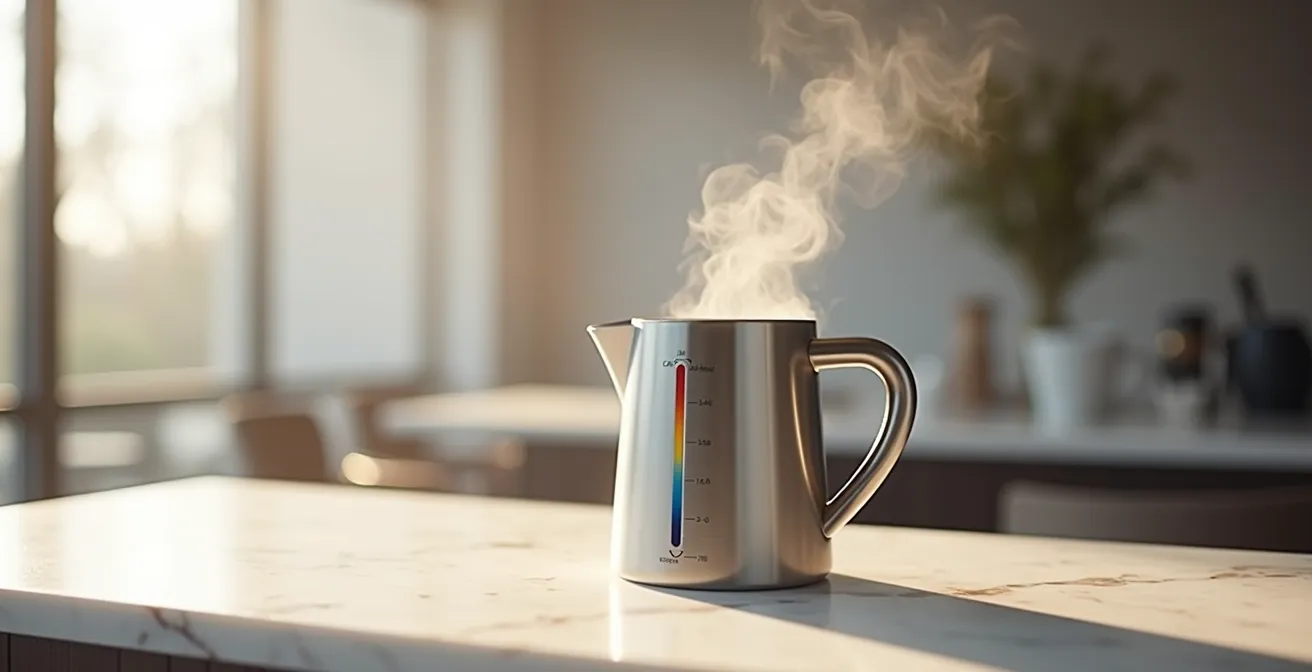
Mastering oat milk is therefore a game of temperature control. Using a thermometer is non-negotiable when you’re starting out. Pay close attention and stop steaming the moment you hit that sweet spot. This single adjustment can be the difference between a silky, delicious latte and a cup of warm, liquid porridge.
When to Use Coconut Milk: The Fat Replacement Ratio for Ganache
While often too thin for a great latte on its own, coconut milk shines in other applications where its high fat content is an asset, not a hindrance. One of the best examples is creating a rich, decadent vegan chocolate ganache. In traditional ganache, the fat from heavy cream emulsifies with the cocoa solids in chocolate to create a smooth, stable, and glossy mixture. To replicate this without dairy, you need a plant-based source with a comparable amount of saturated fat.
This is where full-fat canned coconut milk excels. It possesses a high percentage of saturated fat, which solidifies at room temperature, giving the ganache the structure it needs to set properly. Using a “light” coconut milk or a carton-based coconut beverage will result in a runny, unstable ganache because they simply don’t have enough fat to create the proper emulsion. The right choice of chocolate is also key to success.
Case Study: The Perfect Vegan Ganache Ratio
To achieve the ideal ganache consistency, extensive recipe testing reveals a simple yet effective formula. Using equal parts by weight of 100% cocoa chocolate and full-fat canned coconut milk creates a perfect, scoopable, and pipeable ganache. For the best results, it’s crucial to choose a chocolate with a cacao mass between 70-75%. Chocolate with a lower cacao percentage contains more sugar and other additives, which can interfere with the ganache’s ability to set firmly.
This application demonstrates a core principle: when substituting ingredients, you must match their function. For ganache, the function is all about fat. By understanding that you’re replacing the fat globules of dairy cream with the saturated fat from coconut, you can successfully adapt classic recipes to be fully plant-based without sacrificing texture or richness. A nutritional analysis shows that full-fat coconut milk provides the necessary fat structure for this chemical process.
Why Low-Fat Cream Fails to Hold Air When Frozen?
The crucial role of fat becomes even more apparent when we look at dairy itself, especially when dealing with freezing. Have you ever tried to make ice cream with low-fat cream or milk, only to end up with an icy, crystalline block instead of a smooth, creamy scoop? This failure is directly linked to the function of fat globules in an emulsion, which is just as important for ice cream as it is for whipped cream.
In full-fat cream, the tiny fat globules do more than just provide a rich taste. During churning and freezing, these globules partially break apart and clump together, forming an intricate three-dimensional network. This network does two critical things: it traps the tiny air bubbles that are whipped into the mixture, creating a light texture, and it physically gets in the way of water molecules, preventing them from forming large, crunchy ice crystals. The result is a smooth, scoopable texture.
Low-fat cream simply lacks a sufficient number of these fat globules. Without a dense network to trap air and inhibit ice crystal growth, the air escapes and the water freezes into a solid, icy mass. According to food science research, a favorable protein-fat ratio is essential not just for foam in a hot latte but also for the frozen foam structure of ice cream. Fat isn’t just for flavor; it’s the primary structural architect in high-fat dairy products, providing the stability needed to hold air and maintain a desirable texture, whether hot or cold.
35% vs 40% Cream: Which Whipped Cream Holds Longer?
When standing in the dairy aisle, you might see “whipping cream” (around 35% milk fat) and “heavy cream” or “heavy whipping cream” (often 36-40% or even higher). While a 5% difference may not seem like much, it has a dramatic impact on the final product, especially its stability over time. The principle is the same as with ice cream: the fat globules create the structure.
When you whip cream, you’re doing two things simultaneously: incorporating air and forcing the fat globules to collide and stick together, forming a matrix that holds that air. A cream with 35% fat has enough fat to create a stable foam, resulting in a light, airy whipped cream that’s perfect for immediate use as a topping. It’s soft, billowy, and delightful.
However, a cream with 40% fat has a much denser concentration of fat globules. This means that when you whip it, you create a significantly stronger, more rigid, and more interconnected fat network. This structure is not only stiffer from the start but is also far more durable. It’s less likely to “weep” (release liquid) over time and can hold its shape for much longer, even for a day or two in the fridge. This makes 40% cream the superior choice for piping decorations on a cake, filling pastries, or any application where long-term stability is required.
Key Takeaways
- Foam stability is determined by the strength of the protein matrix, which is why high-protein soy milk outperforms low-protein almond milk.
- Oat milk’s starch content will gelatinize (thicken) if heated above 69°C (155°F), creating a “porridge-like” texture.
- Fat is the structural architect of whipped creams and ice creams; a higher fat percentage creates a more stable, longer-lasting structure.
Why Nitro Cold Brew Has a Creamy Head Without Any Dairy?
After exploring how crucial protein and fat are for creating texture, nitro cold brew seems to break all the rules. It has a rich, creamy, and remarkably stable head of “foam” that cascades beautifully in the glass, yet it’s typically made from just coffee and water—no protein, no fat. This magic is a trick of physics, revolving around the unique properties of nitrogen gas.
The foam on a beer or a soda is made with carbon dioxide (CO2). CO2 is highly soluble in water, so it dissolves easily and creates large, aggressive bubbles that quickly rise to the surface and pop. Nitrogen, however, is the opposite. Physics research reveals that nitrogen is about 50 times less soluble in water than CO2. To infuse it into coffee, it must be forced in under high pressure. When the pressure is released at the tap, the nitrogen rushes out of the solution, creating a massive cascade of incredibly tiny, stable bubbles.
This is the key to the “microfoam illusion.” The “creamy” sensation you experience from a nitro head isn’t from fat or protein. It’s a purely physical sensation created by the vast surface area of millions of microscopic bubbles flowing over your tongue. The sheer number and density of these bubbles trick your brain into perceiving a smooth, velvety texture, much like a dairy-based foam. Because the bubbles are so small and stable, the head lasts for a very long time, further enhancing the illusion of richness.
By understanding these core principles—from protein matrices to the physics of nitrogen—you can move beyond frustration and start creating consistently delicious, beautifully textured plant-based beverages. The next step is to take this knowledge into your own kitchen and begin experimenting.