
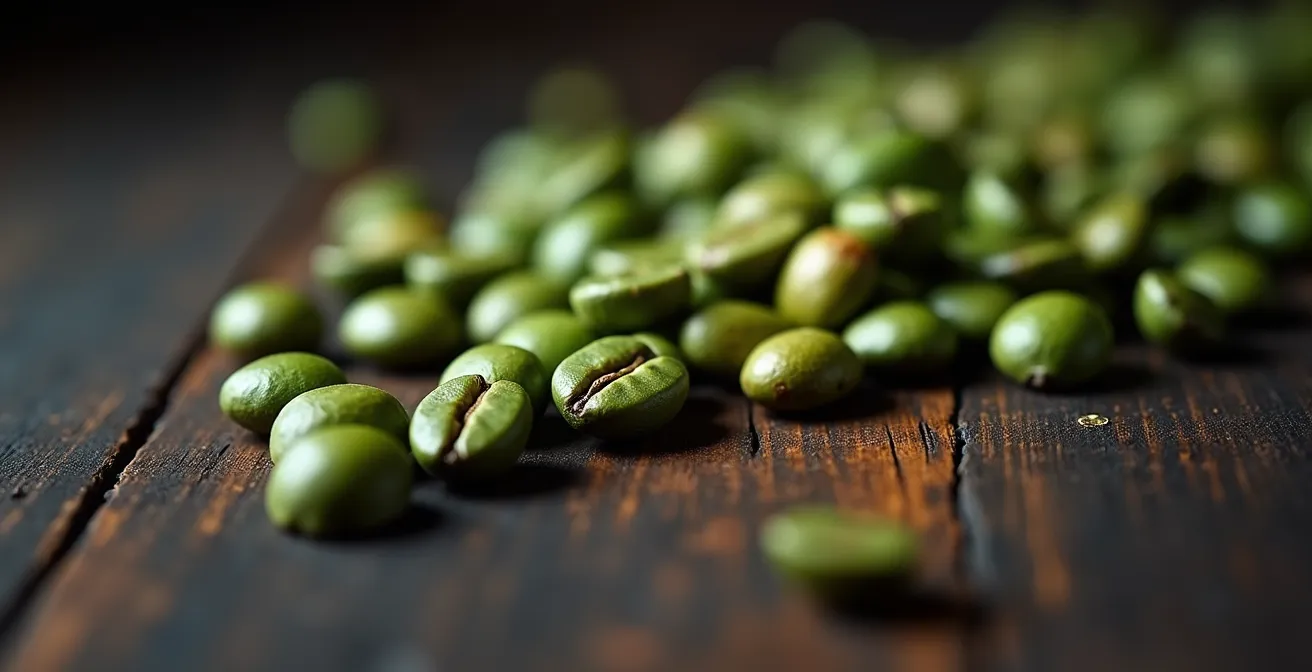
Authenticating premium Sidamo coffee is not about taste; it’s a forensic investigation into physical evidence, supply chain data, and economic red flags.
- Counterfeits range from lower-grade Sidamo (like G4) sold as specialty to entirely different regional beans (like Guji) being mislabeled.
- Key verification involves checking for uniform bean size and a bluish-green hue, demanding grade certification, and being skeptical of prices that are too good to be true.
Recommendation: Adopt a fraud investigator’s mindset. Trust verifiable data and physical evidence over marketing claims and flavor descriptions to ensure you get the quality you pay for.
You paid a premium for Ethiopian Sidamo, expecting that signature vibrant acidity and delicate floral notes. But the cup tastes flat, earthy, or just… generic. The sinking feeling hits: you’ve been sold a counterfeit. In the world of specialty coffee, where origin defines value, this is a costly and frustrating reality. Buyers are constantly at risk of paying top dollar for blended, old, or lower-grade beans deceptively packaged under a prestigious name. The usual advice—”buy from reputable sellers” or “look for the taste”—is useless when you’re trying to prevent the fraud before you buy.
The common wisdom fails because it treats you like a consumer. To protect your investment, you must stop thinking like a consumer and start acting like a coffee fraud investigator. The truth isn’t found in romantic descriptions but in hard evidence. It’s in the physical characteristics of the green beans, the economic signals of its price, and the digital paper trail of its supply chain. This is not about trusting a brand; it is about verifying a claim.
But what if the key to authentication wasn’t about what you taste, but about what you can prove? This guide abandons the typical tasting notes and instead equips you with a forensic toolkit. We will explore the economic reasons behind the Sidamo trademark, teach you how to conduct a visual inspection of the physical evidence, and show you how to identify the red flags that expose imposters—from lower-grade commercial beans to old-crop coffees that have lost their soul. It’s time to arm yourself with knowledge and secure the quality you deserve.
This article will guide you through the essential checkpoints of a coffee fraud investigation. The following table of contents outlines the key areas of forensic analysis you will master to distinguish authentic, high-quality Sidamo from the fakes.
Summary: How to Spot Counterfeit Sidamo Beans
- Why Ethiopia Trademarked the Name “Sidamo”?
- How to Visually Inspect Green Beans for Sidamo Characteristics?
- Guji vs Sidamo: Which Region is Trending Now?
- The Grade 4 Mistake: Buying Commercial Grade Thinking It’s Specialty
- When Does High-Density Sidamo Lose Its Vibrancy?
- Why “Heirloom” Means Thousands of Unknown Varieties?
- How to Use QR Codes to Meet the Farmer Virtually?
- How to Store Green Coffee Beans at Home for Over 6 Months?
Why Ethiopia Trademarked the Name “Sidamo”?
To understand the fight for authenticity, you must first understand the motive. Why did Ethiopia go to such lengths to trademark names like Sidamo, Harar, and Yirgacheffe? The answer is simple: to protect a vital economic asset from exploitation. For years, roasters and distributors around the world profited immensely from the Sidamo name while the farmers in Ethiopia saw little of that value. The name was being diluted and used on inferior blends, damaging its premium reputation. The trademark was a defensive strategy to reclaim control and capture lost revenue.
This wasn’t just about pride; it was a calculated financial decision. An early analysis by the Ethiopian Coffee Trademarking and Licensing Initiative estimated it could increase revenue by $88 million per year by simply controlling the use of its own coffee names. The goal was to ensure that when a buyer pays a premium for “Sidamo,” a fair portion of that premium returns to the Ethiopian economy and its coffee-growing communities. This initiative fundamentally changed the power dynamic in the coffee supply chain.
Case Study: The Starbucks-Ethiopia Trademark Dispute
A pivotal moment in this battle was the protracted dispute with Starbucks in the mid-2000s. In 2007, Ethiopia successfully secured trademark rights in the US, a landmark victory. The Ethiopian Intellectual Property Office strategically chose trademark protection over a geographical indication (GI). This was a crucial decision, as a trademark gave them more negotiating leverage and avoided strictly defining the growing areas, allowing for flexibility. Following this success, Ethiopia licensed the Sidamo name to over 70 global companies, creating a powerful model for other developing nations to protect their valuable agricultural heritage products from unauthorized commercial use.
Therefore, when you see the Sidamo trademark, recognize it as the first piece of evidence. It signifies a legally protected brand that the Ethiopian government actively polices. It’s a clear signal that authenticity is not just a quality marker but a matter of national economic strategy.
Why “Heirloom” Means Thousands of Unknown Varieties?
One of the most misused terms in the marketing of Ethiopian coffee is “heirloom.” It evokes a romantic image of ancient, pure-bred plants passed down through generations. The reality is far more complex and, frankly, anonymous. For a fraud investigator, understanding this distinction is key to cutting through marketing fluff and focusing on verifiable facts. The term is often a veil for a lack of specific information.
As one expert guide points out, the term is a catch-all for genetic diversity that hasn’t been fully mapped. According to the Homegrounds Coffee Guide:
Ethiopian coffees tend to fall under the umbrella of Ethiopian Heirloom or Ethiopian Landrace. These varietals are native to the region and not widespread or well-studied enough to warrant individual names.
– Homegrounds Coffee Guide, Ethiopian Sidamo Coffee Beans: An Origin You Need To Know
This genetic landscape is incredibly vast. Ethiopia is the birthplace of Arabica coffee, and its forests are a living library of coffee genetics. This unmatched biodiversity is a primary reason for the unique and complex flavors, but it also means that “heirloom” is not a single, traceable varietal like Gesha or Bourbon. In fact, Ethiopian coffee’s unmatched diversity includes over 6,000 unique varieties, with many more still wild and uncatalogued. This is what experts refer to as “genetic anonymity.”
Therefore, when a seller heavily markets their Sidamo as “heirloom,” your investigator instincts should kick in. It’s not false, but it’s not specific information either. It’s a generic descriptor for nearly all coffee from the region. Don’t let this romantic term distract you from demanding hard data: the grade, the processing method, the washing station, and the harvest date. These are the facts that prove quality, not a vague nod to an unmapped genetic history.
How to Visually Inspect Green Beans for Sidamo Characteristics?
Before you ever roast or cup, the green beans themselves offer the most critical physical evidence. An imposter bean can’t easily fake the density, size, and color that come from the unique high-altitude growing conditions of the Sidamo region. Conducting a rigorous visual inspection is your first and most powerful line of defense against fraud. Treat it like a forensic examination of a crime scene.
Authentic, high-quality Sidamo beans, grown between 1,550 and 2,200 meters above sea level, are typically dense and uniform. This uniformity is a direct result of meticulous sorting at the washing station—a hallmark of specialty-grade coffee. Blended lots, or those mixed with beans from other regions or lower altitudes, will betray themselves with inconsistencies. The most telling sign of fraud, however, is often the color, which can reveal not just the wrong origin but the wrong age. Old-crop beans, which have lost their vibrant flavor, often have a faded, yellowish appearance compared to the fresh, bluish-green hue of a new harvest.
The illustration below highlights the stark difference between a fresh, high-quality Sidamo bean and an aged one being passed off as new.
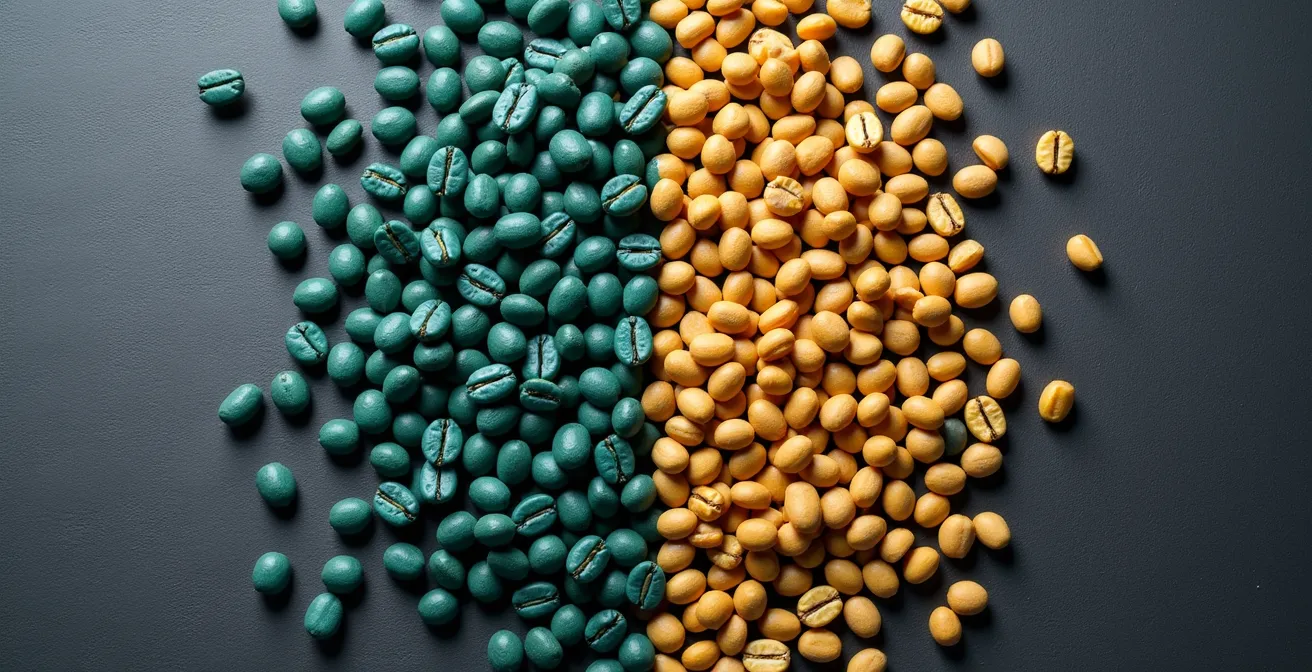
This visual evidence is undeniable. A yellowish or grayish tint is a major red flag indicating potential post-harvest decay. To systematize your inspection, use a checklist to ensure you don’t miss any clues. The following points are your protocol for examining the evidence.
Your Action Plan: Visual Forensics for Authentic Sidamo
- Check bean color: Look for a distinct bluish-green hue. This indicates a fresh crop and proper drying. A grayish or yellowish-tan color signals an old crop that has lost its vibrancy.
- Evaluate density uniformity: Squeeze a handful of beans. High-altitude Sidamo should feel consistently hard and heavy. Soft or spongy beans (quakers) indicate under-ripe cherries.
- Inspect for size consistency: Spread the beans on a flat surface. They should show remarkable uniformity in size. A mix of large and small beans is a clear sign of poor sorting or, worse, a blend of different lots or origins.
- Identify defects: Scrutinize the beans for insect damage (small holes), broken fragments, and pale, discolored beans (quakers). Specialty grades (G1/G2) have very few defects, while commercial grades will have many.
- Verify processing signs: Understand the difference in appearance. Natural processed beans often have a more mottled surface with some silverskin still attached, while washed beans are cleaner and more uniform in color. Know what you bought and verify it matches.
The Grade 4 Mistake: Buying Commercial Grade Thinking It’s Specialty
One of the most common deceptions isn’t selling a different origin, but selling a lower quality from the *same* origin. A seller might offer “100% Sidamo” that is technically true, but it’s Grade 4 (G4) commercial coffee, not the Grade 1 (G1) or Grade 2 (G2) specialty coffee you expect. This is a subtle but significant fraud. You’re paying a premium for a product that lacks the quality, flavor clarity, and rigorous sorting of its specialty counterparts.
The Ethiopian coffee grading system is based on a defect count in a 300-gram sample of green beans. The difference between specialty and commercial grades is stark and non-negotiable. According to the official system, only grades 1 and 2 are classified as specialty coffee. G1, the highest quality, allows for only 0-3 defects. G2 allows for 4-12 defects. In contrast, G4 can have 25-45 defects. These defects aren’t just cosmetic; they include broken beans, insect damage, and under-ripe “quakers” that introduce off-flavors like hay or earthiness into the final cup, destroying the delicate Sidamo profile.
The economic incentive for this fraud is clear: G4 coffee is significantly cheaper to produce and purchase. An unscrupulous seller can buy G4 Sidamo at a low price, label it simply as “Ethiopian Sidamo,” and sell it to an unsuspecting buyer at a specialty price point. Your first line of defense is to demand the grade. A reputable specialty coffee seller will always advertise the grade (G1 or G2) prominently and should be able to provide grading documentation upon request. If the grade is not mentioned, assume the worst. Treat its absence as a major red flag. If the price seems too good to be true for a specialty Sidamo, it almost certainly is.
This grading system is the objective standard that separates true specialty from the rest. It’s a clear, data-driven piece of evidence that you, as an investigator, must demand. Never settle for a coffee where the grade is a mystery; a lack of transparency here is an admission of lower quality.
Guji vs Sidamo: Which Region is Trending Now?
Another form of counterfeiting is substitution, where a bean from a neighboring region is passed off as Sidamo. The most common imposter is Guji. For a long time, Guji was considered a sub-region of Sidamo, and its coffees were sold under the Sidamo name. However, Guji has now been established as its own distinct zone, known for a unique and powerful flavor profile that is increasingly popular in its own right.
Until very recently, Guji was a sub-region of Sidamo but was formed into its own administrative state in 2020.
– House of Coffee Beans, Ethiopia Sidamo Product Description
This separation is key. While both regions produce world-class coffee, they are not the same. A buyer paying for the classic, bright citrus and delicate stone fruit of Sidamo will be disappointed by the dark berry and wine-like notes of a Guji. While Guji is a fantastic coffee, if it’s not what you paid for, it’s fraud. As an investigator, you need to know the suspect’s profile. Understanding the subtle differences in their sensory characteristics is a crucial part of your toolkit, especially when assessing a sample roast.
The following intelligence brief, based on an analysis of Ethiopian coffee regions, breaks down the key sensory differences between the two. While both share a vibrant acidity, their dominant notes are typically distinct.
| Characteristic | Sidamo | Guji |
|---|---|---|
| Primary Notes | Bright citrus (lemon, bergamot) | Dark berry, tropical fruit (mango, passionfruit) |
| Secondary Notes | Delicate stone fruit (apricot, peach) | Pronounced wine-like qualities |
| Body | Rich, full body | Medium to full body |
| Acidity | Vibrant, crisp acidity | Complex, layered acidity |
| Processing | 60% washed, 40% natural | Mixed processing methods |
This table is your field guide. If a coffee labeled “Sidamo” is hitting you with overwhelming notes of dark berries or mango, it’s a strong indicator of a substitution. While flavor is subjective, a clear deviation from the established Sidamo profile, combined with other red flags, strengthens the case for fraud.
When Does High-Density Sidamo Lose Its Vibrancy?
Perhaps the most insidious fraud is selling an authentic, G1 Sidamo that is simply old. Coffee is an agricultural product; it has a shelf life. The vibrant acidity and complex floral aromas that make Sidamo special are volatile. They degrade over time. An old-crop bean, even from the best farm, is a ghost of its former self. Paying a premium for it is like buying a ticket to a concert that already happened.
The “peak freshness” window is a critical piece of intelligence. For most high-quality Ethiopian coffees, their most expressive and dynamic flavors are at their best within a specific timeframe after harvest. According to industry analysis, Ethiopian green coffee beans maintain their signature vibrant acidity and floral notes at peak quality for 3-10 months post-harvest. After this window, the beans begin to lose their complexity. The bright, citrusy notes fade into a generic woodiness or even a baggy taste from the jute sacks used for transport. An unscrupulous seller with leftover stock from the previous year has a strong financial incentive to sell these aging beans as “fresh crop.”
While visual inspection can reveal signs of aging, such as a yellowish hue, a more definitive test occurs during roasting. This is where you can perform post-purchase forensics to confirm your suspicions and build a case against a fraudulent supplier.
Roasting Forensics: Detecting Age in the Drum
Professional roasters know that aged beans behave differently under heat. They are often drier and less dense, causing them to absorb heat and progress through the roast cycle much faster than fresh, moisture-rich beans. The most telling sign is the first crack—the moment when moisture inside the bean turns to steam and fractures its cellular structure. In fresh, high-density Sidamo, the first crack is vigorous and audible. In aged beans, it is often muted, weak, or “rolling” rather than distinct. If you roast a batch of “new crop” Sidamo and it races to first crack with little energy, you have strong evidence that you’ve been sold past-crop beans.
This method provides you with a powerful verification tool. It turns your roaster into a forensic lab, allowing you to confirm the true age and quality of your investment. Always log your roast profiles; they are part of the evidence trail.
How to Use QR Codes to Meet the Farmer Virtually?
In the fight against fraud, data is your ally. In recent years, traceability technology like QR codes has emerged as a powerful tool for verifying a coffee’s origin. A QR code on a bag of green beans promises a direct link to the source—the washing station, the cooperative, even the farmer. However, an investigator knows that not all data is created equal. A QR code can be just as much a part of the deception as it is a tool for transparency.
A fraudulent QR code often leads to a generic corporate homepage or a vague marketing page about “Ethiopian coffee” with stock photos. This is a major red flag. A legitimate traceability link provides specific, verifiable data about the exact lot of coffee in the bag. It’s the digital equivalent of a chain of custody. You should be able to find the name of the washing station, the exact altitude range, the specific lot number, the harvest dates, and details about the processing method.
Your job is to interrogate this data. Does it make sense? Is it consistent? Here are the key verification steps for assessing a QR code’s authenticity:
- Scan and verify the destination: Does the link go to a unique page for a specific coffee lot, or is it just a generic company website? A dead-end link is a sign of fake traceability.
- Check for verifiable data: Look for concrete details like the washing station name (e.g., Bekele Kachara), the exact altitude, a unique lot number, and the harvest and shipping dates.
- Verify farmer information: Real traceability often names the specific cooperative or the number of smallholder farmers contributing to that lot. Vague claims are worthless.
- Look for third-party certification: Genuine traceability systems may include links to export licenses, cooperative registration numbers, or other official documents that can be cross-referenced.
- Test for consistency: If you have multiple bags from the same declared lot, scan them all. They must lead to the exact same information. Any deviation is a sign of a poorly managed or fraudulent system.
A robust QR code system is a powerful piece of evidence that corroborates the physical and economic clues you’ve gathered. But an empty or generic link is also evidence—evidence of a seller trying to hide something. Trust the data, but only after you’ve verified it.
Key Takeaways
- Authenticity is proven through evidence (visuals, grade, data), not just flavor.
- The “Sidamo” name is a trademarked economic asset, giving Ethiopia legal grounds to fight fraud.
- Always demand the grade (G1/G2 for specialty) and be wary of beans marketed only as generic “heirloom.”
How to Store Green Coffee Beans at Home for Over 6 Months?
Your investigation is complete. You have successfully acquired a batch of authentic, specialty-grade, fresh-crop Sidamo. Your final mission is to protect this valuable asset. Improper storage can destroy a perfect coffee in a matter of weeks, undoing all your hard work. The four enemies of green coffee are oxygen, light, heat, and moisture fluctuations. Your storage strategy must neutralize all of them.
Professional importers use specialized, multi-layer bags to create a stable environment for the beans during transit and storage. You can adopt these same principles at home to extend the life of your coffee well beyond 6 months, preserving its vibrant character.
Professional Storage Methods for Home Use
The gold standard in professional storage involves using hermetically sealed packaging like GrainPro or Ecotact bags. These bags create a modified atmosphere that protects beans from oxygen and moisture. Experts report this can extend the peak shelf life by at least 6 months if the beans are kept at a stable temperature (ideally 60-70°F or 15-21°C). For home use, the best practice is to mimic this by vacuum-sealing smaller, manageable portions of your green coffee. This minimizes air exposure each time you need to roast. Adding an oxygen absorber packet to each vacuum-sealed bag provides an extra layer of protection against the subtle degradation caused by residual oxygen.
To implement a robust storage protocol, you must be systematic. The goal is to create a dark, cool, dry, and oxygen-free environment. The following steps will help you preserve the vibrancy and complexity you worked so hard to find:
- Divide and conquer: Immediately portion your beans into smaller, airtight containers or vacuum-seal bags, sized for one or two roasting sessions. This prevents repeated exposure of your entire stock to air.
- Eliminate oxygen: Use vacuum-sealed bags and consider adding oxygen absorbers to each one. If using airtight canisters, choose ones with a one-way valve to let CO2 out without letting O2 in.
- Control the temperature: Store your containers in a cool, dark place with a stable temperature, like a closet or cellar. Never store green coffee near a stove, oven, or sunny window.
- Manage humidity: Aim for a relative humidity below 60%. If you live in a very humid climate, adding food-safe silica gel packets to your storage area (not in direct contact with beans) can help.
- Embrace the darkness: Light degrades the complex organic compounds in coffee. Opaque containers are superior to clear ones.
By adopting this forensic mindset, you shift the power back into your hands. You no longer need to rely on blind trust. Instead, you can rely on evidence, data, and a systematic process of verification to ensure every bag of Sidamo you purchase is the real deal. Start your first investigation today.