

The flavors in your coffee cup are not an accident; they are a direct result of the specific geographical coordinates where the beans were grown.
- The “Coffee Belt” is more than a location; it’s a system where factors like volcanic soil, altitude, and climate act as levers that calibrate a bean’s final taste profile.
- High altitudes slow down cherry maturation, developing more complex sugars and acids, while nutrient-rich volcanic soils provide the essential mineral building blocks for flavor.
Recommendation: To truly understand a coffee’s taste, look beyond the roaster’s notes and inquire about its origin country and elevation. You’ll be tasting the geography itself.
For any traveler or student of the world, the “Coffee Belt” often appears as a simple, static band encircling the globe between the Tropics of Cancer and Capricorn. It’s presented as a neat geographical fact: this is where coffee grows. We learn the names of the countries—Brazil, Vietnam, Colombia, Ethiopia—and associate them with the world’s favorite morning ritual. The common understanding is that these regions simply have the “right climate”: a frost-free environment with the correct balance of sunshine and rainfall. This explanation, while true, is profoundly incomplete.
What if this belt is less a simple boundary and more a complex, global engine of flavor? What if latitude is not just a line on a map, but the primary setting that dictates everything from a coffee’s bright, citrusy acidity to its deep, sweet chocolate notes? The real story lies not in just *that* coffee grows here, but *how* the specific geology, topography, and microclimates within this zone actively craft the sensory experience in your cup. It’s a story of soil chemistry, atmospheric pressure, and the relentless march of harvest seasons across continents.
This article moves beyond the basic definition to explore the dynamic forces at play within the Coffee Belt. We will investigate the fundamental link between volcanic soil and acidity, the critical role of altitude in developing sweetness, and how continental differences produce vastly different flavor profiles. By understanding the geography of coffee, you learn to decode its taste. This is sensory geography, a journey from the map to the mug.
This guide delves into the specific geographical factors that shape the coffee you drink. Below is a summary of the key areas we will explore to connect the world map to your flavor experience.
Summary: From Latitude to Cup: Decoding Your Coffee’s Geographic Signature
- Why Volcanic Soil Produces Higher Acidity in Beans?
- How to Visit a Coffee Farm in Costa Rica Responsibly?
- Africa vs South America: Which Continent for Fruity Notes?
- The Temperature Threat: Will Arabica Survive 2050?
- When to Buy Kenyan Coffee: Understanding Global Harvest Calendars
- Madagascar vs Ecuador: Which Origin is Fruitier?
- High-Altitude vs Low-Grown: Which Arabica is Sweeter?
- Why Ash-Rich Volcanic Soil Creates Higher Acidity Coffee?
Why Volcanic Soil Produces Higher Acidity in Beans?
The foundation of coffee’s flavor profile begins, quite literally, in the ground. Many of the world’s most prized coffee-growing regions, from the slopes of Central America to the Great Rift Valley in Africa, are situated on land shaped by ancient volcanic activity. This isn’t a coincidence. Volcanic soils, known as Andosols, provide a near-perfect medium for cultivating high-quality Arabica coffee. Their unique physical structure is the first key to their success. These soils are lightweight, porous, and have excellent drainage, which prevents water from logging at the plant’s roots and causing rot.
This porous structure allows for deep root penetration, giving the coffee plant access to a wider range of nutrients and ensuring stability on steep slopes. At the same time, the soil’s composition, rich in weathered volcanic glass, allows it to retain significant amounts of water within its structure, releasing it slowly to the plant. This creates a resilient growing environment, buffering the coffee tree against periods of lower rainfall. It’s this combination of drainage and retention that establishes a stable foundation for the plant’s health, allowing it to dedicate its energy to producing high-quality cherries rather than merely surviving.
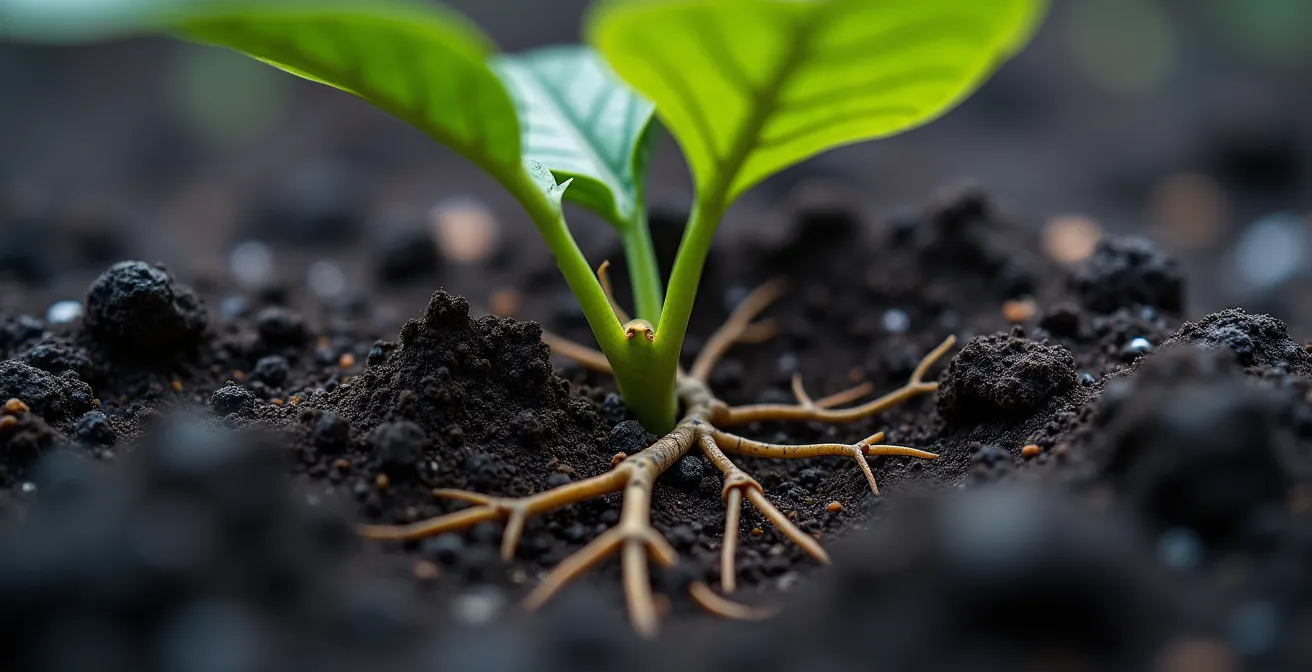
As seen in this close-up, the dark, crumbly texture of volcanic soil is a testament to its rich organic content and mineral makeup. The presence of elements like phosphorus, potassium, calcium, and zinc, all derived from the breakdown of volcanic ash and rock, is critical. These minerals are the fundamental building blocks the coffee plant uses to carry out the complex biological processes that ultimately lead to the development of acids, sugars, and aromatic compounds within the coffee cherry and its seeds—the beans. A healthy, well-fed plant is a prerequisite for a flavorful bean, and volcanic soil acts as a natural, slow-release fertilizer.
How to Visit a Coffee Farm in Costa Rica Responsibly?
For the traveler seeking to connect with the source of their coffee, a farm visit is an unparalleled educational experience. It transforms the abstract concepts of terroir and processing into a tangible reality. However, visiting responsibly is crucial, especially as coffee is the economic backbone for millions. Globally, over 25 million farmers across 70 countries depend on coffee for their income, and responsible tourism can provide a significant and direct financial boost. When planning a visit, particularly to a well-established origin like Costa Rica, the goal should be to engage in a way that is respectful, sustainable, and beneficial for the producer.
This means moving beyond a simple tour and a photo opportunity. Responsible agritourism involves a genuine curiosity about the agricultural and economic realities of coffee production. It’s an opportunity to learn firsthand about the challenges farmers face, from climate change to market price volatility, and the innovative strategies they employ to adapt. By engaging thoughtfully, visitors can support farms that prioritize environmental stewardship and social equity, ensuring that their tourism dollars contribute positively to the local community and ecosystem.
Your Checklist for Responsible Coffee Farm Tourism
- Research farms that practice shade-grown cultivation and maintain biodiversity indicators like native bird populations.
- Ask farmers specific questions about varietal selection, climate adaptation strategies, and water management for processing.
- Purchase coffee directly at the farm gate to provide higher margins to producers versus selling through cooperatives.
- Participate in cupping sessions at the farm to understand how soil, altitude, and processing affect the final cup profile.
- Document and share the farm’s sustainability practices online to promote responsible agricultural tourism and support their story.
By following these steps, a visit becomes a meaningful exchange rather than a simple transaction. You leave not only with fresh coffee but with a deeper appreciation for the immense labor, expertise, and natural resources required to produce it. This informed perspective is the most valuable souvenir a coffee lover can acquire.
Africa vs South America: Which Continent for Fruity Notes?
While both Africa and South America are titans of the Coffee Belt, their flavor profiles often present a study in contrasts, particularly when it comes to fruit notes. This divergence is a product of different dominant varietals, climates, and, most importantly, traditional processing methods. As Mela Coffee Roasting Co. observes, “Africa’s diverse growing regions produce a plethora of flavors that are often complex, fruity and floral. They are generally stronger, more fragrant, and more acidic than coffee from the other two growing regions”. This points to a general rule: if you are seeking bright, vibrant, and often intense fruitiness, East Africa is your most reliable destination.
South American coffees, especially from powerhouses like Brazil and Colombia, are often celebrated for their balance, sweetness, and notes of chocolate and nuts. While fruity notes are present, they tend to be softer and more reminiscent of stone fruits or red apple, seamlessly integrated with a caramel-like sweetness. African coffees, particularly those from Ethiopia and Kenya, are known for a much more forward and dominant fruit character. Here, you can expect everything from the delicate citrus and floral notes of a washed Yirgacheffe to the explosive blueberry and strawberry jam flavors of a natural-processed Harrar.
The following table, based on an analysis of regional coffee characteristics, breaks down these continental tendencies, highlighting how geography and processing work together to shape the final fruit expression in the cup.
| Region | Typical Fruitiness | Processing Method | Key Characteristics |
|---|---|---|---|
| East Africa | Citrus, blackcurrant, floral | Washed & Natural | Bright acidity-driven fruit, wine-like complexity |
| South America | Stone fruit, chocolate undertones | Primarily Washed | Balanced, mild fruitiness with nutty notes |
| Ethiopia (specific) | Blueberry, strawberry | Natural process | Intense fermented fruit bombs |
| Colombia (specific) | Red apple, caramel | Washed process | Clean, sweet fruit with balance |
Ultimately, neither continent has a monopoly on quality, but they offer different expressions of fruitiness. The choice between them depends entirely on the drinker’s preference: the balanced, comforting fruit of South America or the wild, complex, and vibrant fruit of Africa.
The Temperature Threat: Will Arabica Survive 2050?
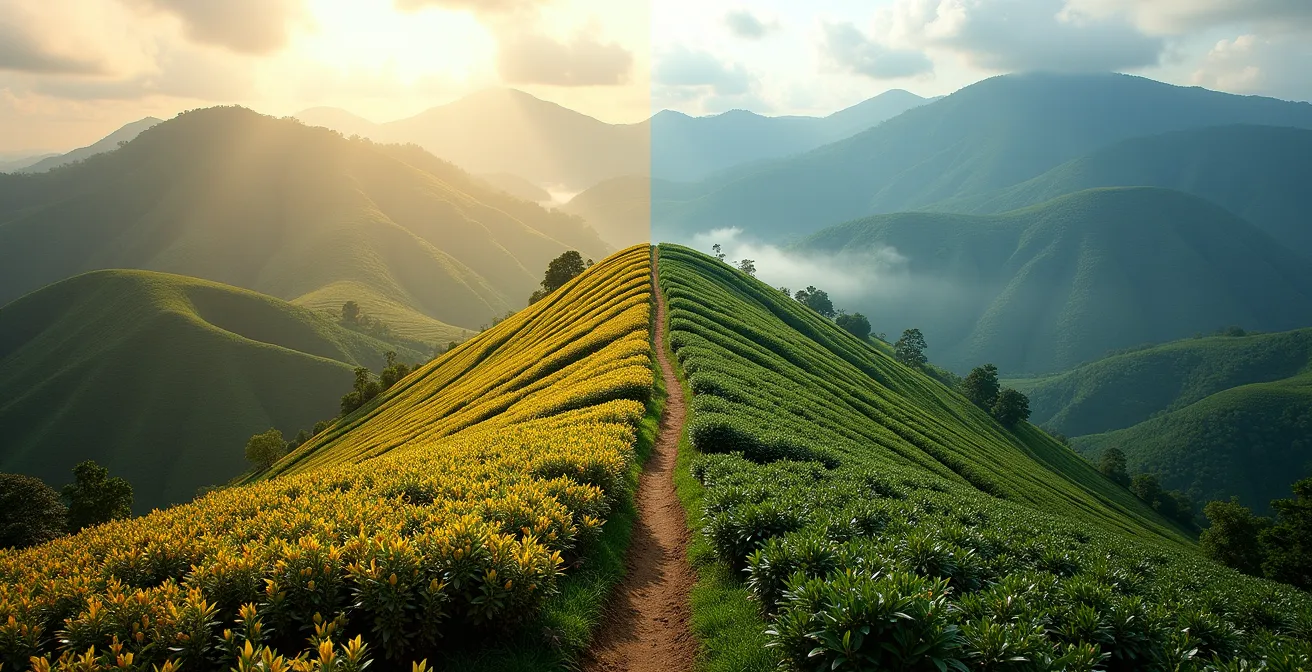
The precise and delicate climatic conditions of the Coffee Belt are both a blessing and a vulnerability. The Arabica species, which accounts for the majority of the world’s specialty coffee, is notoriously sensitive to temperature. It thrives in a narrow band of mild climates typically found at high altitudes in the tropics. This sensitivity makes coffee one of the crops most at risk from global climate change. According to a stark warning, by 2050, good coffee-growing land might shrink by half, with yields dropping approximately 15% for each 1°C temperature rise.
This isn’t a distant, abstract threat; its effects are already being felt across the globe. Rising temperatures push coffee farms to ever-higher altitudes, a strategy known as “migratory farming.” However, this is a temporary and often unsustainable solution. As farms move up, they may enter protected forest reserves, leading to deforestation. Furthermore, there is a finite amount of suitable high-altitude land available. This climatic pressure creates a slow-motion crisis for the millions of smallholder farmers whose livelihoods depend on this delicate crop.
Case Study: The Most Vulnerable Coffee Regions
The impact of climate change is not uniform across the Coffee Belt. Low-elevation regions in Brazil face temperature increases exceeding global averages, directly threatening their massive production. The famed Ethiopian highlands, the genetic birthplace of Arabica, are experiencing increasingly unpredictable rainfall patterns, disrupting flowering and harvest cycles. Meanwhile, Central American countries like Honduras and Guatemala face a double threat of rising temperatures and more frequent extreme weather events, such as hurricanes and droughts, which can wipe out an entire year’s crop and threaten the very survival of smallholder farmers who lack the capital to relocate or invest in climate-resilient farming techniques.
The future of Arabica coffee may depend on a combination of strategies: developing more heat-tolerant hybrid varietals, implementing advanced agroforestry systems to provide shade and cool microclimates, and ultimately, a global effort to mitigate the root causes of climate change. For the coffee industry, the map is being redrawn not by explorers, but by temperature.
When to Buy Kenyan Coffee: Understanding Global Harvest Calendars
The concept of “freshness” in coffee extends beyond the roast date; it begins with the harvest itself. Like any agricultural product, coffee is seasonal. The moment a coffee cherry is picked, a clock starts ticking. Over time, the unroasted green beans will slowly lose their vibrancy, and the bright, complex flavors that define a great Kenyan or Colombian coffee can fade, replaced by woody or papery notes. Therefore, for a geographer or a discerning coffee enthusiast, understanding the global harvest calendar is just as important as understanding soil types or processing methods. It adds the crucial dimension of time to the equation of flavor.
The Coffee Belt’s location straddling the equator means that harvest seasons are staggered across the globe. While countries north of the equator, like those in Central America, typically harvest from late fall through spring, countries south of the equator, like Brazil or Peru, harvest during their respective fall and winter (our spring and summer). Some equatorial countries like Colombia are unique in having two distinct harvest seasons per year. This global rhythm means that “fresh crop” coffee is always being harvested somewhere in the world.
To get the best experience from a specific origin, such as Kenya, it’s essential to align your purchasing with its harvest cycle. Kenya’s main crop is harvested from roughly October to December. Factoring in time for processing, drying, shipping, and resting, these coffees typically begin arriving at roasteries in North America and Europe around March or April. Therefore, buying a Kenyan coffee in the spring and early summer often means you are tasting it at its absolute peak of freshness and vibrancy. An informed consumer can engage with their local roaster, asking about crop age and distinguishing between the higher-quality main crop and the smaller, often lower-quality “fly crop” (or *mitaca*).
Madagascar vs Ecuador: Which Origin is Fruitier?
As the specialty coffee map expands, intriguing new origins are challenging established flavor profiles. A fascinating comparison can be made between Madagascar and Ecuador. According to a recent specialty coffee market report, “Ecuador is a rising star known for competition-winning nano-lots and high prices, while Madagascar is an undiscovered gem offering unique flavors and great value for the adventurous coffee drinker.” This contrast highlights two different paths to achieving fruitiness: one driven by intense processing innovation and the other by unique genetic heritage.
Ecuador has burst onto the specialty scene by focusing on meticulous, and often experimental, processing. Ecuadorean producers are masters of controlled fermentation techniques, such as anaerobic and carbonic maceration. By manipulating the environment in which the coffee cherry ferments, they can create intense, targeted fruit flavors that are often described as “cinna-mon,” “tropical punch,” or “stewed fruit.” This fruitiness is less a product of the land and more a result of a carefully executed, recipe-driven process. It’s a testament to human ingenuity in flavor creation.
Madagascar, on the other hand, represents a more traditional and genetically-driven source of flavor. While still a relatively unknown origin in specialty Arabica, the island is a significant producer of fine Robusta and is home to unique coffee varietals, including the naturally low-caffeine Laurina. The fruit notes found here are often more subtle and inherent to the bean itself, reflecting the island’s unique biodiversity. This table provides a clear comparison of their distinct approaches to the market and flavor production.
| Origin | Fruit Profile Source | Processing Innovation | Market Position |
|---|---|---|---|
| Madagascar | Genetic heritage (Laurina variety) | Traditional methods | Undiscovered gem, value-focused |
| Ecuador | Processing-driven intensity | Anaerobic fermentation | Rising star, premium pricing |
| Madagascar | Subtle inherent fruitiness | Fine Robusta production | Great value proposition |
| Ecuador | Intense, controlled fruitiness | Fermentation recipes | Competition-winning lots |
So which is fruitier? It depends on the definition. Ecuador offers a loud, manufactured, and often spectacular fruitiness born from process. Madagascar offers a quieter, more inherent fruitiness rooted in its unique genetics. The former is a feat of science, the latter a discovery of nature.
High-Altitude vs Low-Grown: Which Arabica is Sweeter?
Within the Coffee Belt, one of the most significant factors influencing a coffee’s final flavor profile is altitude. While high-quality coffee can be found at various elevations, a general rule holds true: higher altitude often correlates with higher quality, particularly regarding sweetness and complexity. The best Arabica coffees are typically found on farms located between 3,000 and 6,500 feet (900-2,000 meters). The reason for this is rooted in basic plant biology and the effect of a cooler environment.
At higher elevations, the cooler temperatures and reduced oxygen levels create a more challenging environment for the coffee plant. As The Roasted Record Coffee Shop explains, “Cooler temperatures mean that the beans grow more slowly, and the cherry surrounding them ripens more gradually. This extra time allows for the complex flavors to develop.” This slow maturation process is crucial. It gives the plant more time to produce and concentrate the complex sugars and acids within the coffee cherry. The result is a denser, harder bean packed with the potential for nuanced flavors—often a crisp, cane-sugar-like sweetness and a bright, vibrant acidity.
However, this doesn’t mean low-altitude coffee is inherently inferior. It simply presents a different flavor profile, often characterized by a fuller body, lower acidity, and earthy or chocolatey notes. Furthermore, skilled farmers can use processing methods to compensate for the lack of altitude-driven complexity.
Case Study: Brazilian Farmers’ Low-Altitude Sweetness Compensation
Brazil, the world’s largest coffee producer, grows the majority of its coffee at relatively low altitudes, around 4,000 feet. To achieve the sweetness demanded by the market, expert Brazilian farmers have mastered honey and natural processing methods. Unlike the washed process common at high altitudes, these methods involve leaving some or all of the sugary fruit mucilage on the bean during the drying phase. This allows the sugars from the fruit to be absorbed by the bean, dramatically boosting the perceived sweetness and body, resulting in the classic Brazilian flavor profile of chocolate, nuts, and a rich, sweet finish.
Therefore, while high-altitude Arabica tends to be inherently sweeter due to slow development, the skill of the farmer and their choice of processing method can create exceptional sweetness at lower elevations as well. Altitude sets the potential, but human expertise can shape the final result.
Key Takeaways
- The Coffee Belt’s geography is not a passive backdrop but an active force; volcanic soil provides a mineral-rich foundation for flavor development.
- Altitude acts as a natural calibrator for flavor, with higher elevations slowing maturation to create more complex sugars and acids.
- Climate change poses a direct threat to the geography of coffee, forcing production to migrate to higher, cooler altitudes and jeopardizing the future of the Arabica species.
Why Ash-Rich Volcanic Soil Creates Higher Acidity Coffee?
While we’ve established that volcanic soil in general is beneficial for coffee, the specific contribution of “ash-rich” soil to coffee’s acidity reveals a deeper layer of chemical geography. The term “ash” refers to the fine-grained particles (tephra) ejected during a volcanic eruption. This material is not burnt organic matter, but pulverized rock and volcanic glass, and its chemical composition is a key factor in creating the bright, desirable acidity found in many high-end coffees.
The primary advantage of volcanic ash is the bioavailability of its nutrients. Unlike dense, compacted soils where minerals are locked away, the fine, porous nature of ash means its chemical components are more readily accessible to a plant’s root system. A crucial element found in high concentrations in volcanic ash is phosphorus. Phosphorus plays a vital role in a plant’s energy transfer and is a key component of the metabolic processes that create organic acids within the coffee cherry, such as citric acid and malic acid. These are the same acids responsible for the tartness in a lemon or a green apple, and in coffee, they are perceived as a pleasant, sparkling acidity.
Furthermore, these ash-rich soils are often slightly acidic themselves, which further influences the uptake of certain minerals. This creates a feedback loop: the soil’s inherent properties encourage the plant to produce a cherry that reflects those same properties. When a roaster or a coffee lover describes a coffee as having a “bright, volcanic acidity,” they are not speaking metaphorically. They are tasting the direct chemical signature of the ground in which the coffee grew. It is the final, delicious proof that in coffee, geology and flavor are one and the same.
The next time you choose a coffee, look beyond the tasting notes on the bag and inquire about its origin. Understanding its place on the map—its soil, its altitude, and its climate—is the first step to truly appreciating the remarkable journey from the Earth into your cup.