
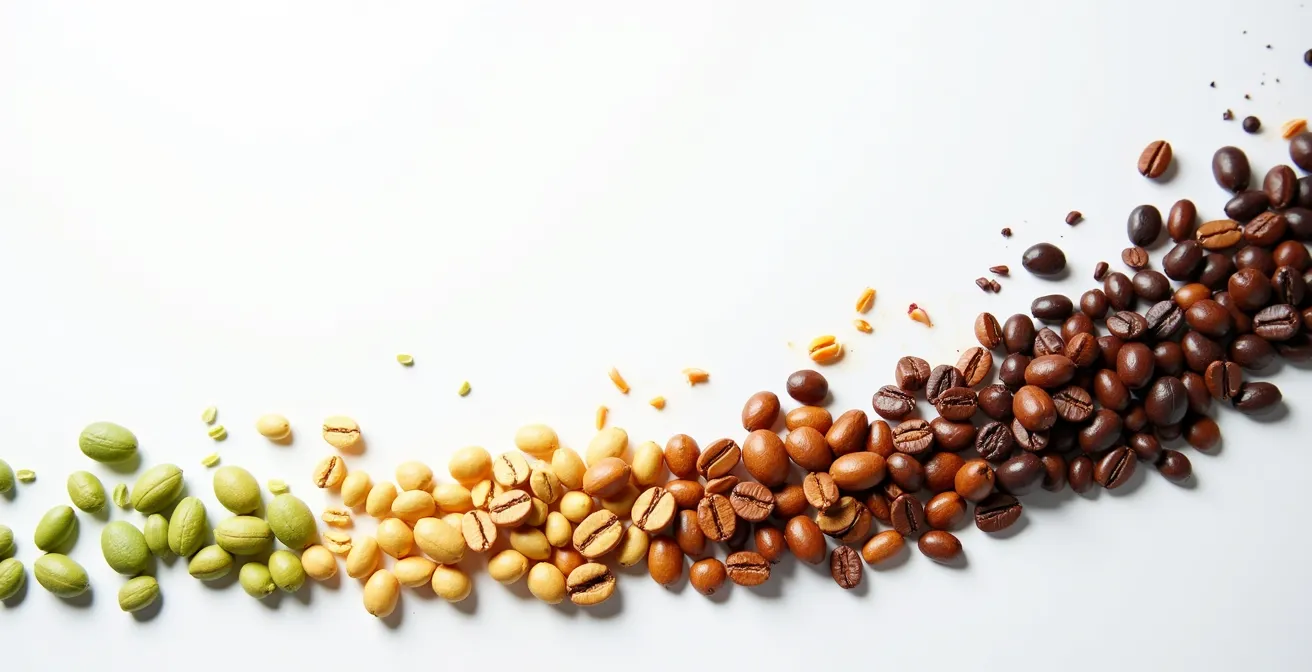
Achieving consistent caramel sweetness in your coffee roast is not an art, but a matter of precise chemical control over sugar transformation.
- Sweetness development begins with the Maillard reaction around 140°C and intensifies with caramelization above 170°C.
- Controlling the Rate of Rise (RoR) and extending the Maillard phase are critical for developing body and toffee-like flavors.
Recommendation: To maximize sweetness, focus on a steadily declining Rate of Rise after the beans turn yellow and end the roast just as the first crack finishes, before pyrolysis destroys the sugars you’ve worked to create.
For any home roaster, the quest for that perfect cup often leads to one specific, elusive goal: a deep, sugary sweetness reminiscent of caramel or toffee, achieved without adding a single grain of sugar. You follow the guides, you watch the beans turn from green to brown, yet the result can be frustratingly inconsistent. One batch is delightfully sweet, the next is flat and bready, and the one after is acrid and burnt. This inconsistency stems from a common misconception that roasting is purely an intuitive art form. While experience plays a role, the creation of sweetness is, at its core, a predictable series of chemical reactions.
Many resources will mention the Maillard reaction and caramelization, but they often stop there. They don’t explain the molecular journey of sucrose and amino acids, or how your control over time and temperature directly pilots the formation of specific flavor compounds. The real key to unlocking consistent caramel notes isn’t about having a “magic touch”; it’s about understanding the process like a food chemist. It’s about knowing precisely when reactions start, how to influence their speed, and recognizing the critical tipping point where sweetness creation turns into flavor destruction.
This guide will demystify the science of sweetness. We will break down the chemical transformations that occur inside the bean, moving from the inert green state to the complex aromatic profile of a perfect roast. We’ll explore how to manipulate the Maillard phase, identify the fine line between caramelization and pyrolysis, and understand how even the weather can impact your results. By the end, you’ll have a chemical roadmap to transform potential into predictable, delicious sweetness.
Summary: A Molecular Roadmap to Caramel Flavors in Coffee Roasting
- Why Green Beans Have No Caramel Flavor Until 170°C?
- How to Stretch the Maillard Phase to Boost Body and Sweetness?
- Caramelization vs Pyrolysis: When Does Sweet Turn to Burnt?
- The ROR Mistake That Flattens Sweetness into Breadiness
- When to End the Roast for Maximum Toffee Notes?
- The Weather Mistake That Ruins Sugar Work
- Why Longer Roasting Destroys Floral Aromas in Coffee?
- Light vs Dark Roast: Which Bean Retains More Caffeine?
Why Green Beans Have No Caramel Flavor Until 170°C?
A raw, green coffee bean is essentially a storage vessel of potential. It contains the necessary precursors for flavor—sugars (primarily sucrose), amino acids, and lipids—but they exist in a chemically inert state. Chewing on a green bean reveals a grassy, astringent taste with no hint of the rich caramel notes to come. This is because the flavor-creating reactions are triggered by heat, and they occur in a specific, sequential order. The journey begins with the Maillard reaction, a non-enzymatic browning process involving amino acids and reducing sugars. This reaction is what gives bread its crust and steak its savory flavor, and in coffee, it’s responsible for a huge range of aromatic compounds. The Maillard reaction becomes significant once the bean temperature climbs past 140°C (280°F), initiating the “yellowing” phase of the roast.
However, the Maillard reaction primarily creates savory, nutty, and malty notes, forming complex polymers called melanoidins that contribute to the coffee’s body and color. True caramel flavor requires a different, more intense reaction: caramelization. Caramelization is the thermal decomposition of sugar itself, a process that doesn’t involve amino acids. This reaction requires a higher activation energy, only kicking in significantly when the bean’s internal temperature reaches a critical threshold. Research on coffee roasting chemistry confirms that sugars begin to properly caramelize when the beans are heated to about 170°C (338°F), where sugars start to caramelise. At this point, the simple sucrose molecules break down and reform into hundreds of new compounds, including the highly desirable furans that we perceive as caramel, toffee, and buttery notes.
Therefore, a roast that doesn’t reach this 170°C threshold will lack true caramel sweetness. It might have some malty sweetness from the Maillard reaction, but it will miss the deeper, more complex sugar-browning flavors. This temperature is the gateway from simple browning to complex sweetness creation.
How to Stretch the Maillard Phase to Boost Body and Sweetness?
The Maillard reaction is not a single event but a complex cascade of reactions that unfolds over time and temperature. While it starts around 140°C, its most productive phase for flavor development in coffee occurs within a specific window. The critical temperature range for the Maillard reaction to create the desirable melanoidins that contribute to body and sweetness is between 140°C and 200°C (284°F to 392°F). Manipulating the amount of time the beans spend in this phase is one of the most powerful tools a roaster has to influence the final cup profile. A longer, more gradual journey through this window allows for a more thorough conversion of precursors into complex flavor compounds, resulting in a cup with a heavier body and deeper, more integrated sweetness.
This concept of “stretching” the Maillard phase is a deliberate strategy. A rapid roast that blasts through this temperature range will curtail the reaction, often leading to a thin-bodied coffee that lacks complexity. To extend it, a roaster must carefully manage heat application, ensuring the beans’ temperature rises steadily but not too quickly. The choice of roasting equipment itself has a profound impact on this process, as different methods of heat transfer create different conditions for the Maillard reaction to unfold.
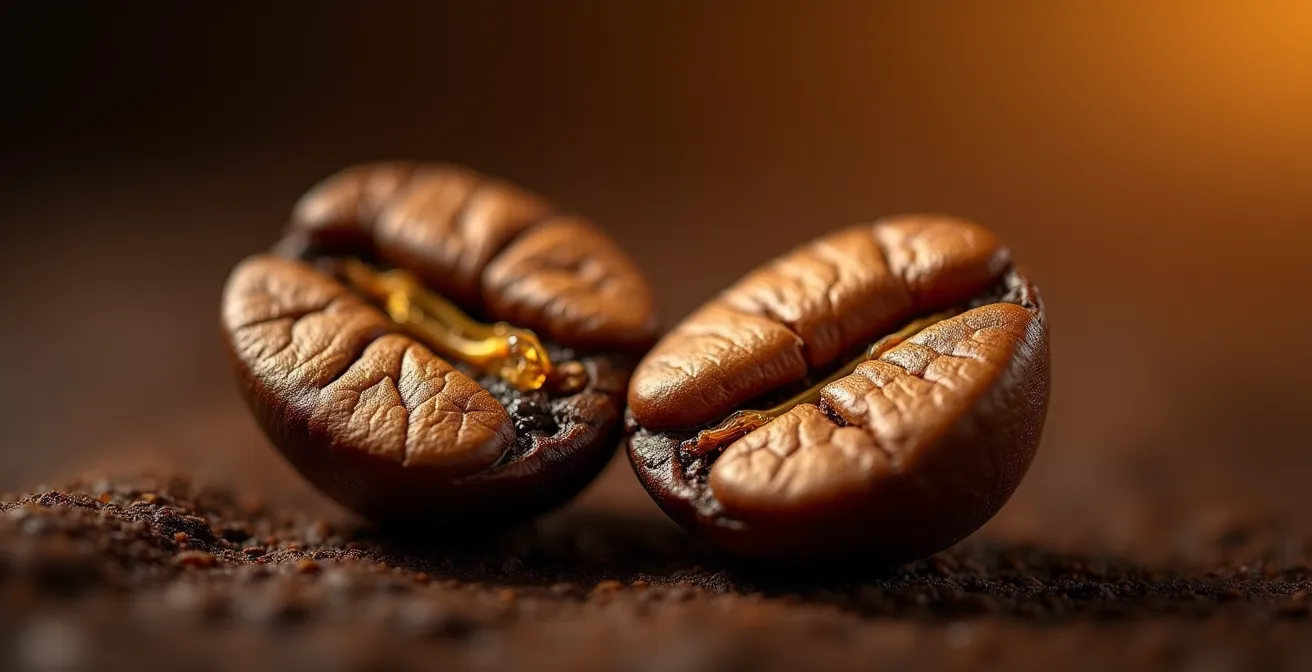
As the illustration shows, heat penetrates the bean from the outside in. Roasting methods that provide slower, more conductive heat transfer, such as a traditional drum roaster, are naturally inclined to lengthen the Maillard phase. This leads to more profound caramelization and heavier-bodied coffees with classic notes of chocolate and nuts. In contrast, fluid-bed (air) roasters use convective heat, creating a shorter, more intense Maillard window. This method tends to preserve acidity and highlight brighter, more delicate floral and fruit notes. Neither approach is inherently superior, but understanding how your equipment influences reaction time is key to achieving your target flavor profile.
Caramelization vs Pyrolysis: When Does Sweet Turn to Burnt?
As the roast progresses past the Maillard phase and deep into caramelization, the roaster walks a fine line. On one side lies the peak of sweetness, where sugar browning creates a rich tapestry of toffee, caramel, and butterscotch notes. On the other side lies pyrolysis, a chemical cliff where those carefully crafted flavors are rapidly destroyed and replaced by bitterness and char. Pyrolysis is the thermal decomposition of organic material at elevated temperatures, and in coffee, it signifies the point of no return. It’s when you are no longer developing flavor, but incinerating it. The most universally recognized indicator of peak caramelization is the “first crack,” an audible popping sound as water vapor and carbon dioxide forcefully escape the bean. This event signals that the bean’s internal structure is changing dramatically.
The first crack typically occurs when the bean’s internal temperature reaches approximately 385-390°F (196-199°C). The time between the start and end of the first crack is a critical development phase where sweetness is at its maximum potential. Pushing the roast beyond the end of the first crack means you are deliberately heading toward pyrolysis. The “second crack,” which is a quieter, more rapid crackling sound, is the definitive announcement that pyrolytic reactions are now dominant. Sugars are being carbonized, oils are migrating to the surface, and the flavor profile shifts from sweet and complex to thin, roasty, and eventually, burnt. For a home roaster, learning to identify the sensory cues that signal the transition from caramelization to pyrolysis is the most crucial skill for preserving sweetness.
Checklist: Identifying the Onset of Pyrolysis
- Monitor for a “second crack”: Listen for a sound shift from the loud popping of the first crack to a more subtle, rapid crackling, similar to oil in a hot pan.
- Watch for smoke color change: The initial white/gray steam from water evaporation will shift to a more pungent, blue-gray smoke, indicating that organic matter is beginning to burn.
- Note the aromatic shift: The aroma in the room will change from a sweet, bready, or caramel-like scent to a sharp, acrid, and unmistakably “burnt sugar” smell.
- Observe the bean surface: Look for the rapid migration of oils to the surface of the beans, which will appear increasingly shiny or even wet. Dark, carbon-like spotting may also become prominent.
- Track the temperature: Be vigilant as the temperature rises above 225-230°C (437-446°F), as this is the zone where pyrolytic reactions accelerate dramatically.
The ROR Mistake That Flattens Sweetness into Breadiness
Beyond absolute temperature, the *speed* at which a bean’s temperature increases is a critical variable that professional roasters obsess over. This is known as the Rate of Rise (RoR), typically measured in degrees per minute. A common mistake among home roasters is to focus solely on hitting target temperatures, ignoring the journey between them. An improperly managed RoR can sabotage sweetness development, even if the final temperature is perfect. One of the most common flavor defects is a “bready” or “papery” taste, which is often the result of a “stalled” or “baked” roast. This occurs when the RoR flatlines or crashes, particularly during the crucial Maillard reaction phase. When the temperature progression stalls, the chemical reactions lose momentum, failing to develop the complex sugars and melanoidins needed for a rich flavor profile.
To avoid this, professional roasters aim to maintain a steadily declining RoR curve throughout the roast. The roast should start with a high RoR to power through the initial drying phase, and then the heat should be gradually reduced to allow the RoR to decrease smoothly. This controlled decline ensures the chemical reactions proceed at an optimal, consistent pace, fully developing the bean’s potential without scorching the exterior or leaving the interior underdeveloped. A crashing RoR is like taking your foot off the gas pedal on a steep hill—you lose all momentum. A flicking RoR, where it goes up and down, disrupts the delicate sequence of reactions. The goal is a smooth, controlled descent.
As the roasting experts at General Warfield’s Coffee note, this control is fundamental to achieving complexity:
Professional roasters also monitor Rate of Rise (RoR) — the speed at which bean temperature increases over time. A steadily declining RoR ensures the Maillard reaction unfolds gradually, preventing flavor ‘stalling’ or scorching. Flat or inconsistent curves during this stage can produce dull, papery flavors instead of sweetness and complexity.
– General Warfield’s Coffee Roasting Team, The Maillard Reaction and the Art of Coffee Roasting
For a home roaster, tracking RoR (even with a simple stopwatch and thermometer) can be the single biggest step-up from novice to advanced roasting. It shifts the focus from simply “cooking” the beans to actively directing their chemical transformation.
When to End the Roast for Maximum Toffee Notes?
Pinpointing the exact moment to end a roast is where science meets sensory skill. The goal is to drop the beans from the roaster when the specific flavor compounds you desire are at their peak concentration, just before they begin to degrade. For those chasing rich toffee and caramel notes, the key chemical players are a class of volatile compounds called furanones, with sotolon being a prominent example. These compounds are generated during the later stages of the Maillard reaction and the early stages of caramelization. Research indicates that many furans responsible for imparting sweet, caramel-like notes are produced as the temperature rises past 150°C (302°F) and continue to develop through the first crack.
This creates a clear trade-off for the roaster. If you end the roast too early, say, just as the beans start to brown, you won’t have generated a sufficient concentration of these furanones, and the coffee may taste more bready or nutty. If you push the roast too far past the first crack, these same desirable compounds begin to break down under the intense heat of pyrolysis, and their sweet character is replaced by roasty, smoky, and bitter notes. The sweet spot, therefore, lies in a narrow window: the period from the middle of the first crack to its immediate conclusion. Dropping the beans within this “development time” allows you to capture the peak of caramelization without venturing into pyrolytic territory.
The final roast temperature and the duration of this development phase directly correlate with the balance of flavors. As a general rule, a shorter development time and a lower final temperature (e.g., dropping the beans just as the first crack is ending) will favor the expression of the coffee’s inherent sweetness and acidity. Conversely, extending the development time and pushing to a higher final temperature will diminish acidity and build more caramelized or roasted character. For maximum toffee notes, the goal is to hit that perfect balance right at the end of the first crack, capturing the sweetness before it begins to wane.
The Weather Mistake That Ruins Sugar Work
A common frustration for home roasters is a lack of consistency from one batch to the next, even when following the exact same roast profile. Often, the culprit is not within the roaster itself, but in the surrounding air. The ambient environment—specifically temperature, humidity, and barometric pressure—has a significant and often underestimated impact on heat transfer and reaction kinetics during a roast. Ignoring these variables is a critical mistake that can completely derail your attempts at precise sugar development. For instance, roasting on a cold, dry winter day is chemically different from roasting on a hot, humid summer day.
High ambient humidity is one of the most impactful factors. The air entering the roaster is already laden with moisture, which means more energy and time are required to complete the initial “drying phase” of the roast. This can prolong the entire roast, potentially “baking” the beans and flattening the flavor profile if heat application isn’t adjusted accordingly. Conversely, low barometric pressure (often associated with high altitudes or approaching storms) can cause the first crack to occur at a lower temperature than expected, tricking a roaster into ending the development phase too early. A cold roastery will also cause greater heat loss from the drum, requiring higher gas or power settings to maintain the desired Rate of Rise.
An expert roaster acts like a pilot, constantly making micro-adjustments based on external conditions. To achieve consistent results, it’s crucial to be aware of your roasting environment and compensate for its effects. The following table outlines the key adjustments needed for common environmental conditions, based on principles of roasting science.
| Environmental Factor | Effect on Roasting | Adjustment Needed |
|---|---|---|
| High Humidity | Prolongs drying phase | Increase initial heat input |
| Low Barometric Pressure | First crack at lower temperature | Extend development time |
| Cold Ambient Temperature | Increased heat loss | Higher gas/power settings |
Why Longer Roasting Destroys Floral Aromas in Coffee?
The development of sweetness through roasting is not a process of pure creation; it is also a process of transformation and, inevitably, destruction. As you push a roast longer and hotter to build deep caramel and chocolate notes, you are simultaneously breaking down other, more delicate flavor compounds. The most notable casualties are the volatile organic compounds responsible for a coffee’s bright, floral, and fruity aromas. These compounds, which include various esters and aldehydes, are what give high-quality light roasts their vibrant and complex aromatic profiles, with notes of jasmine, citrus, or berry.
These delicate compounds are formed early in the roast and are highly volatile, meaning they evaporate or decompose easily with sustained heat. Research on the evolution of volatile compounds during roasting demonstrates that many desirable floral esters peak in concentration early in the development phase and then plummet as the roast continues toward and beyond the first crack. The same heat that masterfully caramelizes sugars is a blunt instrument that shatters these fragile aromatic molecules. This is the fundamental trade-off in coffee roasting: you cannot simultaneously maximize bright, floral acidity and deep, roasty sweetness in the same bean.
This is why roast levels are associated with such distinct flavor profiles. Light roasts (e.g., Cinnamon Roast) are dropped early, undergoing less caramelization but preserving maximum flavor clarity, sweetness, and acidity. Medium roasts (e.g., City Roast) represent a balance, having developed moderate caramelization while retaining some of the bean’s original character. Dark roasts (e.g., French or Italian Roast) are taken deep into or past the second crack. They undergo extensive caramelization and pyrolysis, resulting in low acidity and a flavor profile dominated by roasty, smoky, and bittersweet notes, with nearly all of the original floral and fruit compounds having been destroyed.
Key Takeaways
- Caramel sweetness is a result of specific chemical reactions (Maillard and caramelization) that require temperatures above 170°C.
- Controlling the Rate of Rise (RoR) to ensure a steady, declining curve is crucial for avoiding “baked” flavors and developing full-bodied sweetness.
- The line between peak sweetness (caramelization) and bitterness (pyrolysis) is thin; ending the roast just after the first crack is key to preserving sugars.
Light vs Dark Roast: Which Bean Retains More Caffeine?
One of the most persistent debates among coffee drinkers revolves around caffeine content: does a light roast or a dark roast pack a bigger punch? The common wisdom often suggests that the bold, strong flavor of a dark roast must equate to higher caffeine. From a chemical standpoint, however, the opposite is closer to the truth. Caffeine is a relatively stable alkaloid, but it does degrade slightly under the prolonged, intense heat of a dark roast. As beans are roasted longer and hotter, they lose mass through the evaporation of water and the burning of organic matter. Since caffeine contributes to this mass loss, darker roasts physically contain less caffeine per bean than lighter roasts.
However, the most accurate answer is more nuanced and points to a happy medium. A groundbreaking 2024 study has provided one of the most definitive answers to date. The research found that the maximum caffeine level was found in medium-roasted coffee that had experienced about 14-16% mass loss. The study tested 30 different combinations of roast level, coffee variety, and brew method, consistently finding that light and medium roasts yielded higher caffeine concentrations than dark roasts when brewed under identical conditions. The reason for the medium roast peak is a fascinating balance of chemistry and physics. While ultra-light roasts have the most caffeine locked inside the bean, their greater density makes that caffeine harder to extract during brewing. A medium roast offers the best of both worlds: high caffeine retention and sufficient porosity for efficient extraction.
The lead researcher of the study, Zachary Lindsey, elegantly summarizes this complex interplay:
Our results show that coffee loses caffeine during the later stages of roasting. While an ultra-light roast may have the most caffeine packed into the roasted coffee seeds, the low porosity makes it much more difficult to extract that caffeine into your cup. If it’s caffeine that you want, our data suggest that a medium roast is generally a solid choice.
– Zachary Lindsey, Berry College Assistant Professor of Physics
So, if your primary goal is maximizing caffeine intake, science suggests skipping the oily, dark beans and reaching for a well-balanced medium roast.
Now that you are armed with a chemical understanding of sweetness, the next step is to apply it. Approach your next roast not just as a cook, but as a chemist. Track your temperatures, monitor your Rate of Rise, and use your senses to pinpoint those critical transition moments. Start experimenting with a well-balanced medium roast profile to master the fundamentals of sugar development.