
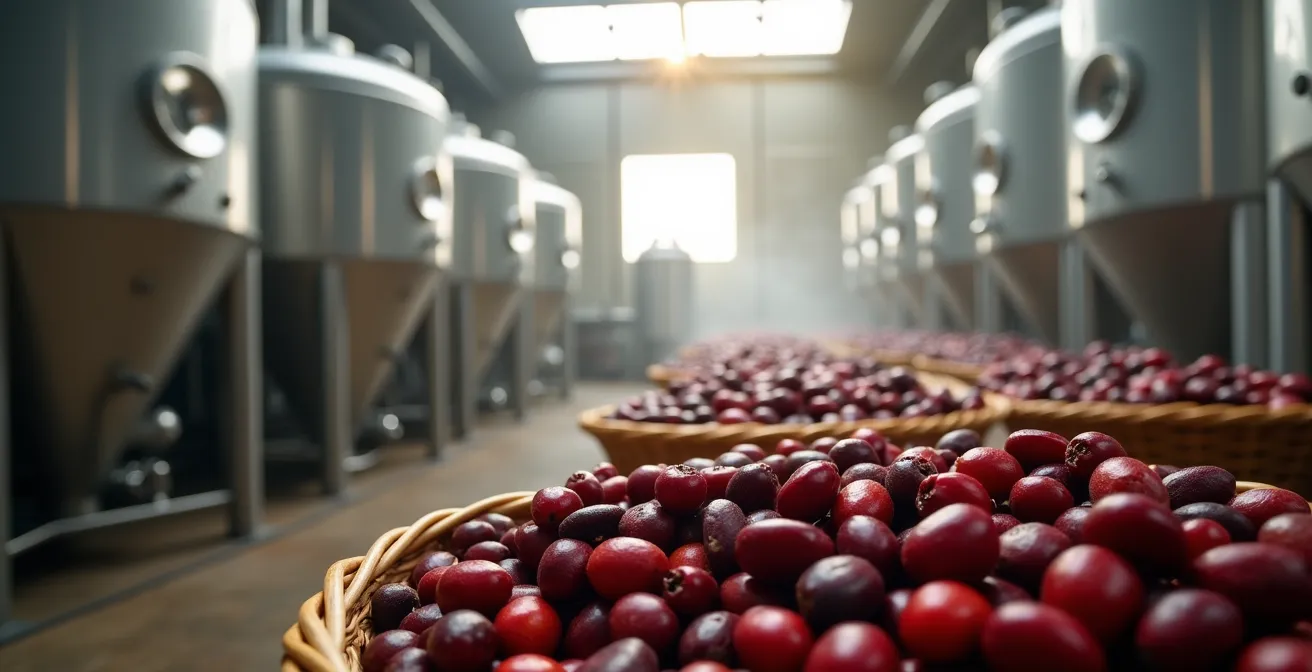
Anaerobic coffee’s “funky” taste isn’t a flavor; it’s the audible signature of a controlled biochemical reaction turning each bean into a miniature bioreactor.
- The process fundamentally alters the bean’s cellular structure, making it more porous and soluble, which demands a different brewing approach.
- Sealed tanks force microbes into metabolic stress, creating complex acids and wine-like aromatic compounds not found in traditional coffee.
Recommendation: Treat it like a science experiment. Adjust your grind coarser, control your water temperature precisely, and serve it intentionally to unlock its complex chemistry.
You take a sip of your morning coffee, expecting the familiar, comforting notes of chocolate or nuts. Instead, your palate is hit with a wave of something entirely unexpected: the tartness of red wine, the funk of rum, the sweetness of overripe strawberries. For a traditional coffee drinker, this moment is jarring. It can feel like a mistake, a flaw in the bean. But what you’re experiencing is not a defect; it’s the frontier of coffee processing, a deliberate and scientific manipulation of fermentation known as the anaerobic method.
Most guides will tell you this coffee is “fruity” or “boozy,” treating these radical flavors as simple descriptors. But this approach misses the point. As a fermentation scientist, I see coffee not just as a beverage, but as a biological medium. The “funk” you taste is the direct result of a controlled biochemical pathway, a series of chemical reactions forced upon the coffee cherry in an oxygen-deprived environment. We are not just brewing coffee; we are tasting the metabolic output of microorganisms under stress.
This guide will demystify that “wine-like” taste by treating the coffee bean as what it is: a miniature fermentation lab. We will decode the science behind the sealed tanks, explore how it changes the bean’s physical structure, and learn how to properly extract these volatile, complex compounds. This is for the coffee drinker who was shocked by the funk but is curious enough to understand the science behind it.
To fully grasp this new world of flavor, we’ll break down the entire process, from the chemistry in the tank to the final pour. This guide provides a complete map of the anaerobic coffee experience.
Summary: A Scientist’s Guide to Anaerobic Coffee Flavors
- Why Sealed Tanks Create Lactic Acid Notes in Coffee?
- How to Adjust Grind Size for Highly Soluble Anaerobic Beans?
- Carbonic Maceration vs Natural Process: Which is Funkier?
- The “Rotten Fruit” Taste: Is It Ferment or Defect?
- When to Serve Anaerobic Coffee: Brunch or Dessert?
- Why Green Beans Have No Caramel Flavor Until 170°C?
- Why High Acidity Coffees Taste Sour When Brewed Too Cool?
- Light vs Dark Roast: Which Bean Retains More Caffeine?
Why Sealed Tanks Create Lactic Acid Notes in Coffee?
The defining characteristic of anaerobic processing is the sealed, oxygen-free tank. This is more than just a container; it’s a controlled bioreactor. In a traditional open-air fermentation, microbes have access to oxygen and follow predictable metabolic pathways. In a sealed tank, you induce metabolic stress. The native yeasts and bacteria on the coffee cherry are forced to switch from aerobic (oxygen-using) respiration to anaerobic fermentation to survive.
This biochemical pivot is what creates the “wine-like” flavors. Instead of producing simple acids, the microbes begin generating a host of different compounds, including lactic acid, which imparts a creamy mouthfeel and tangy, yogurt-like notes. Other volatile aromatic compounds, such as esters, are also produced, contributing to flavors of tropical fruit, cinnamon, and rum. The sealed environment also traps CO2, increasing pressure and further altering the chemical reactions and how these new flavor compounds infuse the bean.
Case Study: Diego Samuel’s Double Fermentation
Pioneering producer Diego Samuel’s coffee exemplifies this process. His beans undergo a double fermentation—first with the cherry intact, and then again after de-pulping. This process can last from 12 hours up to a week in sealed tanks. The result is a green bean that smells exceptionally fruity and fragrant, a world away from the grassy, hay-like aroma of traditionally processed green coffee. This is the sensory evidence of a profound chemical transformation occurring within the bean itself.
Essentially, the sealed tank isn’t just removing oxygen; it’s creating an extreme environment that forces the development of an entirely new, more complex flavor profile. It’s a deliberate, scientific manipulation to push the boundaries of what coffee can taste like.
How to Adjust Grind Size for Highly Soluble Anaerobic Beans?
If you’ve tried brewing an anaerobic coffee with your standard grind setting, you likely ended up with a cup that was either aggressively bitter or confusingly “boozy.” This is because the intense fermentation process doesn’t just create new flavors; it fundamentally alters the physical structure of the bean. The extended fermentation breaks down complex carbohydrates and pectins in the bean’s cell walls, making it more porous and brittle than a conventional bean.
This increased porosity means the bean is highly soluble. Water penetrates the coffee grounds much more quickly and extracts flavor compounds at an accelerated rate. Using a grind size that works for a washed coffee will lead to massive over-extraction with an anaerobic bean, pulling out harsh, astringent, and unpleasantly alcoholic notes. The key is to compensate for this high solubility by significantly coarsening your grind.
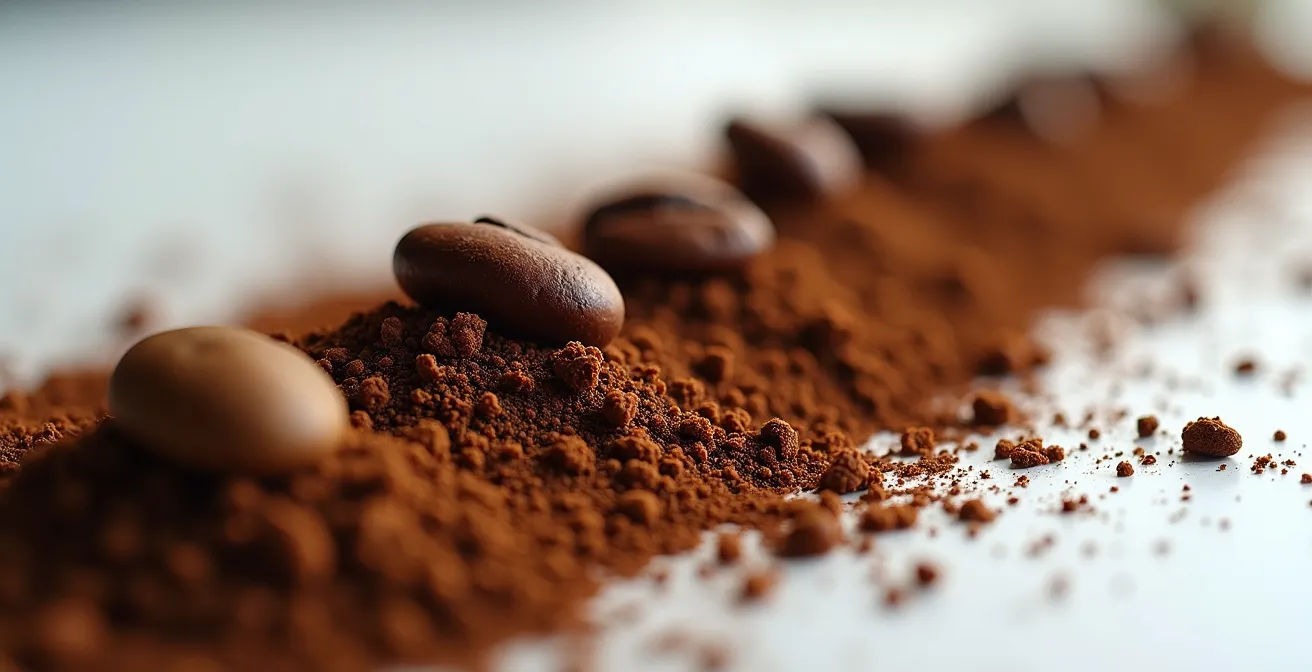
As the macro photograph shows, the texture of the grounds is visibly different. The anaerobic grounds appear less dense and more fractured, a direct visual cue of their altered cellular structure. This is why a simple adjustment in grind size is the most critical variable to control when brewing these coffees.
Your Action Plan: Grind Adjustment Protocol for Anaerobic Beans
- Start with a grind setting 2-3 clicks coarser than your usual setting for conventional coffee.
- Brew a test cup and taste for boozy or astringent notes. If they are present, you are still extracting too much; go even coarser.
- For pour-over methods like a V60, you may need to adjust finer than expected to compensate for the very fast flow rate, but your starting point should still be coarse.
- For immersion methods like French Press or AeroPress, use a very coarse grind to prevent the brew from becoming muddy and over-extracted during the steep time.
- Document your settings for each specific coffee. Anaerobic beans vary significantly from lot to lot, and what works for one may not work for another.
Carbonic Maceration vs Natural Process: Which is Funkier?
Within the world of “funky” coffees, the terms can get confusing. While both carbonic maceration and natural process coffees are known for their fruit-forward profiles, the type of “funk” they produce is chemically and sensorially distinct. The key difference, as noted by expert Neel Vohora, lies in the state of the cherry: in carbonic maceration, the cherry is left intact, not pulped, before entering the sealed tank. This leads to a unique phenomenon.
The main thing that differentiates anaerobic coffee fermentation from carbonic maceration of coffee is that in carbonic maceration the cherry is left intact, and not pulped prior to entering a sealed tank.
– Neel Vohora, Daily Coffee News Guide to Carbonic Maceration
This seemingly small detail triggers intracellular fermentation. The CO2-rich environment causes fermentation to begin *inside* each individual coffee cherry cell, without the influence of external yeasts and bacteria. A natural process, by contrast, involves drying the whole cherry in the open air, where fermentation is driven by the microbes on the fruit’s exterior. This leads to very different flavor outcomes.
| Characteristic | Carbonic Maceration | Natural Process |
|---|---|---|
| Fermentation Type | Intracellular fermentation | External fermentation |
| Funk Profile | Aromatic-spicy funk (bubble gum, red fruits, cinnamon) | Fruit-compote or overripe fruit funk |
| Control Level | Highly controlled, predictable | Wild, subject to ambient conditions |
| Flavor Consistency | Clean, specific funky profile | Wider, unpredictable spectrum |
| Processing Time | Days to weeks in sealed tanks | 2-4 weeks drying with fruit |
So, which is “funkier”? It depends on your definition. The natural process offers a wild, unpredictable, and often intensely jammy or overripe fruit funk. Carbonic maceration, however, delivers a more refined, aromatic, and spicy funk—think bubble gum, cinnamon, and bright red fruits. It’s less of a “barnyard” funk and more of a clean, complex, and wine-like aromatic profile.
The “Rotten Fruit” Taste: Is It Ferment or Defect?
For a traditional coffee drinker, the line between an exciting new flavor and a clear defect can be blurry. That note of “fermented strawberry” can easily be perceived as “rotting strawberry.” This is where the science of control becomes paramount. The difference between a prized, complex anaerobic coffee and a faulty, over-fermented one is the difference between a masterfully guided biochemical reaction and a runaway chemical accident.
A skilled producer using anaerobic methods is not just letting coffee ferment; they are orchestrating a process. They control temperature, pH, and time to promote the growth of specific microbes that produce desirable compounds, while inhibiting those that create off-flavors. When this control is lost—if fermentation goes on too long, at the wrong temperature, or with the wrong microbes taking over—the result is a defect. The desirable esters and complex acids are replaced by sharp, unpleasant compounds.
The experts at Coffee Review provide a clear sensory guide to distinguish between these two outcomes. The language they use highlights the fine line between complexity and spoilage.
Intentional Ferment creates complex notes of aged rum, brandied cherries, rich molasses, with a pleasant, lingering sweetness, while Defect from over-fermentation produces sharp vinegar or acetic notes, compost, onion/garlic, or moldy/phenolic medicinal notes.
– Coffee Review Team, Coffee Review Processing Experiments Report
So, if your coffee tastes like a fine aged rum or a rich cherry liqueur, you are tasting intentional, controlled fermentation. If it tastes of sharp vinegar, compost, or has a medicinal quality, you are tasting a defect. The “rotten fruit” taste is a sign that the process went wrong, and the flavor reactions were not halted at the optimal moment. A truly well-executed anaerobic coffee should be complex and wild, but never unpleasant or spoiled.
When to Serve Anaerobic Coffee: Brunch or Dessert?
The radical flavor profile of anaerobic coffee challenges not just our palate, but also our rituals. A coffee that tastes of wine, rum, and tropical fruit doesn’t necessarily fit into the “cup to wake up” morning routine. Its intensity and complexity demand a different context, a moment of focused tasting rather than mindless consumption. Serving this type of coffee is less about providing a caffeine kick and more about presenting a unique sensory experience.
This shifts the ideal serving time away from the traditional breakfast or brunch slot and towards moments usually reserved for a digestif or a dessert wine. The rich, boozy, and sweet notes are perfectly suited to be an after-dinner palate cleanser or a standalone “dessert in a cup.” The context of the serving can dramatically change the perception of the flavor.
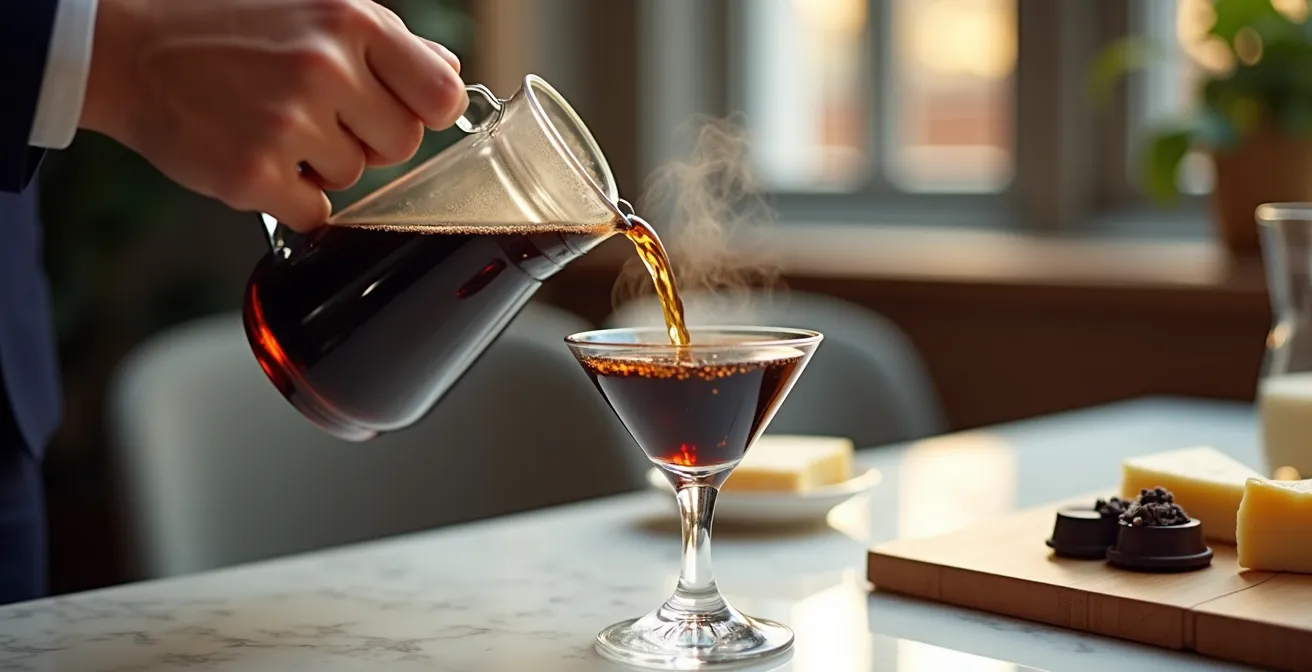
The practice of serving these coffees in wine glasses is not just for show; it’s functional. The shape of the glass helps to concentrate the volatile aromatic compounds, enhancing the complex bouquet before you even take a sip, much like with a fine wine or spirit. This ritual signals to the drinker that they are about to experience something special and worthy of attention.
Case Study: Saša Šestić’s Championship Service
In 2015, Australian barista Saša Šestić won the World Barista Championship with a carbonic maceration coffee. His winning move was not just the quality of the coffee, but how he presented it. He served it at a controlled temperature of 60-70°C in wine glasses to focus the judges’ attention on the sparkling citric acidity and big stone fruit flavors. He explicitly positioned the coffee as a digestif-style experience, fundamentally changing the context and leading him to victory.
Why Green Beans Have No Caramel Flavor Until 170°C?
This question gets to the heart of coffee roasting chemistry. The flavors of caramel, toast, and nuts that we associate with coffee are not present in the green bean. They are created during the roast through two key chemical reactions: the Maillard reaction and caramelization. Both of these processes require one crucial ingredient: sugar. The roaster’s job is to apply heat (starting around 170°C or 340°F) to transform the bean’s natural sugars into these complex and beloved flavor compounds.
However, anaerobic processing introduces a significant complication. The extended fermentation that creates the unique fruity and boozy notes does so by consuming the very sugars the roaster needs. The microbes use the sugars in the coffee mucilage as fuel for their metabolic processes. Recent research confirms this phenomenon, showing that glucose consumption reaches significant levels after 48 hours of anaerobic fermentation.
This creates what one expert calls a “sugar debt.” The bean arrives at the roastery with less available sugar to power the Maillard and caramelization reactions. This presents a major challenge for the roaster, who must carefully manage the roast to develop flavor without scorching a bean that has less fuel to work with.
The fermentation process consumes some of the bean’s natural sugars. This ‘sugar debt’ impacts the roaster’s strategy – they must carefully manage the roast to achieve development without scorching the bean, as there is less sugar available for caramelization.
– Dr. Taya Brown, Cafe Imports Research on Fermentation
This is why you’ll rarely find a dark-roasted anaerobic coffee. A dark roast profile relies heavily on sugar caramelization. With less sugar available, roasters must use a lighter touch, focusing on highlighting the unique aromatic compounds created during fermentation rather than creating traditional roast flavors. The “wine-like” notes are the star of the show, not a caramel finish.
Why High Acidity Coffees Taste Sour When Brewed Too Cool?
The conventional wisdom in coffee brewing is that sourness is a sign of under-extraction, typically caused by water that is too cool. For most coffees, this holds true: hotter water is needed to properly extract the sugars and oils that balance the natural acids. However, with intensely fermented anaerobic coffees, this simple rule can be misleading. The “sourness” you might perceive can actually be a sign of over-extracting the wrong compounds, even with cooler water.
Anaerobic coffees are packed with a higher concentration of unique, volatile acids and esters created during fermentation. These compounds are often more soluble and delicate than the acids found in a typical washed coffee. While you still need sufficient heat for a balanced extraction, the margin for error is much smaller. A key finding from research is that brewing these coffees with water that is *too hot* (above 92°C or 198°F) can be the real culprit.
Extremely hot water can aggressively strip the most intense and volatile ferment compounds from the grounds, leading to an unpleasantly “boozy” or “vinegary” taste. A drinker unaccustomed to these flavors might simply label this sensation as “sour,” leading them to the incorrect conclusion that they need to increase their brew temperature, which would only make the problem worse. The challenge with anaerobic coffees is not just extracting enough, but extracting the *right things* in the right proportions. It’s a quest for a balanced extraction of an unbalanced bean.
The goal is to find the sweet spot—a temperature hot enough to extract the desired sweetness and complexity, but not so hot that it over-extracts the harsh, alcoholic notes. This often means starting your brew temperature a few degrees cooler than you would for a conventional coffee and adjusting from there.
Key Takeaways
- Anaerobic processing is a controlled chemical reaction driven by metabolic stress, not just a simple flavor-adding technique.
- The fermentation physically alters the bean’s cellular structure, making it more soluble and requiring a coarser grind and precise temperature control.
- The line between a complex, intentional “ferment” flavor (like aged rum) and an unpleasant “defect” (like vinegar) is defined by the producer’s level of control.
Light vs Dark Roast: Which Bean Retains More Caffeine?
One of the most persistent myths in coffee is the relationship between roast level and caffeine. Many believe that dark roasts have more caffeine for a stronger “kick,” while others swear that light roasts retain more of the original caffeine content. From a chemical standpoint, the answer is surprisingly simple: the roast level has an almost negligible effect on the total amount of caffeine in a bean.
Caffeine is an extremely stable alkaloid. The temperatures used in coffee roasting, even for the darkest roasts, are not high enough to significantly destroy it. A green bean and a dark, oily bean from the same batch have, for all practical purposes, the same amount of caffeine. The confusion arises not from chemistry, but from measurement.
Caffeine is extremely stable at roasting temperatures. The difference is in measurement: measured by weight, a light roast has slightly more caffeine because it’s denser. Measured by volume, a dark roast has slightly more because the beans are larger and less dense.
– CoffeeGeek Research Team, CoffeeGeek Caffeine Analysis
As beans are roasted, they lose water and expand. A light roast bean is smaller and denser; a dark roast bean is larger, less dense, and has lost more mass (water). So, if you measure your coffee by weight (e.g., 20 grams), the light roast will have slightly more caffeine because you’re using more individual beans. If you measure by volume (e.g., one scoop), the dark roast will have slightly more caffeine because the beans are larger and take up more space. This difference, however, is minimal.
The single biggest factor determining caffeine content is not the roast, but the type of coffee bean itself. For example, comprehensive studies have established that Arabica beans contain 34.1-38.5g of caffeine per kg, while Robusta contains 68.6-81.6g per kg. Switching from Arabica to Robusta will double your caffeine intake, a far more significant change than switching from a light to a dark roast.
Ultimately, the choice between light and dark roast should be based on flavor preference, not a misguided quest for more caffeine. Armed with this knowledge, you can approach your next cup of anaerobic coffee not as a consumer, but as an informed explorer, ready to discover the complex and fascinating world of flavor hidden within the bean.