
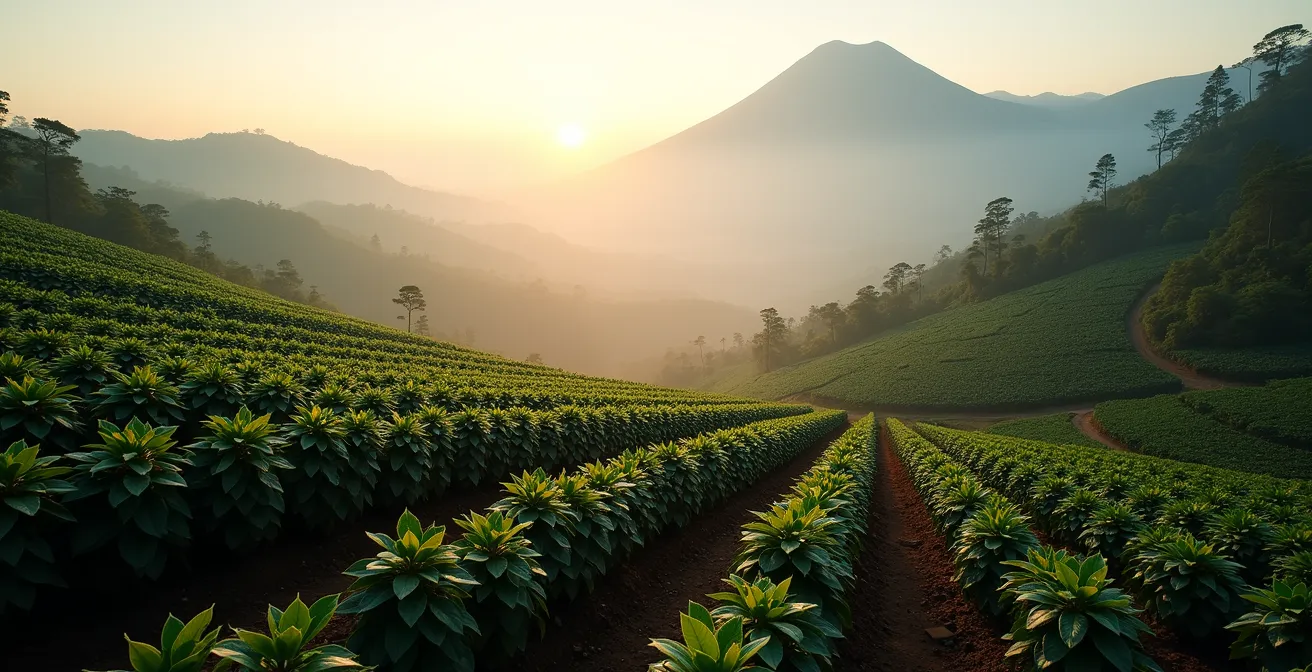
The exceptional taste of volcanic coffee isn’t magic; it’s a direct result of specific geochemical processes where the soil’s mineral composition directly builds the flavor profile of the bean.
- Volcanic soils (Andisols) are rich in phosphorus and potassium, which the coffee plant uses as precursors to synthesize the bright organic acids that define high-acidity profiles.
- Magnesium availability in these soils is crucial for developing sugars, creating the sweetness that balances the acidity and provides a complex, rounded cup.
Recommendation: To truly appreciate your next cup of single-origin coffee, consider its geological journey—from the Earth’s mantle to the final brew—as an integral part of its flavor.
For a geology enthusiast, the link between the ground and the cup is a fascinating story written in minerals and time. We often hear that volcanic soil is simply “better” or “more nutritious” for coffee, but this statement barely scratches the surface. It treats the earth like a black box, ignoring the intricate chemical ballet that occurs between the soil, the plant’s roots, and the developing coffee cherry. This simplified view misses the fundamental truth: the specific, vibrant acidity in a cup of high-altitude volcanic coffee is not an accident of nature, but a direct and predictable outcome of its geochemical origins.
The real key is not just the presence of nutrients, but their specific form and availability within the unique structure of volcanic ash. While many soils contain minerals, volcanic soils, known as Andisols, possess a distinct combination of chemistry and physics that other soil types cannot replicate. Instead of just saying the soil is “rich,” we must ask: which elements are responsible for which flavors? How does the soil’s physical structure enable this process? This article moves beyond the platitudes to explore the precise mechanisms, dissecting how the mineral-rich ash is metabolized by the plant to forge the complex organic acids and sugars that a discerning palate can identify as the signature of a volcanic terroir.
This guide will trace the journey of flavor from the soil’s composition to the final brewed cup. We will explore the chemical pathways, the physical advantages of the soil, and the other critical factors like altitude and genetics that work in concert with the geology.
Summary: Why Ash-Rich Volcanic Soil Creates Higher Acidity Coffee?
- Why Volcanic Soil Produces Higher Acidity in Beans?
- Why Magnesium in Soil Equals Sweetness in the Cup?
- Loam vs Volcanic Ash: Which Drains Better for Coffee Roots?
- When to Plant Above 1800m: The Volcanic Altitude Sweet Spot
- How to Read a Map to Find Volcanic Coffee Origins?
- Castillo vs Caturra: Does Rust Resistance Kill Flavor?
- The Farming Mistake That Causes Landslides on Volcanic Slopes
- Why High Acidity Coffees Taste Sour When Brewed Too Cool?
Why Volcanic Soil Produces Higher Acidity in Beans?
The characteristic bright, crisp acidity of volcanic coffee is not a generic quality but the direct result of the soil’s specific mineral makeup. Volcanic ash deposits create soils, scientifically classified as Andisols, that are exceptionally rich in certain key elements, most notably phosphorus and potassium. These are not just “food” for the plant; they are the essential building blocks, or precursor molecules, for flavor. The coffee plant absorbs these minerals and, through metabolic processes, transforms them into the complex organic acids—like citric and malic acid—that we perceive as vibrant acidity in the cup. This is a fundamental principle of geochemistry influencing taste.
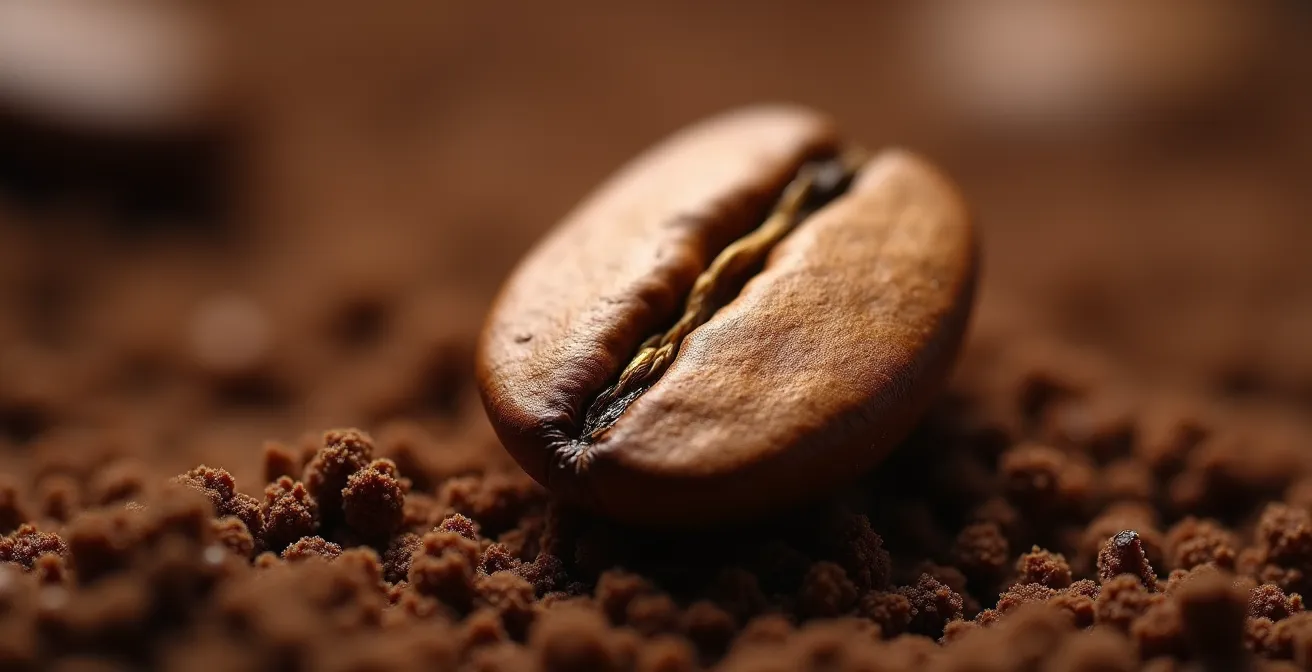
This paragraph introduces the resulting flavor profile. The crystalline structures on the bean’s surface, as seen below, are the final physical manifestation of this complex internal chemistry.
The process is highly specific. As EGU Network Researchers explain in the European Geosciences Union’s Four Degrees Blog, the chemistry is direct and measurable:
The level of potassium influences total sugar and citric acid content while nitrogen is important for amino acid and protein buildup and can influence caffeine build up.
– EGU Network Researchers, Four Degrees Blog – European Geosciences Union
Furthermore, it’s confirmed that plants grown in phosphorus and potassium-rich volcanic soil produce coffees with significantly better aroma, flavor, and acidity. The unique, non-crystalline clay minerals in Andisols, such as allophane and imogolite, have a high capacity to hold onto these nutrients and release them steadily to the plant’s roots, ensuring a constant supply for acid synthesis throughout the cherry’s development.
Why Magnesium in Soil Equals Sweetness in the Cup?
While acidity provides the bright, lively character of coffee, it is sweetness that delivers balance, complexity, and a pleasant finish. Acidity without sweetness can easily become sour or sharp. Here again, the specific mineralogy of volcanic soil plays a crucial role, this time through the availability of magnesium (Mg). Magnesium is the central atom in the chlorophyll molecule, making it essential for photosynthesis—the process by which the plant creates sugars. A healthy supply of magnesium from the soil translates directly into efficient sugar production in the coffee cherry.
This is why coffees from certain volcanic regions are celebrated not just for their acidity, but for their intricate sweetness. In fact, Ethiopian coffee from volcanic soils rich in phosphorus and potassium also shows high sugar content, partly due to a soil pH (5.5-6.5) that optimizes nutrient uptake. This slightly acidic environment makes elements like magnesium more available to the plant’s roots. The result is a cup profile where the bright acidity is perfectly complemented by deep, inherent sweetness.
Case Study: The Balance of Colombian Volcanic Coffee
Colombian coffee from regions like Huila and Nariño provides a perfect example of this synergy. These coffees are grown in loamy volcanic soils rich in organic matter and minerals, including magnesium and calcium. The resulting flavor profile is consistently described as having balanced acidity, a medium body, and distinct notes of caramel sweetness. This demonstrates how magnesium directly influences the development of sugars within the coffee cherry, which in turn balances the high acidity derived from phosphorus and potassium, creating a well-rounded and highly sought-after cup.
Therefore, the relationship is clear: sufficient magnesium in the soil powers the plant’s sugar factory, and these sugars are what temper the acids, transforming a potentially one-dimensional “acidic” coffee into a complex and complete sensory experience.
Loam vs Volcanic Ash: Which Drains Better for Coffee Roots?
Beyond chemistry, the physical structure of the soil is paramount. Coffee plants, particularly Arabica, are notoriously sensitive to “wet feet”—a condition where waterlogged soil suffocates the roots and leads to rot. This is where the physical properties of volcanic ash (Andisols) provide a decisive advantage over other fertile soils like loam. Volcanic ash is composed of light, porous, and fluffy particles. This structure creates a soil with excellent drainage, allowing excess water to pass through quickly and preventing waterlogging, even during heavy rainfall.
This paragraph explains the structural differences between soil types. The diagram below illustrates how a coffee plant’s roots interact with the porous volcanic ash versus the denser loam.
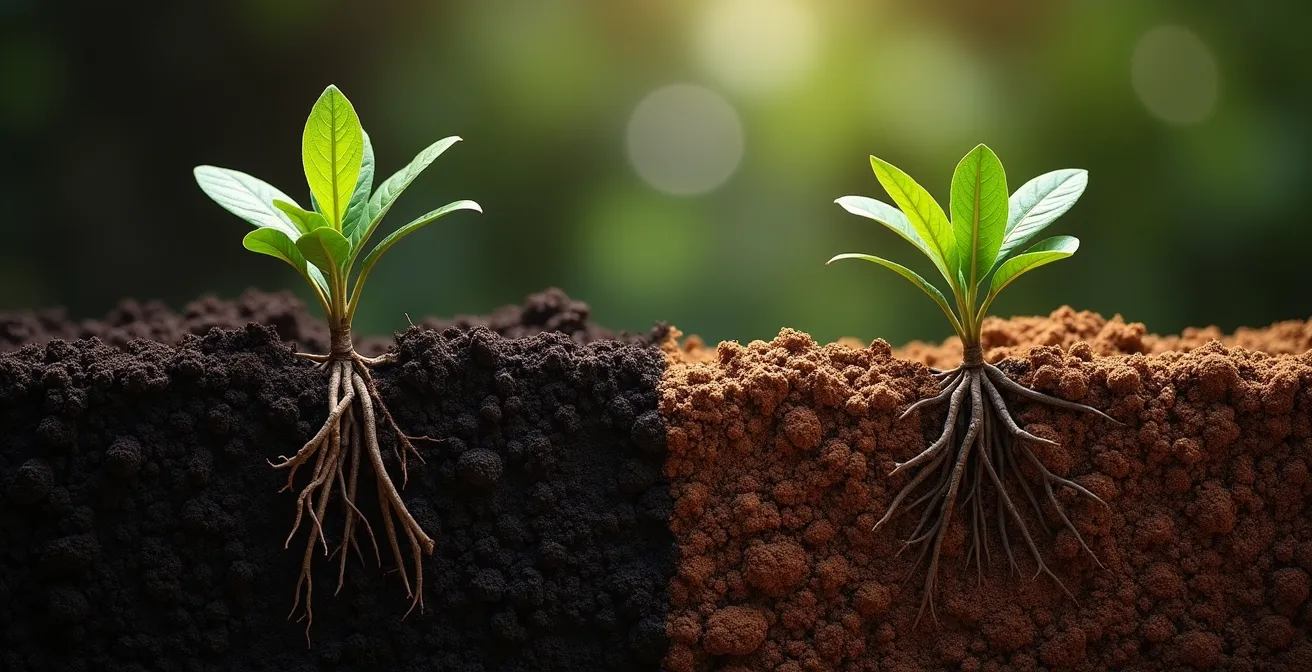
However, what makes Andisols truly remarkable is their ability to combine excellent drainage with effective water retention. The non-crystalline minerals like allophane act like microscopic sponges, holding onto water molecules and making them available to the plant’s roots during drier periods. This duality is a significant advantage. Loam, while fertile, is denser and can become compacted, leading to moderate drainage and a higher risk of waterlogging. The superior porosity of volcanic soil also ensures better root aeration, supplying the oxygen necessary for healthy root function and nutrient uptake.
The following table, based on analysis from sources like specialty coffee researchers at 43 Factory Coffee Roaster, summarizes these critical differences:
| Soil Property | Volcanic Ash (Andisols) | Loam Soil |
|---|---|---|
| Structure | Light, fluffy, highly porous | Dense, mixed composition |
| Water Retention | Effective retention despite high drainage | Superior water holding capacity |
| Drainage Rate | Excellent – prevents root rot | Moderate – risk of waterlogging |
| Root Aeration | Superior due to high porosity | Good but less than volcanic |
| Drought Resistance | Relatively drought resistant | Better in dry seasons |
In essence, volcanic soil provides the perfect physical environment: it protects the plant from excess water while simultaneously guarding it against drought, allowing the roots to breathe and efficiently access the minerals that build flavor.
When to Plant Above 1800m: The Volcanic Altitude Sweet Spot
The unique geochemistry of volcanic soil is a powerful foundation for flavor, but it realizes its full potential when combined with another critical environmental factor: altitude. Most of the world’s active volcanoes are situated in mountainous regions, creating a natural synergy between soil and elevation. For Arabica coffee, there is a recognized “sweet spot” for cultivation. As agricultural research confirms, Arabica plants thrive at altitudes between 1,000-2,000 meters above sea level (m.a.s.l.), where average temperatures hover between 18-21°C.
Planting at high altitudes, particularly above 1,800 meters, has a profound impact on the coffee cherry’s development. The cooler temperatures at these heights slow down the cherry’s ripening process. This extended maturation period is not a drawback; it is a significant advantage. It gives the plant more time to carry out the complex chemical synthesis of sugars, organic acids, and other aromatic compounds. The result is a bean that is denser, harder, and packed with more complex and concentrated flavors than its lower-altitude counterparts.
Case Study: The Altitude Effect in Ethiopian Yirgacheffe
Ethiopian Yirgacheffe coffee is a world-renowned example of the altitude effect. Often grown at elevations exceeding 2,000 meters in mineral-rich volcanic soils, these coffees are celebrated for their exceptional sweetness and delicate, tea-like or floral notes. The slow ripening process allows a greater concentration of complex flavor molecules to build up within the berry. This demonstrates that while the volcanic soil provides the raw materials for flavor, the high altitude acts as the catalyst that allows those materials to be refined into a truly exceptional and nuanced final product.
When high altitude is combined with the superb drainage and rich mineral profile of volcanic soil, the ideal conditions for specialty coffee are met. The soil provides the building blocks, and the altitude provides the necessary time for the plant to construct a masterpiece of flavor within each cherry.
How to Read a Map to Find Volcanic Coffee Origins?
Identifying potential high-quality coffee origins is a geographical detective story. For a geology enthusiast, a map is not just a collection of lines and names; it’s a treasure map pointing to potential sources of terroir-driven coffee. By combining geological, topographical, and agricultural data, one can pinpoint regions where the conditions for volcanic coffee are met. The first and most obvious clue is the Pacific Ring of Fire, an area of intense tectonic activity that is home to the vast majority of the world’s active volcanoes and, consequently, many famous coffee-growing countries like Colombia, Guatemala, and Indonesia.
Once you’ve identified a volcanic region, the next step is to look for more specific soil classifications. Geological survey maps often use classifications like “Andisols” to denote soils of volcanic origin. These are typically dark-colored and found on the flanks of volcanoes. Topographical maps then come into play to identify the crucial altitude factor. By looking for the contour lines that indicate elevations between 1,000 and 2,000 meters, you can zero in on the “sweet spot” where Arabica thrives.
Finally, slope angle is a subtle but important detail. The lower flanks of volcanoes, with gentle slopes of 6-10 degrees, are often ideal as they balance good drainage with reduced risk of soil erosion. By layering these different map types, a clear picture emerges of where exceptional coffee might be grown.
Your Action Plan: Locating Volcanic Coffee on a Map
- Look for coffee-growing countries located within the ‘Pacific Ring of Fire,’ which contains roughly 75% of the world’s active volcanoes.
- Identify ‘Andisol’ soil classifications on geological survey maps; these are the dark-colored soils derived from volcanic ash.
- Search for growing regions situated between 1,000 and 2,000 meters above sea level on the slopes of volcanoes using a topographical map.
- Check for locations with gentle 6-10 degree slope angles on the lower flanks of volcanoes, which offer a balance of drainage and stability.
- Focus on areas within a 100km radius of the world’s active volcanoes, where ash deposits are most concentrated and recent.
Following this process transforms map-reading from a simple navigational exercise into a predictive tool for discovering the geological origins of world-class coffee.
Castillo vs Caturra: Does Rust Resistance Kill Flavor?
Even with perfect soil and ideal altitude, the final flavor is ultimately determined by the plant itself: the coffee variety. The genetic makeup of the plant dictates its ability to absorb and process soil nutrients, a concept known as terroir expression. This becomes particularly evident when comparing a traditional, pure Arabica variety like Caturra with a modern, disease-resistant hybrid like Castillo.
Caturra, a natural mutation of the famed Bourbon variety, is highly expressive of its environment. When planted in mineral-rich volcanic soil, it excels at absorbing the available phosphorus, potassium, and magnesium, translating them into the complex acids and sugars that create a vibrant, nuanced, and terroir-specific cup. However, Caturra is extremely vulnerable to coffee leaf rust (la roya), a devastating fungus that can wipe out an entire harvest. This makes it a high-risk, high-reward choice for farmers.
In response, scientists developed the Castillo variety. It is a hybrid containing genetic material from Robusta, which grants it strong resistance to leaf rust. This provides farmers with a crucial safety net and a guaranteed harvest. However, this resilience often comes at a cost to flavor. Castillo is generally considered less capable of expressing the subtle nuances of its terroir. Its acid profile is often simpler, and it may not develop the same level of sweetness as a Caturra grown in the same soil. The following table highlights this trade-off:
| Characteristic | Caturra (Bourbon mutation) | Castillo (Hybrid) |
|---|---|---|
| Genetic Heritage | Pure Arabica | Arabica-Robusta hybrid |
| Disease Resistance | Vulnerable to leaf rust | Rust-resistant |
| Terroir Expression | Highly expressive of volcanic minerals | Less nuanced, more standard profile |
| Acid Development | Complex acids and sugars | Simpler acid profile |
| Farmer Risk | High risk, high reward | Low risk, guaranteed harvest |
This dilemma presents a fundamental conflict between economic stability for the farmer and the ultimate flavor potential in the cup. While amendments can improve soil health—for instance, soil amendment studies show rock powder can increase phosphorus and potassium levels—the genetic blueprint of the plant remains the final gatekeeper of flavor expression.
Key Takeaways
- Chemical Foundation: Volcanic soil’s high phosphorus and potassium content are directly metabolized by the coffee plant into the organic acids responsible for bright, complex acidity.
- Structural Advantage: The unique, porous structure of Andisols provides superior drainage and aeration, preventing root rot and allowing for efficient nutrient uptake.
- Synergistic Factors: The combination of volcanic soil, high altitude (slowing ripening), and specific plant genetics (like Caturra) is what creates the most exceptional and terroir-expressive coffees.
The Farming Mistake That Causes Landslides on Volcanic Slopes
The very properties that make volcanic slopes ideal for coffee—their steepness, which aids drainage, and their loose, ashy soil—also make them inherently fragile. These ecosystems exist in a delicate balance, and improper agricultural practices can have catastrophic consequences, including devastating landslides. The single most significant farming mistake that triggers this instability is deforestation and the removal of native shade cover. The deep, complex root systems of native trees and undergrowth act as a natural net, binding the light volcanic soil together.
When this natural vegetation is cleared to make way for sun-grown coffee monocultures, the soil is left exposed and structurally compromised. During periods of heavy rainfall, a common occurrence in these tropical, high-altitude regions, the unanchored soil can quickly become saturated. Its own weight, combined with the lubricating effect of the water, can cause it to break away from the mountainside in a sudden, destructive landslide. This not only destroys the coffee farm but can also threaten downstream communities and ecosystems.
Furthermore, this type of mismanagement leads to rapid soil degradation. As recent agricultural studies in Peru’s Pichanaqui district demonstrate, coffee plantations with improper land management suffer from soil acidification and drastically reduced yields, sometimes as low as 0.70 tons per hectare. Sustainable practices, such as agroforestry (growing coffee under a canopy of native trees), are therefore not just an environmental ideal but a practical necessity for preserving the long-term viability and stability of these precious agricultural landscapes.
Why High Acidity Coffees Taste Sour When Brewed Too Cool?
After a journey spanning geology, chemistry, and agriculture, the coffee bean’s potential is finally realized in the last step: brewing. All the complexity developed in the volcanic soil can be either highlighted or hidden by the brewing process. This is especially true for high-acidity coffees. When a patron complains that their specialty coffee tastes “sour,” the culprit is almost always under-extraction, which is frequently caused by using water that is too cool.
Flavor extraction is a temperature-dependent chemical process. Different compounds dissolve into the water at different rates and temperatures. The bright, fruity organic acids (like citric and malic acid), which are the hallmark of volcanic coffees, are highly soluble and extract early in the brewing process. The sugars and heavier compounds that provide balance, sweetness, and body require more energy—i.e., higher water temperature—to dissolve. If the brew water is too cool (e.g., below 90°C or 195°F), you will extract the acids but not enough of the balancing sugars. The result is a one-dimensional, sour cup that fails to represent the coffee’s true potential.
To properly brew a high-acidity volcanic coffee and unlock its intended flavor profile of bright acidity balanced by sweetness, a precise approach is needed. The goal is to achieve a full, balanced extraction where all the desirable compounds make it into the cup. The following points provide a solid protocol:
- Use water at the correct temperature, typically between 94-96°C (201-205°F), to ensure proper dissolution of all flavor compounds.
- If the coffee tastes sour, consider grinding slightly finer or extending the brew time to increase extraction.
- Avoid letting brewed coffee sit on a heat source for too long, as this can cause the development of quinic acid, which tastes bitter and astringent.
- Always adjust your grind size as the primary variable for tuning extraction before making drastic changes to temperature.
Ultimately, brewing is the final act of respect for the coffee’s origin. Understanding the science of extraction ensures that the long, complex story written in the volcanic soil is told completely and deliciously in the final cup.
To fully appreciate and correctly prepare these unique coffees, start by exploring their origins and then master the brewing techniques that honor their complex chemistry.