
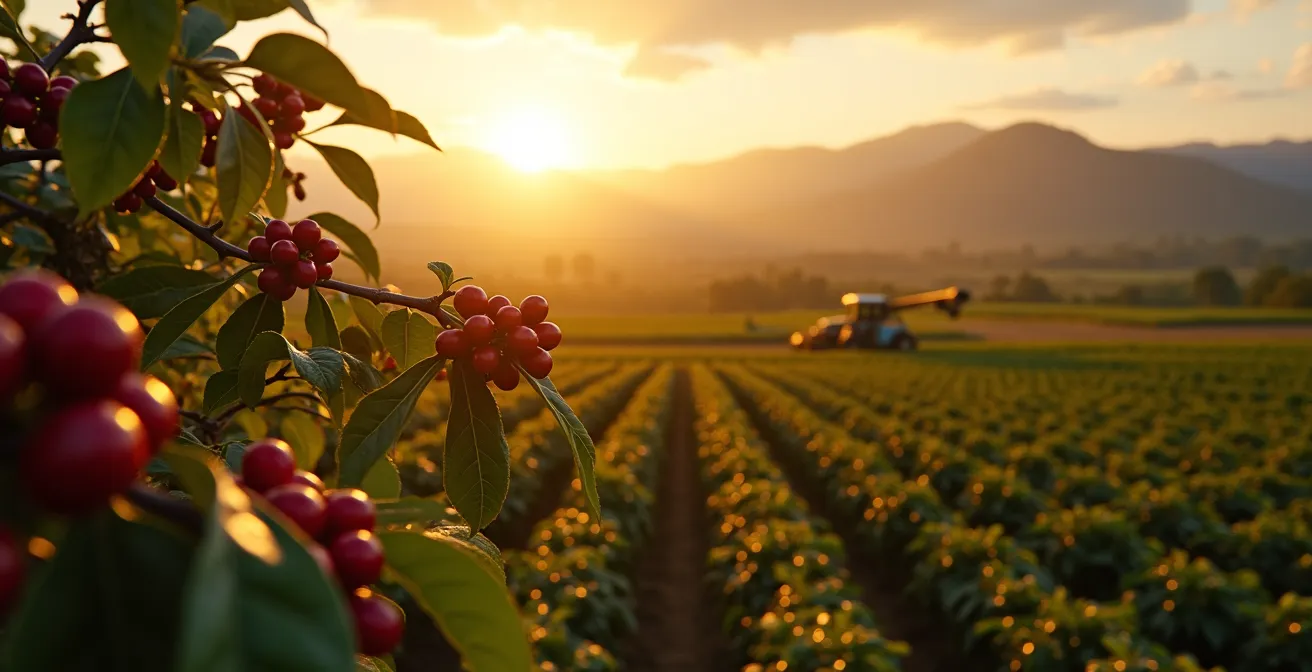
For coffee lovers who cherish a low-acid, heavy-bodied cup, Brazilian coffee is the undisputed champion. But for us as blenders, its value goes far beyond the classic chocolate and nut profile. Brazil’s true genius lies in its structural reliability—a predictable, consistent, and forgiving canvas that serves as the architectural foundation for nearly every great espresso blend. It’s the one origin that provides the body and sweetness that allows other, more volatile coffees to shine.
There’s a comforting familiarity in a perfectly pulled shot of espresso—that rich, syrupy body, the persistent crema, and a deep, resonant sweetness that coats the palate. More often than not, the coffee responsible for that foundational experience is from Brazil. For decades, drinkers have associated Brazilian beans with approachable, low-acidity flavors of chocolate, caramel, and roasted nuts. This classic profile makes it a crowd-pleaser and a staple in cafes around the world.
While this flavor description is accurate, it only tells half the story. The common wisdom stops at “it tastes like chocolate,” but for those of us who build espresso blends for a living, that’s just the starting point. We don’t just choose Brazil for its taste; we choose it for its function. The discussion often circles around tasting notes, but rarely delves into the agricultural and processing realities that make this coffee so uniquely consistent and reliable.
But what if the true reason Brazilian coffee reigns supreme in espresso isn’t just its flavor, but its role as an indispensable architectural component? This article explores the world of Brazilian coffee from a blender’s perspective. We will move beyond the tasting notes to understand why its flat farmlands, unique regional profiles, and forgiving nature in the portafilter make it the structural backbone of the espresso world. We’ll examine how its consistency provides a stable canvas, and why treating it like a high-acidity African coffee is a fundamental brewing mistake.
This guide delves into the strategic thinking behind using Brazilian coffee. By exploring its role from the farm to the final blend, you’ll gain a deeper appreciation for what makes this gentle giant the true king of espresso.
Summary: The Blender’s Guide to Brazilian Espresso Dominance
- Why Flat Savanna Lands Allow for Mechanical Harvesting?
- How to Brew Brazilian Beans to Maximize Mouthfeel?
- Cerrado vs Sul de Minas: Which Region is More Chocolatey?
- The Brewing Mistake: Treating Brazil Like Kenya
- When to Add Brazil to a Blend: The Base Layer Strategy
- Why Robusta Creates Thicker Crema Than Arabica?
- Why Leaving Coffee in the Press for 10 Minutes Ruins It?
- 100% Arabica vs Blends: Why Italians Add Robusta to Espresso?
Why Flat Savanna Lands Allow for Mechanical Harvesting?
When we look for a base component for a blend, the number one attribute we need is consistency. Flavor is important, but predictability is king. This is where Brazil’s geography gives it an unparalleled advantage. Unlike the steep, volcanic slopes of Colombia or Kenya, large parts of Brazil—particularly in the Cerrado Mineiro region—are vast, flat savannas. This topography is the key to one of the most important aspects of Brazilian coffee production: mechanical harvesting.
Mechanical harvesters are large, tractor-like machines that straddle the coffee trees and use vibrating spindles to shake the ripe cherries off the branches. This method is only feasible on flat or gently sloping terrain. The immediate benefit is scale and efficiency, allowing vast areas to be harvested quickly. For a blender, this speed is crucial because it minimizes the risk of uncontrolled fermentation that can happen when ripe cherries sit for too long, thus preserving a clean, consistent flavor profile.
But the real value lies in the uniformity it creates. While critics argue mechanical harvesting is less selective than hand-picking, modern Brazilian agriculture has turned this into a strength. Farmers manage their lots for uniform ripening, and the harvest is followed by a rigorous post-harvest sorting process. Optical sorters remove under-ripe or over-ripe cherries, while density tables separate beans by weight. The result is a massive volume of coffee with an incredibly consistent quality, free from the flavor defects that can plague smaller, less controlled lots. This process delivers the predictable canvas we need to build a blend upon.
How to Brew Brazilian Beans to Maximize Mouthfeel?
Brazilian coffee is celebrated for its heavy body and rich, syrupy texture, or what we call mouthfeel. This quality is a direct result of its lower growing altitudes, which produce softer, less dense beans with a higher concentration of soluble solids and lipids. Maximizing this characteristic during brewing isn’t about chasing bright, acidic notes; it’s about a gentle, thorough extraction that coaxes out sweetness and body without introducing bitterness.
To achieve this, we need to adjust our espresso parameters specifically for Brazilian beans. Because they are less dense, they extract more easily than their high-altitude counterparts. The goal is to use this to our advantage. We often use slightly higher water temperatures, between 94-96°C (201-205°F), to enhance the extraction of sugars and lipids that contribute to body. A longer brew ratio, such as 1:2.5 or even 1:3 (e.g., 18 grams of coffee to 45-54 grams of liquid), stretches the shot and further emphasizes sweetness and texture over intensity.
Gentleness is also key. Lowering the peak pressure from the standard 9 bars to around 7-8 bars can result in a smoother, less aggressive extraction, reducing the chance of channeling and astringency. This, combined with a gentle pre-infusion of 5-7 seconds, ensures the coffee puck is fully saturated before the main pressure is applied, leading to a more even and balanced shot.
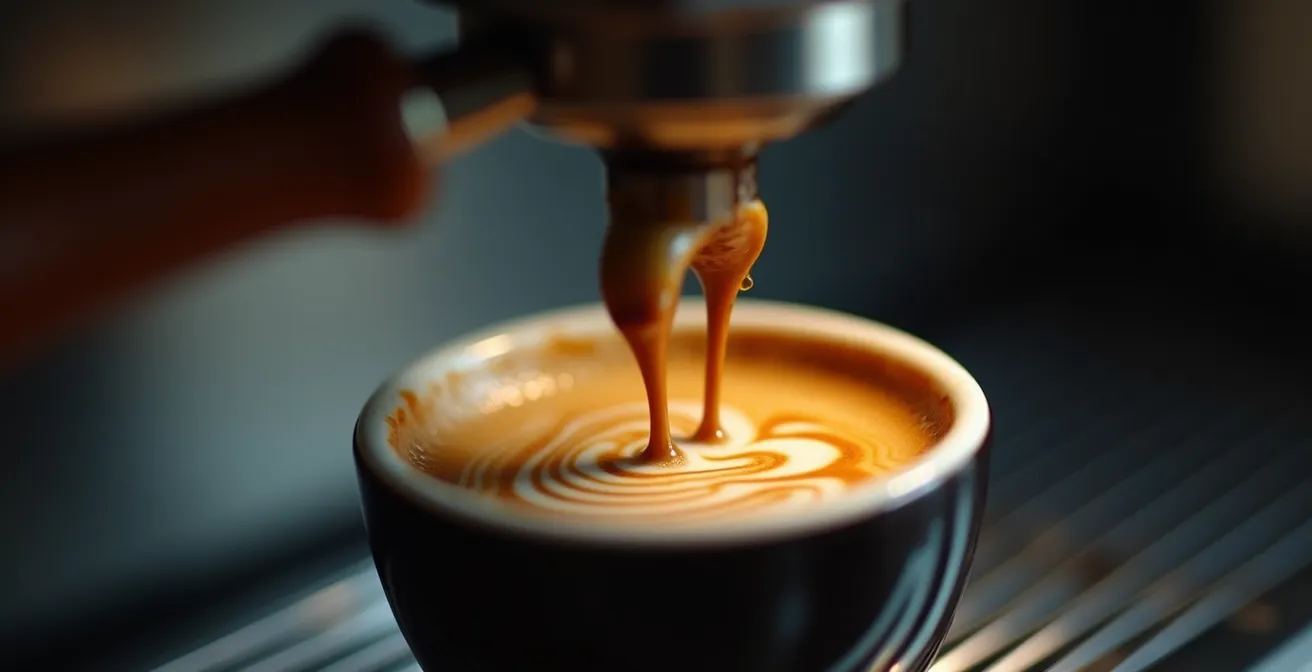
The visual result of this careful approach is a thick, persistent, hazelnut-colored crema, as seen in the extraction above. This crema is not just for show; it’s an emulsion of coffee oils and CO2, and its presence is a strong indicator of the rich mouthfeel that awaits in the cup. This is the texture that makes Brazilian coffee such a satisfying single-origin espresso and an essential component in any blend designed for body.
Cerrado vs Sul de Minas: Which Region is More Chocolatey?
While “Brazilian coffee” is often spoken of as a monolith, its flavors vary significantly by region. The state of Minas Gerais is the powerhouse of Brazilian coffee, and as a study on the region shows, Minas Gerais accounts for close to 50% of Brazil’s total production. Within this state lie two of the most important and distinct regions for blenders: Cerrado Mineiro and Sul de Minas. Both offer chocolatey notes, but the character of that chocolate is quite different.
Cerrado Mineiro is the classic, reliable workhorse. As the first protected Designation of Origin in Brazil, its profile is defined by its consistent climate—hot, wet summers and dry winters. This leads to very even cherry maturation and processing. For a blender, Cerrado is synonymous with a clean, nutty profile dominated by milk chocolate and caramel notes. Its low acidity and full body make it the perfect, unwavering base for a traditional espresso blend. It provides the sweetness and weight without adding any surprising or distracting flavors.
Sul de Minas, on the other hand, offers more complexity. Its rolling hills and varied microclimates create a wider spectrum of flavors. While still low in acidity, coffees from Sul de Minas often feature notes of dark chocolate, red fruit, and even a subtle winey quality. This complexity makes them excellent as single-origin espressos or as a component in a modern blend where you want the Brazilian base to contribute more than just body. It’s the region we turn to when we need a Brazilian coffee with a bit more personality.
The choice between them depends entirely on the blender’s goal. For a straightforward, classic blend, Cerrado is the safe and reliable bet. For a blend that needs a touch more character and nuance from its base, Sul de Minas provides that extra layer of complexity.
| Region | Primary Flavor Notes | Climate Impact | Best For |
|---|---|---|---|
| Cerrado | Milk chocolate, roasted nuts, caramel | Consistent dry/wet seasons create uniform ripening | Espresso base, consistent profiles |
| Sul de Minas | Dark chocolate, red fruit, wine notes | Varied microclimates add complexity | Single origin espresso, specialty blends |
| Mogiana | Brown sugar, nuts, balanced sweetness | Stable temperatures around 22°C | Traditional espresso blends |
The Brewing Mistake: Treating Brazil Like Kenya
One of the most common mistakes baristas make is applying a single brewing recipe to all coffees. This is especially problematic when switching between coffees from different continents, like a dense, high-altitude Kenyan and a softer, lower-altitude Brazilian. Treating them the same way guarantees a poor result because their physical structures are fundamentally different and demand different approaches to extraction.
Kenyan coffees are grown at very high altitudes, resulting in hard, dense beans that are packed with bright, complex acids. To properly extract these flavors, you need high water temperatures (often 96°C/205°F or higher) and a fine grind to break down the cellular structure. In contrast, Brazilian beans are grown at lower altitudes (averaging around 1,100 meters) and are therefore softer and less dense. An analysis by professional roasters confirms this, noting that Brazilian beans extract 15-20% faster than high-altitude Kenyan beans. Applying a “Kenyan” recipe to a Brazilian coffee will lead to rapid over-extraction.
When you hit a soft Brazilian bean with very hot water and a fine grind, you pull out all the desirable sugars in the first few seconds, and then spend the rest of the shot extracting bitter, dry, and astringent compounds. The resulting cup will be harsh and hollow, completely masking the sweet, chocolatey profile you were hoping for. The solution is to adjust your parameters to be gentler on the more soluble Brazilian bean.
Your Action Plan: Adjusting from African to Brazilian Beans
- Grind Coarser: Increase your grind size by 2-3 notches coarser than you would for a dense Kenyan bean.
- Lower Temperature: Reduce your water temperature by 2-3°C (e.g., from 96°C down to a 93-94°C range).
- Shorten Time: Aim for a slightly faster extraction, typically in the 24-26 second range instead of 28-30 seconds.
- Adjust Dose: Consider slightly reducing the coffee dose (e.g., from 20g to 18g) to compensate for the lower density.
- Target Sweetness: Aim for a slightly lower Total Dissolved Solids (TDS) percentage to focus on sweetness rather than intense acidity.
When to Add Brazil to a Blend: The Base Layer Strategy
In the world of espresso blending, coffees are often categorized by the role they play. Some are “top notes,” providing bright acidity and floral aromatics (like an Ethiopian Yirgacheffe). Others are “mid-palate” coffees, adding complexity and fruit notes (like a Colombian). And then there is the base layer—the foundation that provides body, sweetness, and crema. This is the primary role of Brazilian coffee.
As a blender, we use a Brazilian coffee as the “architectural foundation” for the blend, often making up 40% to 80% of the total volume. Its low acidity and dominant notes of chocolate and nut create a stable, non-intrusive platform. This predictable canvas allows the more delicate and volatile flavors of the other components to express themselves without being overpowered. Adding a bright, acidic Kenyan to a blend without a solid Brazilian base would result in a thin, sour, and aggressive shot. The Brazil adds the necessary weight and sweetness to balance that acidity and create a harmonious, well-rounded espresso.
The percentage of Brazil used depends on the desired style of the blend. A classic Italian-style blend might use a very high percentage to achieve a heavy body and low acidity, while a modern, “third wave” blend might use a smaller percentage to allow for more fruit-forward complexity from its other components. Regardless of the style, the strategic thinking remains the same: Brazil is the component you start with to ensure the final product has the structural integrity and satisfying mouthfeel that customers expect from a great espresso.
The following table illustrates how Brazilian coffee serves as the core component across different popular blend philosophies, demonstrating its versatility as a foundational element.
| Blend Style | Brazilian % | Supporting Origins | Flavor Goal |
|---|---|---|---|
| Classic Italian | 70-80% | Guatemala (20%), Robusta (10%) | Rich body, thick crema, low acidity |
| Modern Balanced | 50% | Colombian (30%), Ethiopian (20%) | Sweet base with fruit highlights |
| Competition Style | 40% | Kenya (30%), Colombia (30%) | Complex with structured acidity |
Why Robusta Creates Thicker Crema Than Arabica?
While Brazil is famous for its Arabica coffee—in fact, a 2022/23 report showed the Arabica variety represented around 69% of its production—it is also a significant producer of Robusta (known locally as Conilon). For espresso blenders, particularly those crafting traditional Italian-style blends, this Robusta is a secret weapon for one specific purpose: creating thick, stable crema.
The science behind this lies in the chemical composition of the beans. Crema is an emulsion of microscopic coffee oils, water, and gas (primarily CO2) created under the high pressure of an espresso machine. The key to a thick and lasting crema is the quantity of lipids (oils) in the coffee. This is where Robusta has a distinct advantage. Laboratory analysis shows that Robusta beans contain nearly double the lipid content of Arabica beans (15-17% vs. 8-9%). These extra oils create a richer, more stable foam that is less prone to dissipating quickly.
This difference is visually dramatic. A shot pulled from 100% Arabica may have a beautiful, delicate crema, but it will often start to break down within 60 to 90 seconds. A shot containing even a small percentage of Robusta (10-15%) will produce a darker, thicker, more rubbery crema that can persist for several minutes. Beyond the visual appeal, these lipids also contribute to a heavier mouthfeel, a quality highly prized in traditional espresso. This is why many classic blends intentionally include a portion of high-quality Brazilian or Indian Robusta—not as a cheap filler, but as a functional ingredient to enhance the texture and visual appeal of the final shot.
Why Leaving Coffee in the Press for 10 Minutes Ruins It?
While Brazilian coffee shines in espresso, its low-acid, heavy-bodied profile also makes it a favorite for immersion brewing methods like the French press. However, this method is prone to a critical error: over-extraction caused by leaving the coffee to steep for too long. The idea that “stronger” coffee comes from a longer brew time is a misconception that leads to a bitter, unpleasant cup.
Extraction is a time-sensitive process where different flavor compounds dissolve into the water at different rates. The initial phase of brewing is where the magic happens. As one aficionado guide explains, this principle is key:
The first 1-4 minutes of brewing extract the desirable sweet sugars and bright acids. Anything beyond that begins to aggressively pull out the heavy, bitter, and astringent compounds.
– Home Barista Community, An Aficionado’s Guide to Espresso Blending
When you leave your coffee grounds sitting in the press for 10 minutes or more, you have long since extracted all the good stuff. The water then begins to attack the woody, cellulose structure of the coffee grounds, pulling out harsh and bitter flavors. With a Brazilian coffee, this is especially tragic as it completely masks its inherent nutty sweetness, replacing it with a flat, muddy bitterness.
The correct technique involves precise timing. After a steep time of around 4 minutes, the plunger should be pressed down gently. Crucially, the coffee should be immediately decanted into a separate server or directly into cups. Leaving the finished brew in the press with the grounds at the bottom means the extraction process continues, albeit slowly, turning a perfectly brewed coffee into a bitter mess over the next few minutes. This is a common pitfall for those seeking a richer cup, when in reality methods like a French Press are better suited to highlight clarity over strength, a quality often lost with over-extraction.
Key Takeaways
- Brazilian coffee’s primary value in blends is its structural reliability and consistency, which comes from its unique agricultural practices.
- Maximizing the mouthfeel of Brazilian beans requires a gentle extraction with lower pressure and a longer brew ratio, not high heat and fine grinds.
- The “base layer” strategy in blending uses Brazil’s predictable, low-acid profile as a canvas to build more complex flavors upon.
100% Arabica vs Blends: Why Italians Add Robusta to Espresso?
The debate between 100% Arabica and blends containing Robusta often pits modern specialty coffee values against traditional Italian espresso culture. For many, Arabica is synonymous with quality, while Robusta is seen as a cheap, harsh-tasting filler. However, this view overlooks the historical context and functional purpose that made Robusta an integral part of the Italian espresso identity—an identity built largely on a Brazilian coffee foundation. In fact, it’s not uncommon that up to 90% of the coffee in an espresso blend is from Brazil.
The tradition of adding Robusta to espresso blends in Italy was born out of post-WWII economic necessity. Robusta was significantly cheaper than Arabica and, crucially, contained nearly double the caffeine (around 2.2% vs. 1.2%). This delivered the “punch” or “kick” that consumers were looking for. Italian roasters quickly discovered that adding a small percentage (typically 10-15%) of high-quality Robusta to a Brazilian Arabica base did more than just cut costs and boost caffeine.
Functionally, the Robusta dramatically improved the crema’s thickness and persistence and added a specific type of bitterness that many came to associate with “true” espresso. This bitter note was particularly effective at cutting through the sweetness of milk in cappuccinos and lattes. The Brazilian Arabica base provided the sweet, chocolatey body, while the Robusta provided the visual flair and the signature bitter finish. This combination became the blueprint for classic Italian espresso, a tradition that continues today. Modern premium Italian blends still follow this formula, using high-quality Robusta from India or Vietnam to complement a dominant base of Brazilian Arabica, creating a cup that is balanced, powerful, and visually iconic.
Now that you understand the architectural role of Brazilian coffee, you can approach your next espresso not just as a consumer, but with the strategic mind of a blender, appreciating the body, sweetness, and structure that form the heart of the experience. To put this knowledge into practice, start by tasting a high-quality single-origin Brazilian coffee and identifying its core characteristics before comparing it to a classic blend.