

We all know the smell of vanilla can instantly transport us back in time. But this phenomenon is far more than simple nostalgia. The true power of scent lies in its unique, direct wiring to the brain’s emotional centers, making it a powerful tool. This article reveals how we can move from passively experiencing these memories to actively using scent as a form of “olfactory architecture” to design profoundly emotional and memorable gastronomic experiences.
That first, subtle wisp of vanilla from a warm cookie, a scoop of ice cream, or a birthday cake. For a fleeting moment, you are not here, in the present. You are somewhere else entirely—a sunlit kitchen, a bustling fair, a quiet moment from a past you thought was forgotten. This experience is universal, yet deeply personal. It’s a phenomenon so powerful it feels like magic, a sensory time machine triggered by a single molecule. We often accept this connection between scent and memory as a given, a charming quirk of our human nature.
As a psychologist specializing in olfactory memory, I can tell you this is no accident. It’s a direct result of our brain’s unique wiring. But the common explanation—that the nose has a direct line to our memory centers—only scratches the surface. It tells us the *what*, but not the *how* or the profound implications for our relationship with food. The most fascinating part isn’t just that vanilla reminds us of childhood; it’s understanding the mechanics of that recall and how it can be harnessed.
The real shift in perspective comes when we stop seeing scent as a passive trigger and start viewing it as an active architectural tool. What if a chef could design a menu not just around flavors, but around a sequence of emotions? What if the timing of a dessert could be calibrated to create the most potent nostalgic peak? This is the world of olfactory architecture, where scent isn’t just an ingredient, but the very scaffolding upon which a memorable gastronomic story is built. In this exploration, we will decode that biological magic and learn how to use it to craft experiences that resonate on the deepest emotional level.
Summary: The Architecture of Scent: Building Emotional Food Experiences
- Why Taste Recalls Memories More Vividly Than Sight?
- Why You Can’t Taste Coffee Notes When Your Nose is Blocked?
- Comfort Food or Haute Cuisine: Which Satisfies Emotional Hunger?
- How to Design a Menu That Tells a Personal Story?
- The Ambiance Mistake That Kills the Gastronomic Vibe
- When to Reveal the Secret Ingredient for Maximum Delight?
- How to Plate Desserts Like a Chef Using Just a Spoon?
- When to Serve Dessert: The Perfect Timing for Maximum Gastronomic Emotion
Why Taste Recalls Memories More Vividly Than Sight?
Have you ever tried to describe a taste or a smell with words alone? It’s difficult because they are not processed like sights or sounds. While visual and auditory information travels through the thalamus—the brain’s main relay station—odors take a different route. They travel on a direct, private highway to the brain’s emotional core. This is why a simple scent can unleash a flood of feeling that a photograph from the same moment might fail to evoke.
Odors take a direct route to the limbic system, including the amygdala and the hippocampus, the regions related to emotion and memory.
– Venkatesh Murthy, Harvard Gazette
This anatomical shortcut is the key. The amygdala processes emotion, and the hippocampus is central to memory formation. Because the olfactory bulb is so intimately connected to these areas, a smell becomes interwoven with the emotional context of the moment it was first experienced. Research confirms this unique power; studies show odor-evoked memories tend to be more emotional and reach further back into our early lives than memories triggered by any other sense. This is the “Proustian Memory,” named after Marcel Proust’s famous passage where the taste of a madeleine cake instantly unlocked a detailed childhood memory. The memory isn’t just a fact; it’s a feeling, an atmosphere, a complete emotional landscape resurrected by flavor.
Therefore, when we “taste” vanilla, we are primarily smelling it, and that smell is not being logically analyzed. It’s being felt. It bypasses the rational parts of our brain and speaks directly to the archives of our emotional history, making it a uniquely potent and vivid trigger for nostalgia.
Why You Can’t Taste Coffee Notes When Your Nose is Blocked?
That frustrating experience of food tasting bland when you have a cold is the most compelling everyday proof of a crucial scientific fact: most of what we perceive as “taste” is actually smell. Our tongues can only detect five basic tastes: sweet, sour, salty, bitter, and umami. The rich, complex world of flavor—the floral notes in coffee, the earthiness of a mushroom, the fruity tang of olive oil—is almost entirely perceived through our sense of smell.
This happens through a process called retronasal olfaction. When you chew and swallow, aromatic molecules from the food travel up the back of your throat to your nasal cavity. Your brain combines these aromatic signals with the basic tastes from your tongue to create the perception of flavor. Harvard neuroscience research demonstrates that up to 80% of what we consider ‘taste’ is actually smell. When your nose is blocked, this pathway is cut off. You can still tell if your coffee is sweet (tongue), but you lose all the nuance—the chocolatey, nutty, or citrusy notes that make it unique (nose).
The profound link between our olfactory system and brain function goes even further, impacting cognitive health itself.
Case Study: The UCI Memory Enhancement Study
In a groundbreaking study from the University of California, Irvine, researchers explored the therapeutic potential of scent. They exposed older adults to a rotation of different fragrances for two hours every night while they slept. After six months, the results were astonishing. The participants showed a 226% increase in cognitive performance compared to a control group. The study powerfully confirms that regularly engaging the olfactory sense directly exercises the brain’s memory circuits, highlighting how essential our sense of smell is not just for flavor, but for overall brain health.
This reveals that flavor is not an event that happens in the mouth; it is a multi-sensory construction that happens in the brain, with smell playing the leading role. Understanding this is the first step toward becoming an olfactory architect.
Comfort Food or Haute Cuisine: Which Satisfies Emotional Hunger?
The question of what truly satisfies us leads to a fascinating divide in the culinary world: the simple, nostalgic warmth of comfort food versus the intellectual, novel experience of haute cuisine. Both can be delicious, but they feed two very different kinds of hunger. When we crave vanilla, we are rarely seeking novel stimulation; we are seeking emotional solace. This is the domain of emotional hunger—a need for comfort, security, and connection that familiar foods are uniquely equipped to satisfy.
Comfort foods, with their simple and recognizable aromas, tap directly into that limbic system pathway we’ve discussed. The scent of cinnamon, baking bread, or vanilla acts as a memory anchor, grounding us in a feeling of safety associated with childhood. It’s an emotional ‘hug’ delivered through retronasal olfaction. Haute cuisine, on the other hand, often aims to surprise and challenge. It presents complex, unfamiliar aromatic combinations that engage the prefrontal cortex—the analytical part of our brain. The pleasure is one of curiosity, discovery, and intellectual appreciation rather than nostalgic comfort.
Neither is superior; they simply serve different purposes. The key for a food lover or a chef is to understand which hunger they are trying to satisfy. A deconstructed vanilla-cardamom foam might be brilliant, but it will not satisfy the emotional hunger for grandma’s vanilla pudding. The following table breaks down this emotional impact:
| Aspect | Comfort Food | Haute Cuisine |
|---|---|---|
| Scent Profile | Simple, recognizable aromas (vanilla, cinnamon) | Complex, novel aromatic combinations |
| Memory Trigger | Direct pathway to childhood memories | Creates new memory experiences |
| Emotional Response | Nostalgic comfort, emotional ‘hug’ | Intellectual curiosity, surprise |
| Brain Engagement | Limbic system (emotion/memory) | Prefrontal cortex (analysis) |
| Satisfaction Type | Emotional hunger relief | Cognitive stimulation |
This distinction, as detailed in an analysis of restaurant concepts, is crucial for anyone looking to create a specific emotional effect with food. The choice between simple nostalgia and complex novelty dictates every aspect of a dish, from ingredients to presentation.
How to Design a Menu That Tells a Personal Story?
Once we understand that scent is the primary driver of emotional memory in food, we can begin to use it with intention. A menu can be more than a list of dishes; it can be a narrative, a journey designed to evoke a specific emotional arc. This is the essence of olfactory architecture: building a story that unfolds through a carefully planned scent progression. The goal is to create a multi-sensory experience that engages the diner on a deeply personal level.
This process begins by shifting the focus of menu descriptions away from a simple list of ingredients. Instead, use language that hints at emotional triggers and nostalgic elements. A “vanilla bean crème brûlée” becomes a “Toasted Sugar & Childhood Memory Crème Brûlée.” The description itself primes the brain, setting an expectation not just for a taste, but for a feeling. The next step is to use memory anchor scents, like vanilla, as a recurring motif. It might appear in a savory sauce, as a hint in a cocktail, and finally, as the star of the dessert, creating a coherent emotional thread throughout the meal.
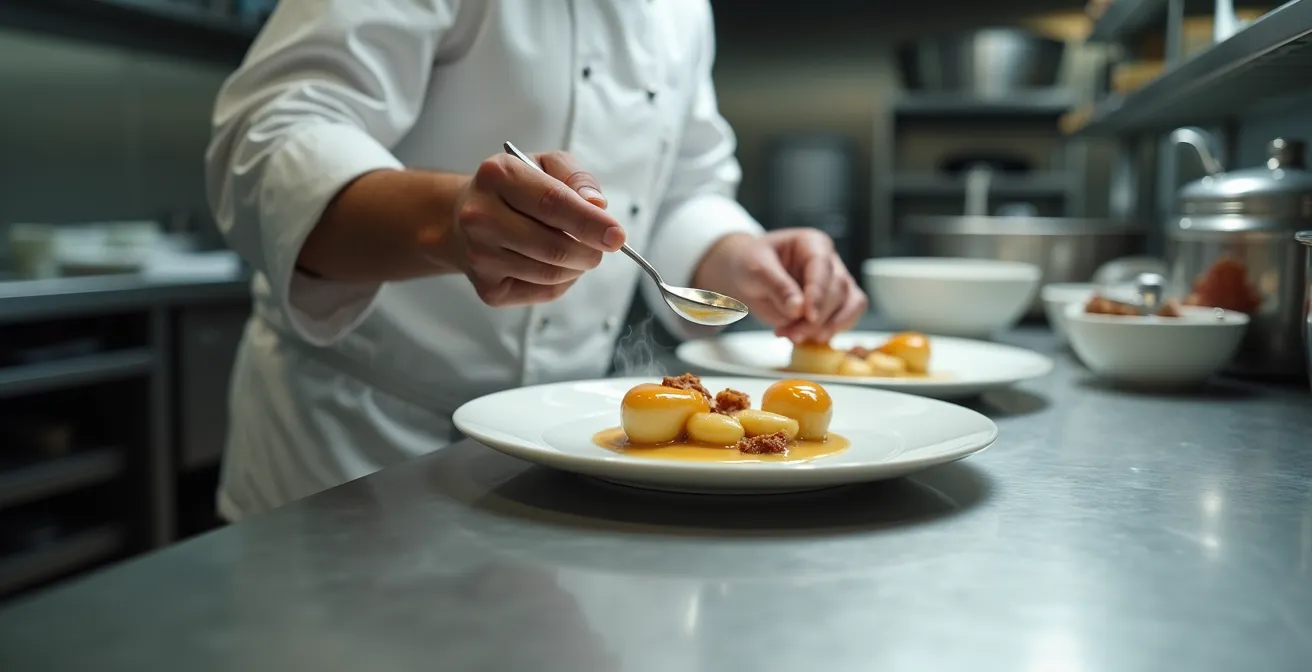
As this chef demonstrates, the final moments of plating are not just for visual appeal; they are crucial for aromatic impact. The warmth of the sauce releases volatile vanilla compounds, ensuring the first impression a diner has is not visual, but olfactory. By thoughtfully sequencing these sensory moments, from the words on the menu to the final garnish, a chef can guide a diner through a story, creating an experience that feels both personal and masterfully crafted.
The Ambiance Mistake That Kills the Gastronomic Vibe
A chef can create the most brilliantly designed olfactory narrative, but if the dining environment works against it, the story will be lost. The single biggest mistake in gastronomic ambiance is olfactory noise. This is any competing scent in the environment that jams the sensory pathways and prevents the aromas of the food from taking center stage. The importance of the overall environment cannot be overstated; a survey from the National Restaurant Association found that 72% of adults are more likely to choose a restaurant based on its ambiance than they were just a few years ago.
Common culprits of olfactory noise are often well-intentioned. They include:
- Overpowering floral centerpieces: A bouquet of lilies or hyacinths can easily overpower a delicate dish.
- Scented candles: Unless the scent is part of the intended experience, candles add a layer of conflicting aroma.
- Strong cleaning products: The lingering smell of bleach or pine cleaner is the antithesis of a fine dining experience and can completely mask food aromas.
- Poor ventilation: A stuffy room where scents from previous courses linger creates a muddled, confusing olfactory landscape.
The goal of good olfactory ambiance is to create a neutral “blank slate” for each course. This allows the specific aromas of the dish to be the main character in that moment of the story. It requires ensuring proper ventilation to clear the air between courses, choosing unscented candles, using neutral cleaning products, and carefully considering any floral arrangements. The ambiance shouldn’t compete with the food; it should be the silent, invisible stage that allows the food’s aromatic story to shine.
When to Reveal the Secret Ingredient for Maximum Delight?
Surprise is a powerful tool in storytelling, and the same is true in gastronomy. The “secret ingredient” is a classic trope, a hidden element that, when revealed, re-contextualizes the entire experience and creates a moment of delight. In olfactory architecture, this is about managing expectations and creating a dramatic reveal. The question is not just *what* the secret ingredient is, but *when* and *how* it is unveiled for maximum emotional impact.
One strategy is to build anticipation. The menu might hint at a “mysterious spice” or a “forgotten aroma.” The dish is served, and the flavor is captivating but elusive. The diner is engaged in a sensory puzzle, trying to identify the source of their delight. The reveal can happen post-meal, by the server or even on a small card presented with the bill. This turns the meal into a memorable game. Another approach is the immediate reveal, where an aromatic element is added at the table—a grating of tonka bean, a spritz of rose water, or a final drop of a rare extract. This creates a moment of theater and ensures the most volatile, exciting aromas reach the diner at their peak.
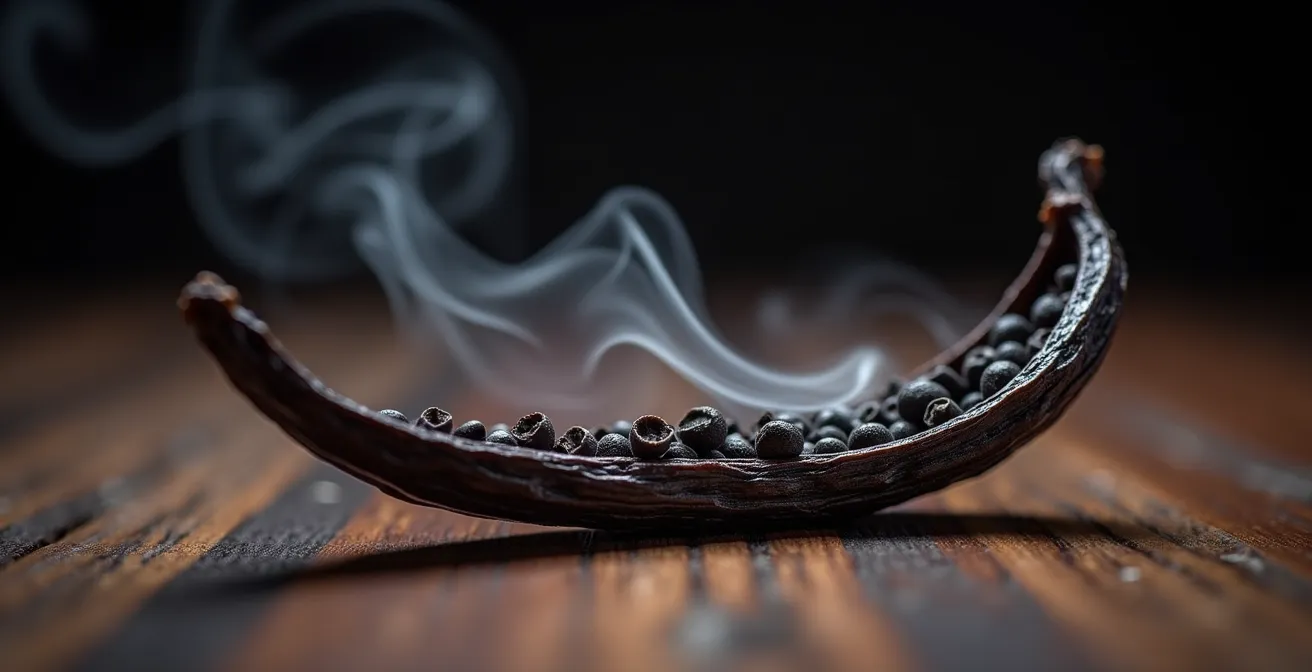
The secret ingredient’s power lies in its ability to create a new memory. While a familiar vanilla scent triggers an old memory, a mysterious twist on it—like smoked vanilla or vanilla paired with a savory element—creates a new memory anchor. The diner will forever associate that unique flavor combination with that specific restaurant, that specific evening. The delight comes from the resolution of a mystery, turning a passive meal into an active, engaging discovery.
Key takeaways
- Scent is responsible for up to 80% of what we perceive as flavor, making it the primary driver of our food experience.
- Olfactory memories are uniquely emotional because smells have a direct neurological pathway to the brain’s memory and emotion centers (hippocampus and amygdala).
- We can intentionally design menus and dining experiences using “olfactory architecture” to tell stories and evoke specific emotions like nostalgia and comfort.
How to Plate Desserts Like a Chef Using Just a Spoon?
The final act of our gastronomic story, the dessert, requires a presentation that supports its aromatic mission. Plating is not just about making food look pretty; it’s a functional art form designed to control and enhance the release of aromas. A chef’s most basic tool, the spoon, is surprisingly versatile for creating presentations that are both beautiful and olfactorily effective. The techniques are about maximizing surface area and guiding the diner’s experience.
Creating a “swoosh” or “smear” with a puree or a thick sauce is a classic technique. By dragging the back of a spoon through a dollop of sauce, a chef dramatically increases its surface area. More surface area means more of the sauce is exposed to the air, which in turn means more aromatic molecules are released, amplifying its scent. Another fundamental spoon technique is the “quenelle,” a perfectly smooth, three-sided oval of ice cream, sorbet, or mousse. Formed by passing the mixture between two warmed spoons, its curved, elegant shape isn’t just for looks. It provides a controlled surface that releases its aroma as it slowly warms on the plate and in the mouth.
Effective plating is also about what you *don’t* put on the plate. Using negative space strategically focuses the eye—and therefore the attention—on the key components. This prevents sensory overload and allows the primary aromatic elements to have their moment. The final touch often involves adding an aromatic garnish just before serving, like a sprinkle of zest or a few drops of an infused oil, to provide that immediate, powerful burst of scent that signals the end of the meal is a special occasion.
Action plan: Professional Plating Techniques for Aromatic Impact
- Master the Swoosh: Practice creating elegant smears with purees or thick sauces to increase surface area and release more aromatic molecules.
- Perfect the Quenelle: Use two spoons to form a smooth, curved quenelle of ice cream or mousse; its shape controls scent release as it warms.
- Embrace Negative Space: Use empty space on the plate to draw focus to the main components and prevent visual and olfactory clutter.
- Apply the Rule of Odds: Plate elements in groups of three or five for a composition that is more visually dynamic and appealing.
- Finish at the Table: Apply final, highly aromatic garnishes like zest or herb oils table-side for an immediate and dramatic scent impact for the diner.
When to Serve Dessert: The Perfect Timing for Maximum Gastronomic Emotion
We’ve designed the menu, controlled the ambiance, and perfected the plating. The final question for the olfactory architect is one of timing. When should the most emotionally resonant course—the dessert, often anchored by a nostalgic scent like vanilla—be served for maximum impact? The answer lies in a psychological principle known as the Peak-End Rule. This rule states that we don’t judge an experience based on the average of every moment, but on how we felt at its most intense point (the peak) and at its very end.
This makes the dessert course disproportionately important for the overall memory of a meal. A meal can be good, but a spectacular, emotionally resonant dessert can elevate the memory of the entire experience to great. Serving a dish with a powerful nostalgic scent like vanilla at the end creates a strong, positive emotional finish. This final feeling of comfort, warmth, and nostalgia colors the diner’s entire recollection of the evening. It’s the emotional equivalent of a film’s perfect ending, the final chord in a symphony that makes the whole piece feel complete.
Anticipation can amplify this effect. Introducing “olfactory trailers”—wafting the scent of baking desserts through the dining room or presenting a pre-dessert with a hint of the final course’s aroma—primes the brain’s memory centers. It builds a craving not just for something sweet, but for the emotional resolution that the dessert promises. By serving the nostalgic dessert at the very end, we are hacking our memory, ensuring that the final, lasting impression of the experience is one of pure, unadulterated comfort and delight. It’s the masterful, final touch of the olfactory architect.
Frequently Asked Questions About Why Does the Smell of Vanilla Trigger Childhood Memories?
Why do nostalgic scents work better at the end of meals?
The Peak-End Rule in psychology shows we judge experiences based on their peak moment and their ending. A vanilla-scented dessert creates a positive emotional finish that colors the entire meal memory, making it feel more special and memorable overall.
How long do scent-triggered memories last?
Research shows that olfactory memories can last for decades or even a lifetime. This is especially true for memories formed in childhood, before the age of 10, when smell is often the dominant sense for processing the world.
Should dessert scents be introduced before serving?
Yes, this is an excellent strategy. Pre-exposing diners to dessert aromas through “olfactory trailers” (like the faint smell of baking cookies) primes their memory centers and builds anticipation. This makes the eventual taste experience even more powerful and satisfying when it arrives.