
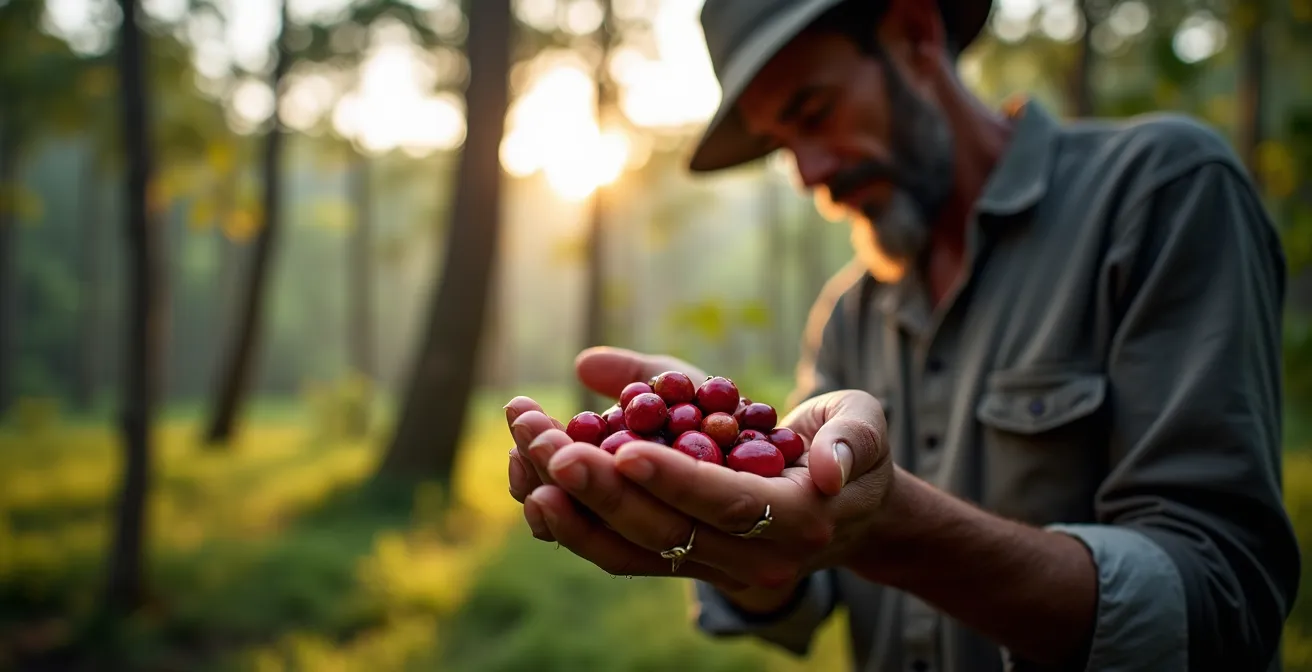
“Fair Trade” labels are not a guarantee of a living wage, but often a marketing tool within a system that traps farmers in poverty.
- The vast majority of a product’s final price is captured by intermediaries, roasters, and retailers, leaving producers with mere pennies.
- Many corporate “sustainability” programs lack independent, third-party verification, making their claims difficult to trust and often amounting to greenwashing.
Recommendation: Look beyond certifications. Investigate a brand’s supply chain transparency, prioritize direct trade models, and understand that the higher price of craft products often reflects a genuinely fairer cost.
You stand in the grocery aisle, a bar of chocolate or a bag of coffee in your hand. You see the “Fair Trade” logo and feel a small sense of relief, a belief that your purchase contributes to a better world. But a nagging question remains: does this sticker truly guarantee the farmer who grew these beans can feed their family? This skepticism is not unfounded. For years, we’ve been told that ethical consumption is as simple as looking for the right certification. We’ve been taught to equate logos with impact.
The reality, however, is far more complex and often deeply unsettling. The journey from a coffee cherry in Ethiopia to your morning latte is a labyrinth of economic pressures, corporate interests, and structural inequalities that a simple label cannot erase. But what if the label on the package is the beginning of the story, not the end? What if it’s a clue in a much larger economic puzzle, prompting us to look deeper? The truth is that the fundamental architecture of the global food supply chain is designed to concentrate value far from the source.
This article will not offer you a simple checklist of “good” and “bad” brands. Instead, it will equip you with the critical lens of an investigator. We will dissect the value chain to reveal where the money truly goes, expose the subtle tactics of greenwashing, and compare the real-world impacts of different sourcing models. By understanding the system’s hidden mechanics, you can move beyond blind faith in labels and begin making choices that are genuinely informed and truly impactful.
To navigate this complex landscape, this article breaks down the key issues you need to understand. The following sections will guide you through the economic realities, marketing myths, and environmental considerations that define truly ethical consumption.
Summary: Decoding the True Cost of Your Coffee and Chocolate
- Why Only $0.10 of Your $4 Latte Goes to the Farmer?
- How to Identify Fake Sustainability Claims on Chocolate Bars?
- Rainforest Alliance vs Direct Trade: Which Helps the Environment More?
- The Shipping Mistake That Negates Organic Farming Efforts
- When to Buy “Shade Grown”: The Impact on Biodiversity
- Why Direct Trade Pays Farmers 3x More Than Fair Trade?
- The “100% Arabica” Myth: Why It Doesn’t Guarantee Quality
- Why Bean-to-Bar Chocolate Costs More Than Supermarket Brands?
Why Only $0.10 of Your $4 Latte Goes to the Farmer?
The sticker price of your daily coffee is a poor indicator of the farmer’s income. The journey from farm to cup is crowded with intermediaries—exporters, importers, roasters, and retailers—each capturing a piece of the final price. This phenomenon, known as value capture, systematically funnels profits away from the producers who perform the most labor-intensive work. The result is a staggering disparity. While you pay several dollars for a finished beverage, the person who grew, harvested, and processed the beans receives a fraction of that amount.
The numbers tell a stark story. According to a report from Fairtrade International, the situation is even more dire than many assume. The organization’s analysis reveals that producers typically retain around one percent of the retail coffee price. For a $4 specialty coffee, this equals a meager $0.04. This isn’t a simple case of unfair margins; it’s a reflection of a structural inequality baked into the commodity market. Farmers are often price-takers, forced to accept rates set by global markets that have little connection to their actual cost of production or their need for a living wage.
An in-depth study of coffee value chains supplying the German retail market, commissioned by IDH and others, confirmed this trend. The “Grounds for Sharing” report found that value consistently concentrates away from farmers in countries like Ethiopia and Colombia, moving towards the powerful buyers and brands in consuming nations. Even the risk-mitigation strategies used by large corporations often end up disadvantaging the most vulnerable producers. The Fair Trade label aims to provide a price floor, but it operates within this fundamentally unbalanced system, often failing to lift farmers out of poverty.
How to Identify Fake Sustainability Claims on Chocolate Bars?
As consumer awareness of ethical issues grows, so does the corporate incentive for greenwashing. Many large chocolate companies have launched their own in-house “sustainability” programs, complete with proprietary logos and feel-good marketing language. These programs, such as Nestlé’s Cocoa Plan or Mondelēz’s Cocoa Life, often make bold claims about improving farmer livelihoods and ending child labor. However, a critical difference separates them from legitimate certifications: a lack of independent, third-party verification. Without external auditors, these claims remain largely aspirational and serve more as a marketing shield than a tool for genuine change.
The ineffectiveness of some of these programs is tragically clear. Despite the proliferation of certifications and corporate initiatives, critical issues persist. In fact, research shows that in West Africa’s cocoa sector, the problem has worsened. One report found a 14% increase in child labor between the 2013/14 and 2018/19 harvest seasons. This collision between marketing narratives and grim reality highlights the consumer’s need for profound skepticism.

To navigate this confusing landscape, it’s crucial to distinguish between robust third-party certifications and unverified corporate programs. The following table breaks down the key differences:
| Type | Examples | Independent Verification | Impact on Farmers |
|---|---|---|---|
| Third-party certifications | Rainforest Alliance, Fairtrade | Yes | Limited but verified |
| Corporate programs | Cocoa Life, Nestlé Cocoa Plan | No | Largely aspirational |
The key takeaway is to prioritize transparency and third-party validation. A corporate logo is a claim; a reputable certification like Fairtrade or Rainforest Alliance is, at the very least, a verified attempt to meet a set of standards, however imperfect.
Rainforest Alliance vs Direct Trade: Which Helps the Environment More?
When it comes to environmental impact, the debate often pits established certification models like the Rainforest Alliance against the philosophy of Direct Trade. The Rainforest Alliance focuses on establishing and certifying a set of sustainable agricultural practices, such as water conservation and reduced pesticide use. It provides a broad framework that can be applied at scale. While this creates a baseline for environmental responsibility, its impact can be diluted by the sheer scale and the varying levels of commitment from certified farms. It sets a standard, but may not always push for the most aggressive environmental regeneration.
Direct Trade, on the other hand, is not a certification but a sourcing model built on relationships. Roasters or chocolate makers buy directly from farmers or cooperatives, cutting out intermediaries. This proximity often fosters a deeper collaboration on quality and sustainability. While its primary goal is often economic, the model inherently supports environmental stewardship because high-quality beans frequently come from healthy ecosystems. Forward-thinking partners often invest in specific environmental projects like agroforestry, going beyond a simple certification’s requirements.
Case Study: Regenerative Agriculture in Action
A partnership between Nestlé and the agricultural supplier Ofi illustrates a targeted environmental approach. The project aims to plant 2.8 million shade trees across 72,000 hectares in Brazil, Nigeria, and the Ivory Coast. By training 25,000 farmers in agroforestry and composting, the initiative is projected to cut 1.5 million tons of carbon over three decades. This type of targeted, long-term investment in regenerative practices often goes beyond the scope of a standard certification audit and demonstrates a deeper commitment to ecosystem health.
Ultimately, neither model is a perfect monolith. The Rainforest Alliance offers wide-reaching, verifiable standards, while Direct Trade provides the potential for deeper, more impactful, but less standardized, partnerships. The most environmentally beneficial choice often depends on the specific commitment of the brand and its willingness to invest in practices like agroforestry and biodiversity, regardless of the label it uses.
The Shipping Mistake That Negates Organic Farming Efforts
The “organic” label has become a powerful symbol of conscious consumption, often associated with better environmental practices. While organic farming methods do eliminate synthetic pesticides and fertilizers, consumers often overlook a massive economic blind spot: transportation. The carbon footprint of shipping can be so significant that it completely negates the environmental benefits gained at the farm level. This is particularly true for “fresh” produce that is air-freighted across the globe to satisfy out-of-season demand.
The scale of this issue is startling. When you choose an organic product that has traveled thousands of miles by plane, you may be making a worse choice for the climate than buying a conventionally-farmed local alternative. The discrepancy is not minor, as a transport emissions analysis reveals:
Air-freighting ‘fresh’ but out-of-season organic produce can generate a carbon footprint up to 50 times larger than local, conventionally-farmed equivalents.
– Analysis based on transport emissions data, Industry analysis of organic food transport
This counter-intuitive fact forces a re-evaluation of what “ethical” truly means. It’s not enough to focus solely on farming methods. A holistic view of the entire supply chain, including the “food miles” a product travels, is essential. For products like coffee and chocolate that are grown in the Global South, sea freight is a much lower-impact option than air freight. Consumers must learn to factor origin and seasonality into their purchasing decisions, prioritizing local when possible and being mindful of the hidden environmental costs of global logistics.
Your Action Plan to Audit a Product’s Carbon Footprint
- Check Origin Labels: Identify where the product was grown and calculate the approximate transport distance to your location.
- Prioritize Seasonality: Choose seasonal, locally-grown produce over produce that has been air-freighted from another hemisphere.
- Look for Shipping Disclosures: Some transparent brands disclose their shipping methods. Prioritize products that explicitly state they are transported by sea freight.
- Support Local Producers: For products that can be grown locally, supporting local farmers is the most effective way to eliminate international shipping emissions.
- Question “Freshness”: Be skeptical of “fresh” exotic produce that is far out of its natural season in your region; it has likely been air-freighted.
When to Buy “Shade Grown”: The Impact on Biodiversity
Among the many terms found on coffee packaging, “Shade Grown” is one of the most environmentally significant. Historically, coffee was cultivated under the canopy of native forest trees. However, in a push for higher yields, many farms were converted to “sun-grown” monocultures, which involved clear-cutting forests. This practice has had a devastating impact on biodiversity, destroying habitats for countless species, particularly migratory birds. Shade-grown coffee represents a return to a more harmonious, integrated agricultural system known as agroforestry.
In a shade-grown system, coffee plants thrive in the understory of a diverse forest. This canopy provides a habitat for birds, insects, and other animals. The birds, in turn, act as natural pest control, reducing the need for chemical pesticides. The leaf litter from the canopy trees enriches the soil, decreasing the reliance on synthetic fertilizers and improving water retention. This creates a resilient, self-sustaining ecosystem that stands in stark contrast to the ecological desert of a sun-grown plantation.
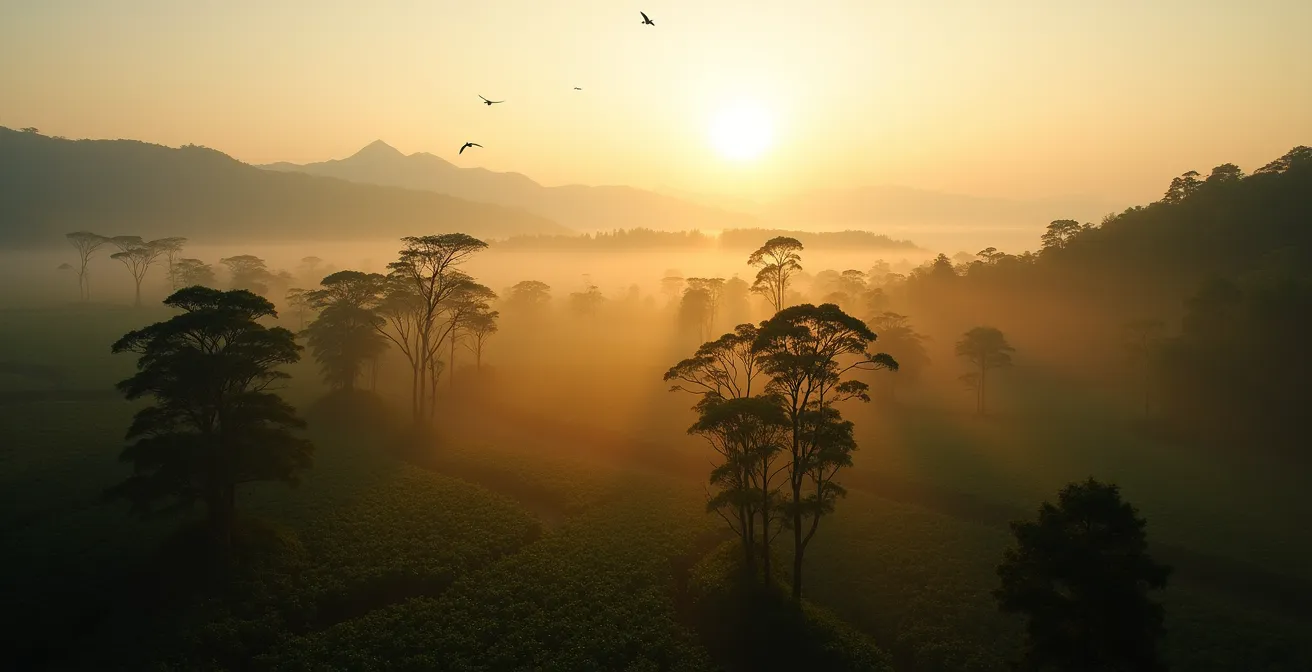
The positive impact on biodiversity is not just theoretical; it’s scientifically documented. The Smithsonian Migratory Bird Center has been a pioneer in this field, creating the “Bird Friendly” certification, the gold standard for shade-grown coffee. Their extensive research provides clear evidence of its benefits. For instance, Smithsonian research confirms that there can be up to 4x more bird species found on shade-grown farms compared to their sun-grown counterparts. Choosing shade-grown coffee is therefore a direct investment in preserving critical habitats and supporting biodiversity.
Why Direct Trade Pays Farmers 3x More Than Fair Trade?
Fair Trade was founded on the principle of ensuring farmers receive a better deal. It operates by establishing a minimum price for coffee and adding a “Fair Trade premium,” a sum of money designated for community development projects. This model provides a crucial safety net, protecting farmers from devastatingly low market prices. Data from Fair Trade USA shows this premium adds a tangible, albeit modest, amount to farmers’ income. For example, their standard offers a premium of $0.30-0.60 per pound over conventional prices for certified coffee. While beneficial, this premium is often not enough to provide a true living wage and is spread across a cooperative rather than directly boosting an individual farmer’s income significantly.
Direct Trade, in contrast, is a sourcing philosophy, not a certification. It’s built on a direct relationship between the coffee roaster and the farmer. By eliminating the layers of intermediaries (exporters, importers), a much larger portion of the money can go straight to the producer. This model is fundamentally about quality. Roasters seek out exceptional coffees and are willing to pay a significant premium for them. This payment is not a fixed premium but a price negotiated based on the coffee’s quality score, often reaching two, three, or even more times the Fair Trade price.
This distinction between a “price floor” and a “quality premium” is the core of the issue. Fair Trade protects against the bottom, while Direct Trade rewards the top. As one industry expert astutely points out, the two models serve different, though sometimes overlapping, purposes.
Fair Trade provides a ‘living wage floor’ and many committed Fair Traders pay substantially higher prices. The few real Direct Traders offer real price premiums for limited amounts of high-quality coffee.
– Dean Cycon, Trellis analysis on sustainable coffee production
For the conscious consumer, this means understanding that while Fair Trade offers a baseline of support, Direct Trade models often represent a more profound economic partnership that can genuinely transform a farmer’s livelihood by directly rewarding their expertise and hard work.
The “100% Arabica” Myth: Why It Doesn’t Guarantee Quality
For decades, coffee marketing has hammered home a simple message: “100% Arabica” equals superior quality. This has led consumers to believe that any coffee labeled as such is inherently better than blends containing Robusta, its hardier cousin. While it’s true that the Arabica species is generally known for its complex, aromatic, and acidic flavor profile, the “100% Arabica” claim has become a hollow marketing slogan that often masks mediocrity.
The reality is that there is a vast spectrum of quality within the Arabica species itself. Low-grade, poorly processed Arabica beans can taste far worse than a high-quality, carefully cultivated Robusta. The “100% Arabica” label tells you nothing about the altitude where the beans were grown, the care with which they were picked, or the precision of the processing method—all factors that have a much greater impact on the final taste in the cup. It’s often used by large commercial brands to justify a slightly higher price point, as market data consistently shows Arabica commands higher prices than Robusta, regardless of actual quality.
This quality hierarchy is now being actively challenged by the emerging “Fine Robusta” movement. This initiative is proving that when the Robusta species is grown with the same care and processed with the same precision as specialty Arabica, it can produce an exceptional cup with a rich body, low acidity, and a pleasant sweetness. The “Fine Robusta” movement demonstrates a crucial point for the discerning consumer: the processing method (like fermentation and drying) and the skill of the farmer have a greater impact on the final taste than the species alone. A focus on “100% Arabica” is another economic blind spot, a marketing shortcut that prevents consumers from discovering a world of high-quality coffee beyond the traditional narrative.
Key Takeaways
- The final price of coffee or chocolate rarely reflects the farmer’s income, as value is systematically captured by intermediaries and brands.
- Corporate “sustainability” programs without independent, third-party verification should be viewed with skepticism as they often serve as marketing tools.
- True ethical impact requires looking beyond labels to consider the entire supply chain, from biodiversity and agroforestry practices to the carbon footprint of shipping.
Why Bean-to-Bar Chocolate Costs More Than Supermarket Brands?
Walking down the confectionery aisle, the price difference is stark: a mass-market chocolate bar might cost a dollar or two, while a craft “bean-to-bar” chocolate can easily be five to ten times more expensive. This isn’t arbitrary pricing; it’s a direct reflection of two fundamentally different production philosophies and economic models. The higher cost of bean-to-bar chocolate is the tangible price of quality, ethics, and craftsmanship.
The first major cost driver is the raw material. Industrial chocolate is made from bulk “commodity” cacao, purchased on the global market for the lowest possible price. In contrast, bean-to-bar makers source “fine flavor” or single-origin cacao, often through direct trade relationships. They pay a significant premium for these beans, rewarding farmers for unique flavor profiles and high-quality post-harvest processing. This sourcing model directly tackles the value capture problem, ensuring more money reaches the producer.
The second factor is the production process itself. Industrial manufacturing is a game of speed and scale, using massive batches and shortcuts. Craft chocolate making is a slow, meticulous art. The “conching” process, which develops flavor and creates a smooth texture, can last for 72 hours or more in a craft setting, compared to just a few hours in an industrial factory. Furthermore, craft makers use minimal ingredients—typically just cacao beans and sugar—while industrial bars often contain cheaper fillers like vegetable fats, soy lecithin, and artificial vanilla to mask the flavor of low-quality beans.
This table summarizes the fundamental divide between the two approaches:
| Aspect | Industrial | Craft/Bean-to-Bar |
|---|---|---|
| Batch Size | Massive scale | Small batches |
| Processing Time | Hours with shortcuts | 72+ hour conching |
| Additives | Vanilla, soy lecithin | Minimal to none |
| Raw Material Cost | Commodity pricing | High-premium pricing |
The next time you see the higher price on a bean-to-bar chocolate, don’t just see the cost. See the investment in a farmer’s livelihood, the dedication to craftsmanship, and the true price of a more just and flavorful world. Choosing these products is one of the most direct ways to vote with your wallet for the system you wish to support.