

In summary:
- Your coffee is bitter not just from brewing too long, but from tiny coffee particles (fines) that continue to extract bitterness.
- Letting coffee sit after plunging is a primary cause of harshness, as extraction never truly stops in a French press.
- The secret to a smooth cup is mastering particle management: let the fines settle and don’t agitate them.
- A dirty filter mesh coated in old, rancid oils will make even the best coffee taste bitter.
There’s a romantic ideal to the French press: the slow plunge, the rich aroma, the full-bodied cup. But the reality for many is often a disappointing, sludgy brew with a harsh, bitter finish. You’ve probably heard the standard advice: use a coarser grind, don’t use water that’s too hot, and stick to a strict four-minute brew time. You follow the rules, yet the bitterness persists. This is frustrating, and it makes you question if you’re just not cut out for this brewing method.
The problem is that this common advice only scratches the surface. It treats brewing like a simple recipe, but it’s really a physical and chemical process that you need to control. The bitterness you’re tasting isn’t necessarily a flaw in your beans or your timer. It’s the result of two hidden enemies: uncontrolled extraction from suspended coffee “fines” and the lingering taste of rancid, polymerized oils from a filter that isn’t truly clean. The key to a perfect French press isn’t just about what you do for the first four minutes; it’s about what you do after, and how you manage the physical elements inside the carafe.
This guide will correct the common mistakes that lead to bitterness. We will go beyond generic tips to explore the science of immersion brewing. You will learn not just what to do, but why you’re doing it, from mastering particle management with the “Hoffmann Method” to understanding the crucial role of filter hygiene. By the end, you’ll have the knowledge to stop producing bitter coffee and start consistently brewing the rich, smooth, and clean cup you’ve always wanted.
For those who prefer a visual demonstration, the following video provides an excellent overview of the ultimate French press technique, which aligns with the principles we’ll be discussing.
To help you navigate these corrective techniques, this article is structured to address each primary cause of bitterness. We will tackle common mistakes one by one, providing the scientific reasoning and a practical solution for each, allowing you to build a reliable brewing routine.
Summary: How to fix bitter French press coffee
- Why Leaving Coffee in the Press for 10 Minutes Ruins It?
- How to Use the “Hoffmann Method” for a Sludge-Free Cup?
- Metal Mesh vs Silicone Seal: Which Presses Cleaner?
- The Stirring Mistake That Increases Bitterness
- When to Deep Clean the Mesh Filter to Remove Rancid Oils?
- Why Paper Filters Remove Oils That Metal Filters Keep?
- How to Brew Brazilian Beans to Maximize Mouthfeel?
- Immersion vs Pour-Over: Which Method for a Cleaner Cup?
Why Leaving Coffee in the Press for 10 Minutes Ruins It?
The single most common mistake casual brewers make is treating the French press like a serving carafe. You plunge the coffee and leave it on the counter, pouring cups as you go. This is a guaranteed recipe for bitterness. Unlike other methods where water passes through the grounds and exits, immersion brewing means your coffee grounds remain in contact with the water for the entire duration. The plunge doesn’t stop extraction; it only separates the majority of the grounds from the liquid above.
Extraction is a race against time. The desirable compounds—sugars, acids, and aromatics—are extracted first. After that, you start pulling out the heavy, bitter compounds. Coffee brewing science confirms that for French press, you hit an “extraction ceiling” after about four minutes. According to coffee professionals, after 4 minutes, bitter compounds dominate extraction, leading to an unbalanced and harsh taste. Every minute the brewed coffee sits on top of the bed of grounds, those suspended fine particles continue to release bitterness into your cup.
The solution is simple but non-negotiable: decant immediately. As soon as you plunge, pour all of the coffee out of the French press and into a separate server or directly into your mugs. This physically separates the brewed liquid from the grounds, effectively halting the over-extraction process. If you only want one cup, consider using a smaller press or adjusting your recipe. Leaving the rest of the brew to sit is the primary reason your second cup tastes so much worse than your first.
How to Use the “Hoffmann Method” for a Sludge-Free Cup?
If you’re frustrated with a gritty, sludgy texture in your coffee, the problem lies in poor particle management. Even with a good grinder, you will always produce a mix of coarse grounds and microscopic “fines.” When you plunge aggressively, these fines are forced through and around the mesh filter, ending up as a muddy sediment at the bottom of your cup. The key is not to fight the fines, but to let them settle naturally.
This is the core principle behind the technique popularized by coffee expert James Hoffmann. Instead of a frantic four-minute brew and a hard plunge, his method is a patient, two-stage process. It involves a standard four-minute steep, followed by a gentle break of the top “crust” of grounds, and then a long, undisturbed wait of five to eight minutes. During this second waiting period, the fines slowly drift to the bottom of the press. The plunger is then used not as a press, but as a strainer, lowered only to the surface of the coffee to hold back the floating grounds as you pour.
This approach dramatically reduces sludge and, as a side benefit, bitterness, because the fines are taken out of the equation. They settle into a compact bed at the bottom and are not agitated, minimizing their ability to over-extract. The result is a stunningly clean and sweet cup that shatters the myth that French press coffee has to be “dirty.”
Your Action Plan: The Hoffmann Method Step-by-Step
- Pour boiling water over your medium-ground coffee (a 30g coffee to 500g water ratio is a great start) and start a timer.
- Wait for 4 minutes without stirring. A crust of coffee grounds will form on the surface.
- At 4 minutes, use two spoons to gently break the crust. Skim any remaining foam or floating grounds off the top.
- Let the coffee sit and settle for an additional 5 to 8 minutes. Do not disturb the press during this time.
- Place the plunger just below the surface of the liquid to act as a gate, but do not press it down through the grounds.
- Pour slowly and steadily into a decanter or your mug, leaving the bottom inch of coffee and the settled sediment behind.
Metal Mesh vs Silicone Seal: Which Presses Cleaner?
You can have the perfect grind and the perfect technique, but if your equipment is working against you, you’ll still get a gritty cup. The quality of your French press’s filter assembly matters more than most people think. The assembly typically consists of a metal mesh filter plate held in place by a coiled spring edge. However, a growing number of modern presses now feature a flexible silicone seal around the edge of the filter.
This seemingly small detail makes a huge difference in clarity. A traditional metal spring edge can never create a perfect seal against the glass carafe. There are always microscopic gaps, and over time, the spring can warp or lose its tension, widening these gaps. When you plunge, water pressure forces the finest coffee particles through these gaps, bypassing the filter entirely and ending up in your cup as sludge.
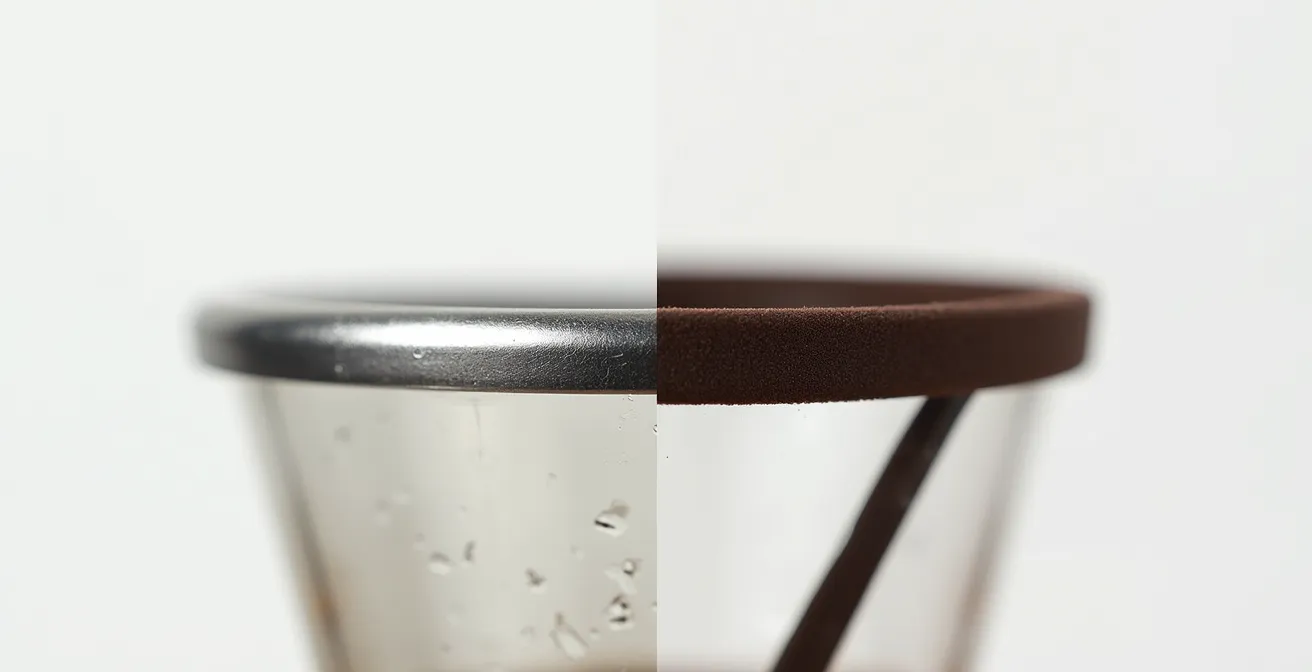
A silicone seal, on the other hand, is flexible and conforms perfectly to the walls of the carafe. It creates a complete barrier that prevents bypass. As you can see in the comparison, the silicone provides a much more effective seal, ensuring that virtually all the liquid must pass through the filter mesh itself. If you’re serious about brewing the cleanest possible cup of French press coffee and are in the market for a new one, opting for a model with a silicone-edged plunger is a smart upgrade for superior passive filtration.
The Stirring Mistake That Increases Bitterness
The impulse to stir a French press is understandable. You pour in the water and see a dry crust of coffee grounds floating on top. Surely, you need to stir them in to ensure they all get wet, right? Wrong. Vigorous stirring, especially mid-brew, is one of the fastest ways to increase bitterness and sludge. When you stir, you create a vortex that doesn’t just wet the grounds—it kicks up all the fine particles and keeps them suspended in the liquid.
These suspended fines have a massive amount of surface area, and they extract very, very quickly. Keeping them agitated throughout the brew time is like putting your extraction on hyperdrive, pulling out harsh, astringent flavors that overwhelm the sweeter notes. This is why the Hoffmann method explicitly advises against stirring. The initial pour of hot water is turbulent enough to saturate the grounds, and the four-minute steep allows the “crust” to form, which actually helps with an even extraction.
If you must do anything, a gentle back-and-forth fold with a spoon right after you pour the water is acceptable to ensure there are no dry clumps. After that, hands off. Minimal agitation is the goal. Here is a simple guide to proper agitation:
- DO: If needed, gently fold the grounds with a spoon during the first 30 seconds (the “bloom” phase) just to ensure all grounds are wet.
- DON’T: Create a whirlpool that keeps fine particles in suspension.
- DO: Break the crust gently with spoons after 4 minutes, causing as little disturbance as possible.
- DON’T: Stir vigorously right before you plunge. This is the worst time, as it churns up all the settled sediment you want to leave behind.
When to Deep Clean the Mesh Filter to Remove Rancid Oils?
Even if you meticulously rinse your French press filter after every use, it’s not truly clean. Coffee is full of natural oils. Over time, these oils build up on the fine wires of the metal mesh. Exposed to air, they oxidize and polymerize, turning into a sticky, rancid varnish that regular dish soap can’t remove. This layer of oil polymerization is a hidden source of bitterness that can taint every subsequent brew.
If your coffee suddenly starts tasting bitter or “off” for no apparent reason, or if you notice a faint, stale coffee smell from your dry filter, it’s a sure sign of oil buildup. A visual check can also be revealing. Hold your clean, dry filter up to a light source. If you see an iridescent, rainbow-like sheen on the mesh, you’re looking at a layer of old, polymerized coffee oil. This buildup not only adds a rancid flavor but can also clog the microscopic holes in your filter, affecting extraction.

Professional Barista Cleaning Protocol
To combat this, coffee professionals use dedicated coffee equipment cleaners. Products like Cafiza contain compounds specifically designed to break down and dissolve polymerized coffee oils. A 30-minute soak in a solution of a specialized cleaner can strip the filter mesh back to its bare metal, completely eliminating the source of rancid flavors and restoring the filter to like-new condition. For home use, a monthly deep clean is a good rule of thumb to keep your coffee tasting fresh.
For a less chemical-intensive approach, a long soak (overnight) in a 1:3 solution of white vinegar and water can also help dissolve some of the buildup, followed by a thorough scrub and rinse. Regardless of the method, deep cleaning your filter is a crucial maintenance step that should not be skipped.
Why Paper Filters Remove Oils That Metal Filters Keep?
The fundamental difference between a French press and a pour-over or drip coffee machine lies in the filter material. It’s a simple distinction—metal versus paper—that completely changes the final cup’s character, body, and flavor profile. This difference comes down to microscopic pore size and the absorbent nature of paper.
A French press’s metal mesh is designed to hold back solid coffee grounds while letting everything else through. This includes water, soluble flavor compounds, and, crucially, the coffee’s natural oils and microscopic fine particles. A paper filter, by contrast, does much more. According to filter porosity research, paper filters have pores measured in microns, which are exponentially smaller than the holes in a metal mesh. These tiny pores trap not only all of the coffee fines but also absorb a significant portion of the oils.
These oils, known as diterpenes, are what give French press its signature heavy body and rich mouthfeel. Removing them results in a “cleaner” cup with higher flavor clarity, where subtle acidic and floral notes can shine through. As one comprehensive study notes, this trade-off is central to the brewing method.
The oils (diterpenes like cafestol and kahweol) are responsible for the heavy body and rich mouthfeel of French Press coffee. Removing them with paper leads to a ‘cleaner,’ more tea-like cup with higher flavor clarity, but less body.
– European Food Research and Technology Study, Comparison of nine common coffee extraction methods
Neither method is inherently better; they simply produce different results. If you value a heavy, creamy texture, the metal filter of the French press is your friend. If you prioritize delicate flavor clarity and a complete absence of sediment, a paper filter method might be more to your liking.
How to Brew Brazilian Beans to Maximize Mouthfeel?
Once you understand that the French press is designed to preserve oils and create a full body, you can start using it to your advantage. This is especially true when brewing coffees that are known for their creamy, nutty, and chocolatey profiles, like many beans from Brazil. For these types of coffees, the goal isn’t necessarily delicate clarity, but rather a rich, satisfying mouthfeel. You can lean into this by adjusting your brew ratio.
The coffee-to-water ratio is a powerful tool for controlling the strength and body of your brew. While a common starting point for many methods is 1:16 or 1:17 (1 gram of coffee for every 16 or 17 grams of water), tightening this ratio will increase the concentration of dissolved solids and oils in the final cup. This leads to a perception of greater body and a more robust flavor profile.
For a classic Brazilian coffee where you want to emphasize its natural sweetness and low acidity, using a French press with a tighter ratio is a perfect pairing. For instance, brewing science demonstrates that a 1:14 ratio increases perceived body significantly compared to a standard 1:16 ratio. This small change can transform your cup from good to great, creating a syrupy, dessert-like experience. This is a clear example of how to match your brewing method and technique to the specific characteristics of the beans you are using.
Key takeaways
- Bitterness is caused by over-extracting fine particles and using a filter with rancid oil buildup.
- The best technique involves a long, patient settling time (Hoffmann Method) to manage sediment.
- Always decant all coffee immediately after plunging to stop extraction. A monthly deep clean of the filter is essential.
Immersion vs Pour-Over: Which Method for a Cleaner Cup?
The debate between immersion (like French press) and pour-over often comes down to a single question: what do you mean by a “clean” cup? As we’ve seen, the definition of clean can refer to flavor clarity, the absence of oils, or the lack of physical sediment. Each method excels in different areas, and the choice depends entirely on your personal preference.
A pour-over, with its dense paper filter, is the undisputed champion of clarity and sediment-free brewing. It produces a light, often described as “tea-like,” cup where delicate and acidic flavor notes are prominent because the oils and all fine particles have been removed. Immersion brewing with a metal filter, by its very nature, produces a cup with more texture and a heavier body. It can be just as “clean” in terms of sediment if you use a proper technique like the Hoffmann method, but it will never have the same flavor profile as a paper-filtered coffee because the oils are preserved.
The following table, based on data from scientific analysis, breaks down the key differences.
| Cleanliness Factor | French Press (Immersion) | Pour-Over (Paper Filter) |
|---|---|---|
| Oil Content | High – metal filter preserves oils | Low – paper absorbs oils |
| Fine Particles | Variable – depends on technique | Very low – paper traps all fines |
| Clarity of Flavor | Lower – oils mask subtle notes | Higher – clean separation of flavors |
| Body/Mouthfeel | Heavy, creamy texture | Light, tea-like consistency |
| Sediment with Proper Technique | Minimal with Hoffmann method | None |
Interestingly, some coffee professionals have developed a hybrid method to get the best of both worlds. They perform a full immersion brew in a French press for full flavor development and then decant the liquid through a paper pour-over filter. According to studies on extraction methods, this technique captures the rich sweetness of immersion while achieving the pristine clarity of paper filtration, proving that you don’t always have to choose one over the other.
Ultimately, brewing a French press you love is about taking control of the process. By understanding that bitterness comes from mismanaged fine particles and dirty equipment, you can move beyond the generic four-minute rule. Embrace a more patient technique, decant your coffee immediately, and keep your filter truly clean. These corrections will empower you to consistently produce a rich, smooth, and sludge-free cup that lives up to the French press’s romantic promise.