
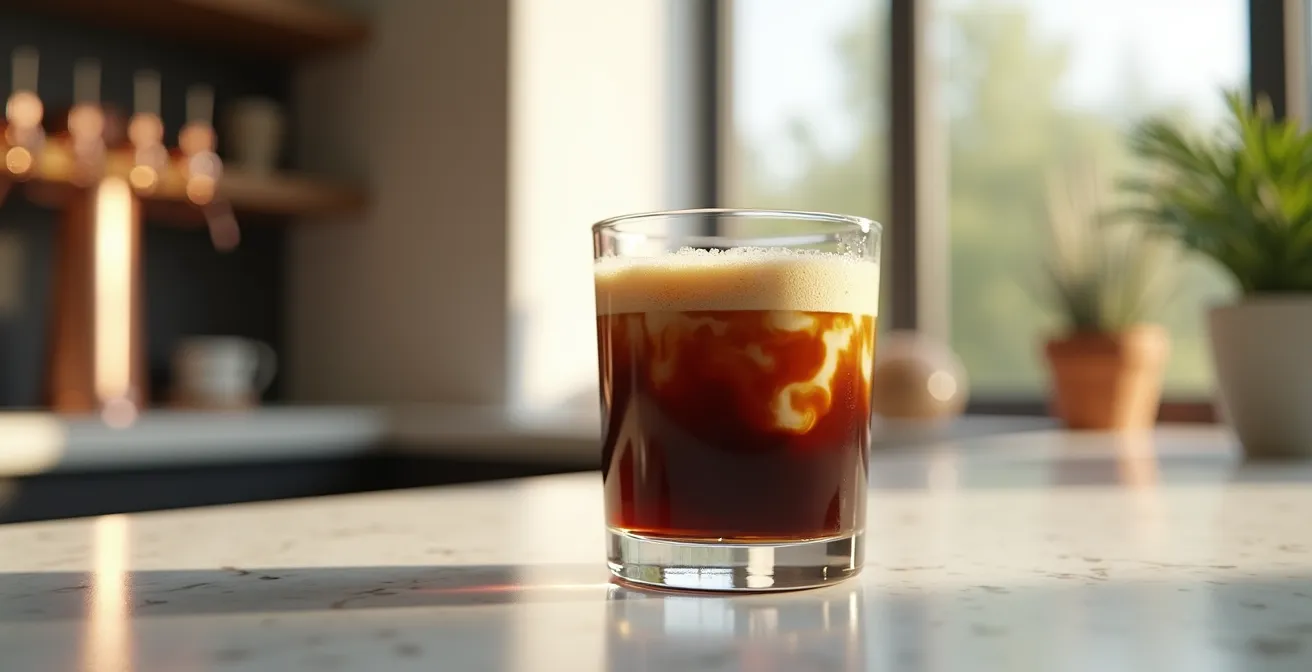
Contrary to what your senses tell you, the rich, creamy texture of nitro cold brew has nothing to do with milk or cream. It’s a feat of beverage engineering rooted in physics. The secret lies in the extremely low solubility of nitrogen gas, which creates billions of microscopic bubbles. These “microbubbles” act as a physical texture agent, manipulating mouthfeel to create a powerful sensory illusion of creaminess that dairy-free drinkers can enjoy.
The first sip of a nitro cold brew is a moment of cognitive dissonance. The eyes see a dark, cascading liquid, but the tongue experiences a rich, velvety smoothness that feels uncannily like it contains cream. For the lactose-intolerant or anyone seeking a dairy-free option, this raises a compelling question: how is this creamy texture possible without a single drop of milk? The common answer, “it’s the nitrogen,” is true but deeply unsatisfying. It’s like saying a car moves “because of the engine” without explaining the principles of internal combustion.
The real innovation behind nitro cold brew isn’t just the addition of a gas; it’s the deliberate manipulation of fluid dynamics and sensory science. This process involves more than just making coffee bubbly; it’s about engineering a specific bubble size and stability to create a desired physical effect. The specialized equipment, from stout faucets to high-pressure kegs, isn’t for show—it’s essential to achieving the precise conditions needed for this textural transformation. The result is a beverage that fundamentally alters the physical interface between the coffee and your palate.
This article will deconstruct the science behind this phenomenon. We will move beyond the surface-level explanations and dive into the physics of gas solubility, the mechanics of microbubble formation, and the sensory science that explains how this texture tricks our brains. By understanding these principles, you’ll not only appreciate your next nitro cold brew on a deeper level but also see how a simple element like nitrogen can revolutionize a beverage’s very nature.
To fully grasp the science and art behind this unique beverage, we will explore the core principles that give nitro cold brew its signature character. This guide breaks down everything from the fundamental physics of the bubbles to the practical methods for recreating the experience at home.
Summary: The Science and Sensation of Nitro Cold Brew
- Why Nitrogen Bubbles Are Smaller and Smoother Than Soda?
- How to Make Nitro Coffee Using a Whipped Cream Dispenser?
- Nitro vs Still Cold Brew: Which Feels Sweeter on the Tongue?
- The Shaking Mistake That Kills the Cascade Effect
- When to Use a Tulip Glass: Enhancing the Nitro Head Retention
- Why Reducing Sugar in Ice Cream Makes It Rock Hard?
- Why Stale Beans Produce Zero Foam on Your Espresso?
- Oat vs Almond Milk: Which Plant Base Steams Like Real Dairy?
Why Nitrogen Bubbles Are Smaller and Smoother Than Soda?
The fundamental difference between the harsh fizz of a soda and the velvety texture of a nitro coffee lies in the physics of gas solubility. The gas used in soda, carbon dioxide (CO2), is relatively soluble in water. When pressure is released, it escapes solution by forming large, aggressive bubbles that our tongue perceives as a sharp, prickly sensation. Nitrogen (N2), by contrast, is the key to smoothness precisely because it resists dissolving in liquid. This is the core of the microbubble effect.
Nitrogen is approximately 70 times less soluble in water than CO2. When high-pressure, nitrogen-infused coffee is forced through a special stout faucet, the dramatic and sudden pressure drop forces the N2 out of the solution. Because it escapes so violently and reluctantly, it shatters into millions of microscopic bubbles. A study of the process explains that these tiny, stable bubbles are so small and numerous—often 10-100x smaller than CO2 bubbles—that they behave differently. Instead of quickly rising and popping, they linger, suspended in the liquid.
These microbubbles act like billions of microscopic ball bearings, creating a rich, viscous mouthfeel. They create a physical structure within the liquid that your tongue interprets as creaminess, all without any fat content. It’s a purely physical illusion, a testament to how changing a beverage’s structure can completely transform its sensory perception. The genius is not in adding a gas, but in choosing a gas that is inherently unstable when dissolved, as described in a detailed scientific explanation of the physics.
How to Make Nitro Coffee Using a Whipped Cream Dispenser?
While commercial establishments use complex kegerator systems with pure nitrogen gas, the fundamental physics of the nitro effect can be replicated at home using a common kitchen tool: a whipped cream dispenser. This method relies on nitrous oxide (N2O) cartridges, which, while chemically different from pure nitrogen (N2), produce a remarkably similar creamy texture and cascading foam due to comparable solubility properties.
The process involves using the pressure from the cartridge to force gas into the cold brew, then releasing that pressure upon dispensing to trigger the formation of microbubbles. The key is vigorous shaking, which creates what are known as nucleation sites—microscopic points in the liquid where bubbles can begin to form. Without sufficient agitation, the gas won’t dissolve properly, and the resulting pour will be flat and lifeless.
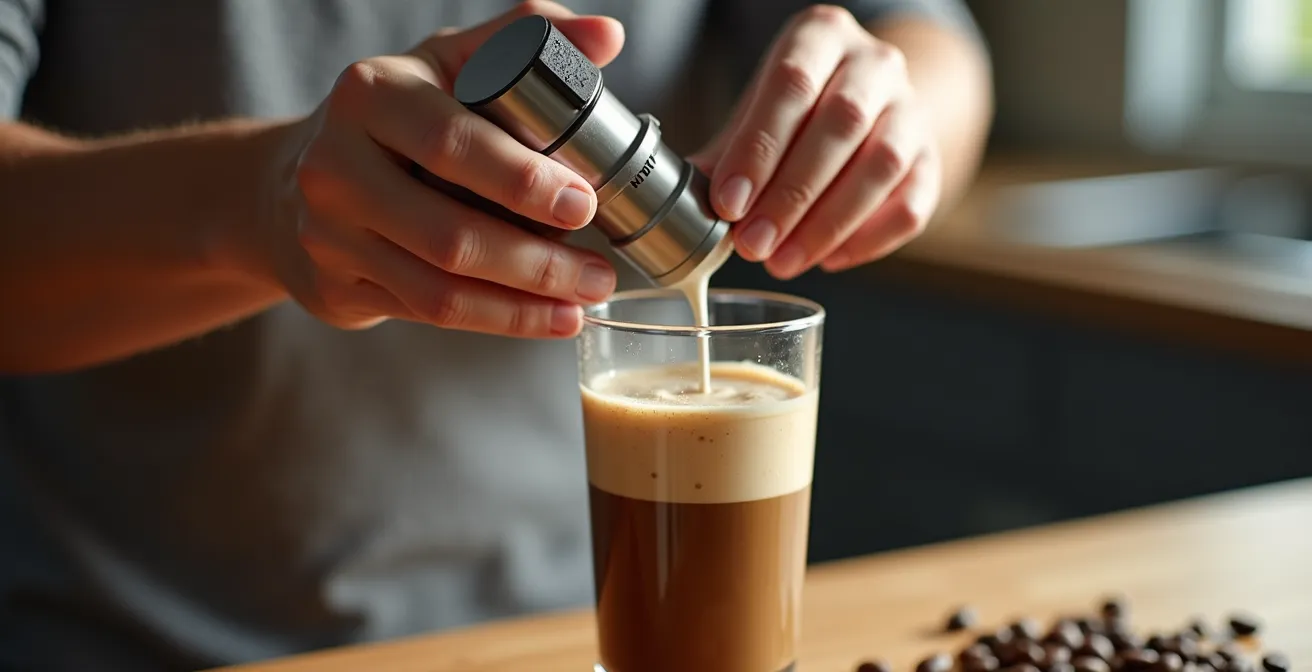
To achieve the perfect home-nitro, precision is key. The ratio of coffee concentrate to water, the number of charges, and the shaking technique all contribute to the final texture. It’s a simple process, but one where technique matters immensely for creating that signature velvety mouthfeel and stable head of foam.
Action Plan: Home Nitro Coffee Preparation
- Pour cold brew concentrate (diluted 1:1 with water) into the whipped cream dispenser.
- Charge the cream whipper with one nitrous oxide (N2O) cartridge.
- Shake vigorously for about 30 seconds to create micro-bubble nucleation sites.
- Discharge any excess gas by pressing the trigger lightly before dispensing.
- Turn the canister upside down and dispense into a frosty glass for best results.
Nitro vs Still Cold Brew: Which Feels Sweeter on the Tongue?
One of the most reported sensory effects of nitro infusion is that it makes the coffee taste smoother and even slightly sweeter, despite having no added sugar. This isn’t a chemical change; the coffee’s molecular composition remains identical. Instead, the perceived sweetness is a direct result of the sensory mimicry created by the nitrogen bubbles. The texture is altering your perception of the flavor.
Bitterness and sweetness are perceived by receptors on our tongue, but the overall experience of “flavor” is heavily influenced by mouthfeel and aroma. The dense foam and velvety liquid of a nitro cold brew act as a buffer, coating the tongue. This creamy layer physically dampens the perception of harsh, bitter compounds that are often present in coffee. By reducing the perceived bitterness, the brain interprets the coffee’s inherent sweetness—from the coffee beans themselves—more prominently. It’s not that the coffee is sweeter; it’s that the bitterness is less distracting.
This phenomenon is expertly explained by Dr. Christopher Hendon, a computational chemist at the University of Oregon, who studies the science of coffee. He notes how the physical structure of the drink is paramount:
Nitrogen doesn’t change the molecular composition of cold brew. It changes the physical interface between beverage and biology. Those microbubbles act like a lubricating film—reducing bitterness perception by up to 37%, per sensory panel data—and altering how volatiles interact with olfactory receptors.
– Dr. Christopher Hendon, University of Oregon
This change in the “physical interface” is the key. The bubbles don’t just add texture; they fundamentally alter how our senses engage with the coffee, creating a smoother, richer, and seemingly sweeter experience without adding a single calorie.
The Shaking Mistake That Kills the Cascade Effect
The mesmerizing “cascade” effect, where bubbles appear to fall downwards before rising to form a thick head, is the visual signature of a perfect nitro pour. However, this effect is surprisingly fragile and is often ruined by a simple mistake: insufficient solids in the coffee itself. The cascade is a complex dance of fluid dynamics, and it requires a certain density in the liquid to work. If the cold brew is too watery, the effect will be weak or non-existent.
The cascade is an illusion created by the shape of the glass and the movement of the liquid. As bubbles rise in a typical flared pint glass, they create a low-density, bubble-rich column in the center. Meanwhile, the denser, bubble-free liquid near the walls sinks, as explained by fluid dynamics experts. This sinking liquid drags some of the tiny, less-buoyant nitrogen bubbles down with it along the sides of the glass, creating the cascading visual. However, if the coffee itself isn’t dense enough, there isn’t enough contrast in density to drive this circulation. The bubbles simply rise, and the show is over.
For a robust cascade, the coffee requires a minimum TDS of 1.25 (Total Dissolved Solids). TDS is a measure of all the soluble compounds extracted from the coffee bean—the oils, acids, and sugars that give coffee its flavor and body. A low TDS indicates a weak, watery brew that lacks the viscosity needed to support the delicate fluid dynamics of the cascade. Shaking the keg or home dispenser is crucial, but if the base liquid isn’t right, no amount of agitation can save the visual effect.
Checklist: Auditing Your Nitro Cascade Technique
- Brew Strength: Is your cold brew concentrate strong enough? Aim for a brew that tastes bold and slightly syrupy before dilution.
- TDS Measurement: If possible, use a refractometer to ensure your coffee has a TDS of at least 1.25% before infusion.
- Gas Pressure & Agitation: Are you using adequate pressure (35-40 PSI) and shaking the keg/dispenser vigorously to ensure full gas saturation?
- Faucet Type: Are you using a proper stout faucet with a restrictor plate? A standard faucet will not create the necessary shear force.
- Glassware: Is the glass clean and at room temperature? A dirty glass can kill the foam, and a frosted glass can sometimes hinder the cascade’s visibility.
When to Use a Tulip Glass: Enhancing the Nitro Head Retention
While a standard pint glass is often used for serving nitro cold brew, the optimal vessel for showcasing its unique properties is actually a tulip glass. Commonly associated with craft beers like Belgian ales and IPAs, the specific shape of a tulip glass is engineered to enhance both aroma and head retention—two critical components of the nitro experience.
The glass’s wide bowl allows the coffee to breathe, releasing its volatile aromatic compounds. As you lift the glass to drink, the tapered lip funnels these aromas directly to your nose, significantly enhancing the overall flavor perception. For a drink like nitro cold brew, where the nitrogen infusion can suppress some aromatics, this feature is particularly beneficial. It helps to bring the subtle notes of the coffee back to the forefront of the experience.
Most importantly, the curved shape of the tulip glass helps support the dense, creamy head. The inward curve provides a physical shelf for the foam to rest on, preventing it from collapsing too quickly. This allows the head to remain stable and thick for longer, ensuring that you experience that signature creamy texture from the first sip to the last. It provides a more complete and extended sensory journey, celebrating the craft that went into the pour.

Why Reducing Sugar in Ice Cream Makes It Rock Hard?
To fully appreciate the role of nitrogen as a physical texturizer in coffee, it’s useful to look at a parallel in a completely different food category: ice cream. A common problem in making “healthier,” low-sugar ice cream is that it often freezes into a rock-hard, icy block. This happens because sugar does more than just add sweetness; it acts as a physical texture control agent by interfering with the formation of large ice crystals.
When ice cream freezes, the water content wants to form large, crunchy ice crystals. Sugar molecules get in the way, physically obstructing this crystal growth and keeping the crystals small, which results in a smooth, scoopable texture. When you reduce the sugar, you remove these obstructions, allowing large ice crystals to form freely and ruining the mouthfeel. This reveals a core principle of food science: texture is often controlled by physically managing crystal (or bubble) size.
This provides a powerful analogy for what nitrogen does in coffee. In ice cream, sugar controls ice crystal size. In nitro coffee, the rapid depressurization controls nitrogen bubble size. In both cases, the goal is to create millions of tiny, uniform particles (crystals or bubbles) to produce a smooth, creamy sensation. Reducing sugar in ice cream leads to a hard texture; failing to infuse nitrogen properly in coffee leads to a flat, non-creamy texture. The mechanism is different, but the principle of physical texture management is identical.
| Property | Sugar in Ice Cream | Nitrogen in Coffee |
|---|---|---|
| Function | Freezing point depressant | Gas bubble creator |
| Effect on texture | Controls ice crystal size | Controls bubble size |
| Physical mechanism | Inhibits crystal growth | Creates microbubbles |
| Result of reduction | Large crystals, hard texture | No foam, flat texture |
Why Stale Beans Produce Zero Foam on Your Espresso?
Anyone who has tried to pull an espresso shot with old, stale coffee beans knows the disappointing result: a thin, watery shot with virtually no crema. This happens because the rich, reddish-brown foam on espresso, known as crema, is primarily formed by carbon dioxide (CO2) gas that is naturally trapped within the coffee beans during the roasting process. As beans age, this CO2 slowly degasses and escapes. When there’s no gas left, there’s nothing for the high-pressure water of the espresso machine to emulsify into foam.
This highlights a key difference between espresso foam and nitro foam. Espresso crema is dependent on the natural (and finite) CO2 content of the beans. Nitro foam, on the other hand, is created mechanically by injecting an external gas. This means that nitro infusion can create a creamy texture even with coffee that might be too old to produce good espresso crema. Furthermore, the nitrogen plays a crucial secondary role: preservation.
Oxidation is the enemy of fresh coffee flavor, causing delicate aromatic compounds to break down and taste stale. As chemistry professor Matt Hartings explains, the process of nitrogen infusion actively combats this. “When you bubble nitrogen through, you get rid of any oxygen that’s in your coffee. And so you preserve all these flavors that might not be there otherwise,” he states. By flushing out oxygen, nitrogen effectively halts the oxidation process, keeping the cold brew’s flavor profile stable and fresh for much longer than it would be if exposed to air.
Key Takeaways
- The creaminess of nitro cold brew is a physical illusion created by nitrogen’s low solubility, resulting in microscopic bubbles that mimic the mouthfeel of fat.
- This “microbubble effect” alters sensory perception, reducing perceived bitterness and enhancing natural sweetness without any chemical changes to the coffee.
- The visual cascade effect is a product of fluid dynamics, requiring sufficient coffee density (at least 1.25 TDS) to create the necessary circulation in the glass.
Oat vs Almond Milk: Which Plant Base Steams Like Real Dairy?
For those who enjoy the creamy texture of nitro but still prefer a lighter-colored coffee, the choice of a plant-based milk becomes critical. The goal is to find an alternative that can create a stable, velvety microfoam when steamed—a quality that has long been the domain of dairy milk. When comparing popular options, there is a clear winner in terms of textural performance: oat milk.
The ability of a liquid to create and hold foam comes down to its protein and fat content. Dairy milk is the gold standard because its specific proteins (casein and whey) denature under heat and create a stable structure around air bubbles, while its fat content contributes to a rich, glossy mouthfeel. Almond milk, being mostly water with a very low protein and fat content, struggles to replicate this. It often produces a thin, bubbly foam that separates and dissolves quickly.
Oat milk, however, has a naturally higher content of both proteins and fats (especially when using a “barista blend” fortified with oils). This composition allows it to behave much more like dairy milk under a steam wand. It can create a durable, silky microfoam that integrates beautifully with coffee, making it the preferred choice for latte art and for adding a genuinely creamy texture. As chemistry professor Matt Hartings notes, texture is key: “When you put any sort of creamer in your coffee, it changes the mouth feel. When you add bubbles, it has the same effect.” Combining the microbubbles of nitro with the microfoam of well-steamed oat milk creates the ultimate layered textural experience.
By mastering these principles of physics and sensory science, you move from simply drinking coffee to actively engineering your own beverage experience. The next logical step is to apply this knowledge, whether by seeking out a perfectly poured nitro from a skilled barista or by beginning your own experiments at home.