
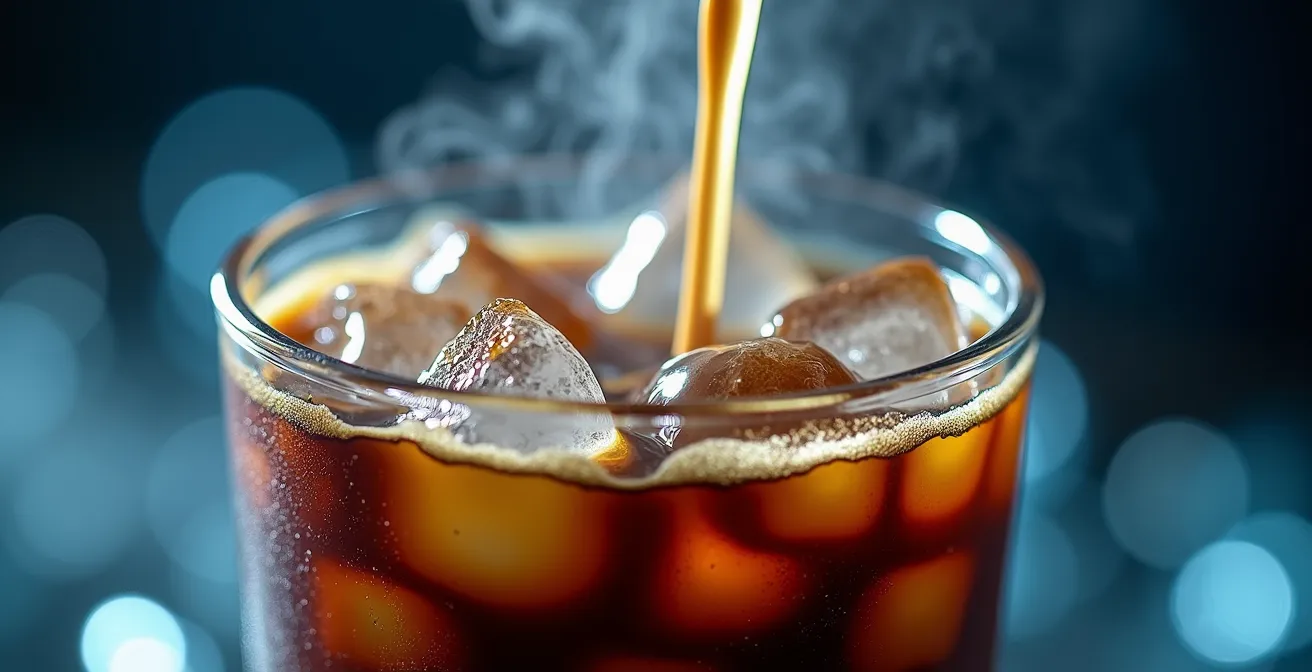
The sudden sourness or bitterness in your iced espresso is not mere dilution; it is flavor fracturing, a result of the thermodynamic shock that deconstructs the coffee’s delicate chemical balance.
- Brewing hotter, paradoxically, can better preserve volatile floral notes in flash-chilled coffee by maximizing extraction before the cold halts all reactions.
- Grinder temperature and vessel material are not minor details; they are critical pre-pour variables that dictate the final sensory outcome.
- Advanced pressure and flow profiling can create shots with filter-like clarity, specifically designed to remain transparent and vibrant when chilled.
Recommendation: To master iced espresso, shift your focus from the pour itself to precisely controlling the heat, grind, and pressure dynamics that occur moments before.
There is a unique disappointment reserved for the specialty coffee enthusiast: painstakingly dialing in a magnificent single-origin bean, pulling a perfect, syrupy shot, only to pour it over ice and find the flavor utterly shattered. The vibrant notes of jasmine or bergamot from your Ethiopian Yirgacheffe collapse into a flat, aggressive sourness. The rich, chocolatey body of your Brazilian bean becomes a thin, astringent memory. The common explanation is simple dilution, a lazy diagnosis for a far more complex and fascinating phenomenon. While water is a factor, it is not the primary culprit. The true transformation lies in a violent, microscopic event: thermodynamic shock.
When a nearly boiling liquid collides with a frozen solid, the rapid, uncontrolled temperature drop does not simply cool the coffee; it fractures its carefully constructed flavor profile. The delicate balance of acids, sugars, oils, and volatile aromatic compounds that sing in harmony in a hot cup are deconstructed. This is not a gentle cooling process. It is a chemical crisis where some compounds are muted, others are amplified, and the beautiful, complex terroir you paid a premium for is lost in the chaos. Understanding this shock is the first step toward controlling it.
The secret to an exceptional iced espresso, therefore, is not to avoid this shock, but to orchestrate it. It requires a shift in thinking, moving beyond conventional hot-brewing wisdom to a methodology focused on selective preservation. By manipulating variables like brewing temperature, pressure, grind consistency, and even the vessel itself, we can protect the most fragile flavor compounds and create a beverage that is not a lesser version of its hot counterpart, but a unique and intentional expression of the bean’s origin. This is the art and science of highlighting terroir through precision chilling.
This guide will deconstruct the science behind this flavor shift. We will explore the chemical reactions at play, from acidic perception to the behavior of coffee oils at different temperatures, and provide a framework for mastering the variables that allow you to pull a shot specifically designed to thrive in the cold.
Summary: Why Pouring Hot Single-Origin Espresso Over Ice Changes the Flavor?
- Why High Acidity Coffees Taste Sour When Brewed Too Cool?
- How to Adjust Your PID Temperature for Ethiopian vs Brazilian Beans?
- Ceramic or Double-Walled Glass: Which Cup Preserves Aromatics Best?
- The Grinding Mistake That Heats Your Beans Before Brewing
- When to Drink Your Espresso: The 2-Minute Peak Flavor Window
- The Extraction Mistake That Makes Your Affogato Taste Burnt
- When to Lower Your Water Temp for Floral Arabica Roasts?
- 9 Bars of Pressure: Why This Number Matters for Your Crema?
Why High Acidity Coffees Taste Sour When Brewed Too Cool?
The sharp, unpleasant sourness that often dominates an iced espresso is a direct consequence of how our palate perceives acidity at different temperatures. Hot coffee contains a complex array of organic acids, including citric, malic, and quinic acid. When hot, these acids are balanced by sweetness and a rich texture, contributing to a vibrant, “bright” flavor profile. However, as the temperature plummets, our perception shifts dramatically. The sweetness becomes muted, and the lipid emulsion of the crema breaks, stripping the coffee of its body. This leaves the acids exposed and unbalanced, transforming perceived brightness into aggressive sourness.
Furthermore, the chemical composition itself plays a role. While the context is different, it’s illustrative to look at the chemistry of cold brew versus hot coffee. Research has shown a significant pH difference between the two preparation methods. A study in Scientific Reports found that hot-drip coffee has a more acidic profile, with typical pH values between 4.85 and 5.13. Cold brew, extracted without heat, is demonstrably less acidic, with a pH range of 5.40 to 5.63. This highlights a fundamental principle: heat is a primary driver in extracting certain acidic compounds.
When you flash-chill a hot espresso, you are essentially freezing a high-acid extraction in a state where its balancing components (perceived sweetness, body) are suppressed by the cold. The result is that the natural, desirable acidity of a high-altitude coffee, which presents as fruity and complex when hot, is interpreted by your palate as one-dimensionally sour. It’s not that the coffee has become more acidic; it’s that the cold has stripped away its context, leaving the acidity to stand alone and unopposed. Mastering iced espresso is therefore an exercise in managing this perceived acidity, not eliminating it.
How to Adjust Your PID Temperature for Ethiopian vs Brazilian Beans?
Controlling the brewing temperature with a Proportional-Integral-Derivative (PID) controller is fundamental to espresso quality, but its application for iced preparations requires a counter-intuitive approach. For hot espresso, the goal is a balanced extraction within the optimal range. Indeed, research confirms the optimal temperature range for most hot espresso extraction is between 195°F and 205°F (90°C to 96°C). Within this window, a barista might use a slightly lower temperature for a delicate Ethiopian bean to preserve its floral notes and a higher temperature for a dense Brazilian bean to extract its deeper chocolate and nutty flavors.
However, when preparing for a thermodynamic shock, this logic is often inverted. The goal is no longer a slow, balanced extraction but a rapid, intense one that captures the maximum amount of desirable volatile compounds before the cold halts the reaction. As we will see later, some of the most delicate floral notes require a higher initial energy input to be successfully extracted and then “locked in” by the ice. This is where precise PID control becomes an art form, adjusting not just for the bean’s origin but for its final destination: hot cup or iced glass.
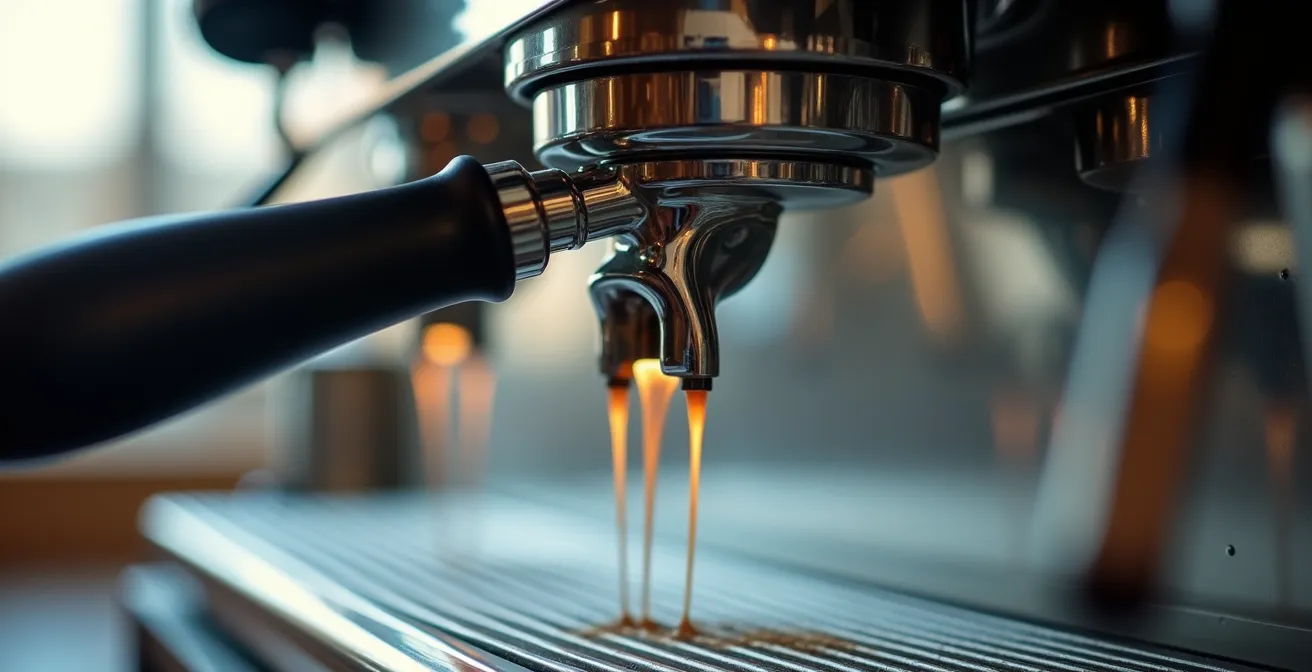
For a dense, chocolatey Brazilian bean intended for an iced latte, you might push the temperature to the upper end of the range (204-205°F) to ensure you pull out all the rich, soluble solids that will stand up to milk and chilling. Conversely, for a floral Ethiopian, conventional wisdom might suggest a lower temperature, but the opposite may be true for an iced pour. A blast of heat at 94°C might be necessary to extract those fragile aromatics quickly enough to survive the chilling process. This is a game of nanoseconds and thermodynamics, where the PID is your primary tool for flavor preservation.
Ceramic or Double-Walled Glass: Which Cup Preserves Aromatics Best?
The choice of vessel is not a trivial aesthetic decision; it is a critical component of thermal management. Pouring a 200°F espresso shot into a room-temperature, thick-walled ceramic mug or a standard glass causes an immediate and significant drop in temperature before it even touches the ice. This initial heat loss compromises the extraction’s integrity, muting volatile aromatics and causing the lipid emulsion of the crema to break down prematurely. The material and design of your vessel directly impact the aromatic preservation and overall stability of your iced espresso.
Double-walled borosilicate glass is unequivocally superior for this application. Its insulating properties minimize heat transfer from the liquid to the glass itself, maintaining the espresso’s temperature for a few crucial seconds longer. Furthermore, its thermal shock resistance is a practical necessity. Scientific temperature stability studies show a significant difference between insulated and non-insulated vessels, with a well-designed glass maintaining a temperature differential of several degrees over minutes. While a 3°C difference over 5 minutes may seem small, in the world of flash-chilling, the difference in the first 10 seconds is what truly matters. The double-walled glass acts as a buffer, ensuring the espresso hits the ice with maximum thermal energy, which is vital for the desired sensory outcome.
Preparing the vessel is as important as choosing it. A pre-chilled glass is essential to minimize the thermal shock on the ice itself, reducing immediate surface melt and subsequent dilution. The shape of the glass also plays a role. A vessel with a wide bowl and a focused rim, like a classic tumbler or a specialized coffee glass, helps to concentrate the volatile aromatic compounds that are released as the espresso chills, directing them toward the nose for a more complete sensory experience.
Action Plan: Preparing Your Glassware for Iced Espresso
- Pre-chill glassware in the freezer for a minimum of 30 minutes before use to minimize dilution.
- Choose thermal-shock resistant glass, such as borosilicate, to prevent cracking from extreme temperature changes.
- Use wide-bowl glasses with a focused rim to concentrate and funnel the delicate aromatics toward your nose.
- Avoid using room-temperature vessels, as they cause an immediate temperature drop and instant dilution upon contact with ice.
- Consider the glass surface smoothness, as microscopic imperfections can act as nucleation sites, accelerating the dissipation of CO2 and flattening the texture.
The Grinding Mistake That Heats Your Beans Before Brewing
The flavor of your espresso is determined long before water ever touches the coffee grounds. One of the most overlooked variables is the heat generated during the grinding process itself. As grinder burrs, whether flat or conical, operate at high speeds, they create significant friction, which translates into heat. This heat is transferred directly to the coffee particles, initiating a premature degradation of volatile aromatic compounds. You are, in effect, “cooking” your coffee before you even begin to brew it, dulling the very notes you aim to preserve.
This is not a minor effect. The thermal expansion of the metal burrs also impacts the grind consistency. As the burrs heat up, the gap between them can change, leading to a coarser and less uniform grind. This change in particle size distribution directly affects extraction. Coarser grounds offer less resistance to the water, causing the shot to pull faster (channeling) and resulting in an under-extracted, sour, and thin-bodied espresso—a death sentence for an iced preparation that already struggles with perceived sourness.
Case Study: The Impact of Grinder Heat on Extraction Speed
Groundbreaking research by Dr. Monika Fekete provided empirical evidence for this phenomenon. Her study demonstrated that as grinders heat up from continuous use (simulated by grinding 2kg of coffee), the coffee grinds become measurably coarser. This shift in particle size directly caused espresso extraction times to reduce by 10-15 seconds. The experiment, which tested both conical and flat burr grinders at cold (13°C) and warm operating temperatures, confirmed that thermal expansion is a significant and often unaccounted-for variable affecting grind consistency and shot flow rates.
For the specialty coffee drinker at home, this means that grinding beans for multiple shots in quick succession can actively sabotage the quality of the later shots. The best practice is to grind per-dose, immediately before brewing, and to be mindful of the grinder’s temperature, especially with high-end, high-speed models. Some professional grinders even incorporate cooling fans for this very reason. Ignoring the heat of your grind is like starting a race with a handicap; the full potential of the bean is already compromised.
When to Drink Your Espresso: The 2-Minute Peak Flavor Window
The life of an iced espresso’s peak flavor is fleeting. Immediately after the hot liquid collides with the ice, a rapid evolution of flavor and aroma begins. The initial moments are a chaotic mix of hot and cold, with volatile compounds being released in a massive burst. This is followed by a brief, perfect window where the beverage achieves a momentary equilibrium. It is in this window that the coffee is at its most expressive, vibrant, and aromatically complex. Miss it, and you are left with a drink that is a pale, oxidized shadow of its potential.

Experience and sensory analysis suggest that this peak flavor window is remarkably short. While a hot espresso evolves over a couple of minutes, an iced one is far more volatile. According to expert guides on the topic, the peak aromatic intensity occurs within 30-45 seconds after the initial chilling and stirring. During this time, the temperature has stabilized enough to be refreshing, but it hasn’t been cold long enough for oxidation to dull the top notes or for the remaining crema to separate into bitter slicks. The initial burst of CO2 has dissipated, but a pleasant texture remains.
After this brief peak, the decline is swift. As the drink continues to sit, ongoing dilution from the ice thins the body. More importantly, oxidation begins to take its toll, transforming the bright, fruity acids into dull, vinegary ones. The remaining lipids from the crema, which are less soluble in cold liquid, can begin to present as a slightly bitter or oily sensation on the palate. The lesson is clear: an iced espresso is not a drink to be nursed. It should be prepared, given a quick swirl to integrate, and consumed immediately to be experienced as intended.
The Extraction Mistake That Makes Your Affogato Taste Burnt
The classic affogato—a scoop of vanilla gelato drowned in a shot of hot espresso—is a perfect case study in flavor dynamics. When it fails, it often fails with a harsh, “burnt” flavor that is mistakenly blamed on a dark roast. However, this off-note is more frequently a product of late-stage extraction compounds clashing with the cold, sweet gelato. This is an extraction error, not a roasting one, and it is entirely avoidable with a specific technique: the ristretto shot.
A standard espresso shot (a 1:2 ratio) is designed to have a balanced flavor profile when consumed hot. However, the final third of the extraction phase, known as “blonding,” pulls out more bitter and less desirable compounds. These are balanced by the body and sweetness of a hot serve but become overpowering and acrid when they hit a cold medium like ice or gelato. The key is to cut the extraction short.
The ‘burnt’ flavor is often not from the roast, but from bitter compounds like phenylindanes extracted late in the shot, which are overpowering when not balanced by the full body and sweetness of a hot serve.
– Coffee extraction analysis, Professional coffee extraction guidelines
By pulling a ristretto, or “restricted” shot, you use a shorter extraction ratio (typically 1:1 to 1:1.5) and stop the shot well before the blonding phase begins. This technique concentrates the sweetest, most aromatic, and full-bodied part of the extraction while leaving the more bitter phenylindanes behind in the puck. A common practice is to aim for a 20-25 second extraction time instead of the standard 30 seconds. For iced drinks and affogatos, this front-loaded, syrupy shot provides all the intense coffee flavor needed without the astringent finish, creating a harmonious blend with the cold, sweet base rather than a jarring, burnt-tasting conflict.
When to Lower Your Water Temp for Floral Arabica Roasts?
Conventional wisdom in hot brewing dictates that delicate, lightly roasted Arabicas with floral and citrus notes benefit from slightly lower brewing temperatures (e.g., 90-92°C). The logic is that excessive heat can scorch these fragile compounds, resulting in a loss of aromatic complexity. When preparing an iced espresso, however, this logic can be spectacularly wrong. The challenge of flash-chilling is not just preserving flavor, but extracting it with enough intensity to survive the thermodynamic shock in the first place.
This leads to a fascinating temperature paradox. To preserve the most delicate floral notes in an iced drink, you may need to brew *hotter*, not cooler. The rapid chilling process effectively “freezes” the state of the coffee the moment it hits the ice. If you use a lower temperature to brew, you get a gentle, slow extraction. When this under-powered extraction is shocked by the cold, its already subtle notes are completely muted, resulting in a thin, sour, and uninteresting drink. A higher temperature provides the necessary energy for a rapid, forceful extraction of those key volatile compounds.
Case Study: The Temperature Paradox in Iced Extraction
A study published in Scientific Reports directly investigated this effect. Researchers compared extractions of a floral Ethiopian Yirgacheffe at 88°C versus a higher 94°C, both destined for iced applications. The results were conclusive: the shots pulled at the higher temperature of 94°C produced superior and more distinct floral aromatics once flash-chilled. This contradicts standard hot brewing principles. The study concluded that the rapid thermal shock requires maximum initial extraction energy to capture volatile compounds before the cold temperatures effectively halt the entire chemical process.
This insight is transformative for anyone serious about iced single-origin espresso. It means you must untether your brewing methodology from hot-coffee conventions. For that prized Geisha or Yirgacheffe, pushing your PID to 94°C or even 95°C might be the key to pulling a shot with enough aromatic power to cut through the cold and express its true, beautiful origin in the final, chilled beverage.
Key Takeaways
- The primary challenge in iced espresso is managing “thermodynamic shock,” a chemical event that fractures flavor, not simply dilution.
- Brewing logic must be inverted for cold drinks; higher temperatures and lower pressures can paradoxically yield better, more transparent flavor profiles.
- Every step before the pour—grind temperature, vessel material, and extraction ratio—is a critical control point for preserving the bean’s delicate terroir.
9 Bars of Pressure: Why This Number Matters for Your Crema?
The standard of 9 bars of atmospheric pressure in espresso is not an arbitrary figure. It is the accepted industry benchmark for achieving the optimal balance of extraction speed, body, and the formation of a stable, reddish-brown crema. This pressure is necessary to force water through a finely-ground, compacted coffee puck in 25-30 seconds, emulsifying the coffee’s oils and dissolving CO2 to create the signature texture and mouthfeel of a great espresso. Deviating from this standard has a direct and measurable impact on quality.
At lower pressures, the shot’s character changes entirely. As pressure testing studies found that pulling a shot at 6 bars produces watery, thin texture compared to 9 bars, the resulting espresso is often described as lacking body and intensity. It more closely resembles a turbo-charged drip coffee than a true espresso. While this might sound undesirable, for iced applications, this “flaw” can be leveraged into a feature. The rich, thick crema produced at 9 bars is a lipid emulsion that can taste intensely bitter and break unpleasantly when shocked by cold temperatures. By reducing the pressure, you reduce the emulsification, creating a “cleaner” shot.
Case Study: Pressure Profiling for Iced Espresso Clarity
Advanced baristas are now using pressure profiling to create shots specifically for iced drinks. Techniques like the “turbo shot” intentionally use lower pressures of around 6-7 bars combined with a slightly coarser grind. This results in a very fast, high-flow extraction that minimizes the emulsification of bitter oils and dissolved gases. The resulting shot has less crema but significantly more flavor transparency and a cleaner, almost filter-like clarity. This approach is particularly effective for preserving the delicate acidity of a single-origin coffee, which would otherwise be masked by the heavy, bitter compounds in a traditional 9-bar crema when served cold.
Thus, 9 bars is the foundation, the gold standard for hot espresso that provides the body and texture we expect. However, mastering iced espresso requires knowing when to break that rule. By intentionally lowering the pressure, you can sacrifice the visual appeal of a thick crema for the superior sensory experience of a cleaner, more vibrant, and transparent chilled beverage that truly lets the bean’s origin shine through.
Your journey to mastering the art and science of iced espresso begins now. By treating the process not as a simple act of cooling but as a controlled chemical orchestration, you can unlock a new world of flavor. Begin by experimenting with just one of these variables—pushing your brew temperature higher, pulling a shorter ristretto shot, or pre-chilling your glassware—and taste the transformation in the cup.