
The decline of the traditional dessert course isn’t simply about health fads or cost-cutting; it’s a profound cultural shift where the meal itself is being ‘unbundled’.
- Diners are increasingly seeking specialized satisfaction, opting for dedicated dessert shops over a restaurant’s all-in-one offering.
- The economic and operational pressures on restaurants encourage faster table turnover, disrupting the leisurely pace required for a final course.
Recommendation: Observe this change not as a loss, but as an evolution in dining, where the final sweet note is a deliberate, separate, and often more indulgent experience.
There is a quiet shift occurring at the dining table. It’s a subtle omission, a question left unasked by the server: “Any room for dessert?” For the observant diner, the final act of the traditional meal seems to be fading. Menus that once boasted a decadent list of cakes, tarts, and mousses now feature a spartan selection, or perhaps just a cheese plate and coffee. The common narrative blames this on a collective turn towards healthier living or the rising costs that make a three-course meal a luxury. While these factors play a part, they are merely symptoms of a much deeper transformation.
The disappearance of the dessert course is not a simple rejection of sugar. It is evidence of a fundamental “unbundling” of the dining experience. Much like how music albums were deconstructed into single tracks, the monolithic three-act meal—appetizer, main, dessert—is being broken apart into its constituent elements. We are moving away from the structured, communal ritual of a full-service meal and toward a more individualistic, emotionally-driven, and specialized pursuit of gastronomic satisfaction. This isn’t the death of dessert; it is its liberation from the confines of the traditional restaurant menu.
To understand this evolution, we must explore the very role of sweetness in our brains, the social dynamics of sharing, the sensory science of flavor, and the powerful connection between scent and memory. By examining these facets, we can appreciate why the grand finale of the meal is no longer a guaranteed performance, but an optional encore sought elsewhere.
Table of Contents: The Evolution of the Final Course
- Why Sweetness Signals the End of a Meal to Your Brain?
- How to Choose a Dessert That Compliments a Heavy Meal?
- Individual Tart vs Shared Platter: Which Creates Better Social Interaction?
- The Flavor Mistake That Makes Dessert Taste Bland After Steak
- When to Serve Coffee with Dessert: Before or During?
- When to Serve Dessert: The Perfect Timing for Maximum Gastronomic Emotion
- Comfort Food or Haute Cuisine: Which Satisfies Emotional Hunger?
- Why Does the Smell of Vanilla Trigger Childhood Memories?
Why Sweetness Signals the End of a Meal to Your Brain?
The tradition of ending a meal with something sweet is not merely a cultural habit; it is deeply rooted in our neurobiology. Sweetness acts as a powerful and satisfying signal of conclusion, a biological bookend to the act of eating. When we consume sugar, our brain’s reward system is activated, releasing dopamine in a way that signals pleasure and satiety. This provides a definitive sense of completion that savory foods often cannot match. It’s a primal cue that the hunt for calories is over and the body can now focus on digestion.
This neurological event creates what can be described as a ritual of closure. The sweet course doesn’t just satisfy a craving; it psychologically finalizes the dining experience. As Dr. Marta Y. Pepino explained in a study on the subject, this response is fundamental to our relationship with food. This biological expectation for a sweet finale is a powerful force, and its absence can leave a meal feeling unresolved or incomplete. As she notes in her research on dopamine response:
Ingestion of sweets releases dopamine in striatum, and both sweet preferences and striatal D2 receptors decline with age.
– Dr. Marta Y. Pepino, Diabetes Journal – NIH Study on Sweet Dopamine
This decline with age might partially explain a shift in adult preferences, but the primary function of sweetness as a meal-concluding signal remains a core part of our gastronomic wiring. The decision to skip this step is a conscious override of a deeply ingrained biological expectation.
How to Choose a Dessert That Compliments a Heavy Meal?
The question is no longer just *which* dessert to choose, but *whether* to choose one at all within the same establishment. This is the heart of the “unbundling” of the dining experience. Data clearly shows a decline in dessert orders within traditional restaurants. According to Toast’s 2024 restaurant industry survey, only 13% of diners order dessert when eating out, a stark contrast to the 26% who order appetizers. This suggests diners are either forgoing the final course or, more significantly, seeking it elsewhere.
This migration is confirmed by another key trend: the explosive growth of specialized dessert destinations. Yelp’s 2024 data reveals a profound shift in consumer behavior, showing that while higher-end restaurant categories saw a decline in new openings, dessert shops experienced a 52% growth. Diners are no longer content with a generic chocolate lava cake. They are seeking out the best artisanal ice cream, the most authentic cannoli, or the most innovative pastry from specialists. They are choosing specialized satisfaction over the convenience of an all-in-one meal.
This changes the calculus for choosing a dessert after a heavy meal. Instead of a light sorbet to cleanse the palate, the choice might be a walk to a nearby gelateria. The “compliment” is no longer about flavor pairing alone, but about curating a multi-location experience. The etiquette is changing, too; it’s becoming perfectly acceptable to have a full dinner at one venue and then move to another just for the final, sweet course.
Individual Tart vs Shared Platter: Which Creates Better Social Interaction?
The format of dessert service itself reflects our changing social dynamics. The classic shared platter—a sampler of various sweets designed for communal digging—was long seen as the epitome of a convivial meal-ender. It encouraged conversation, negotiation (“Did you try the brownie?”), and a shared experience. However, the modern trend is leaning decisively towards the individual portion, a personal and self-contained moment of indulgence.
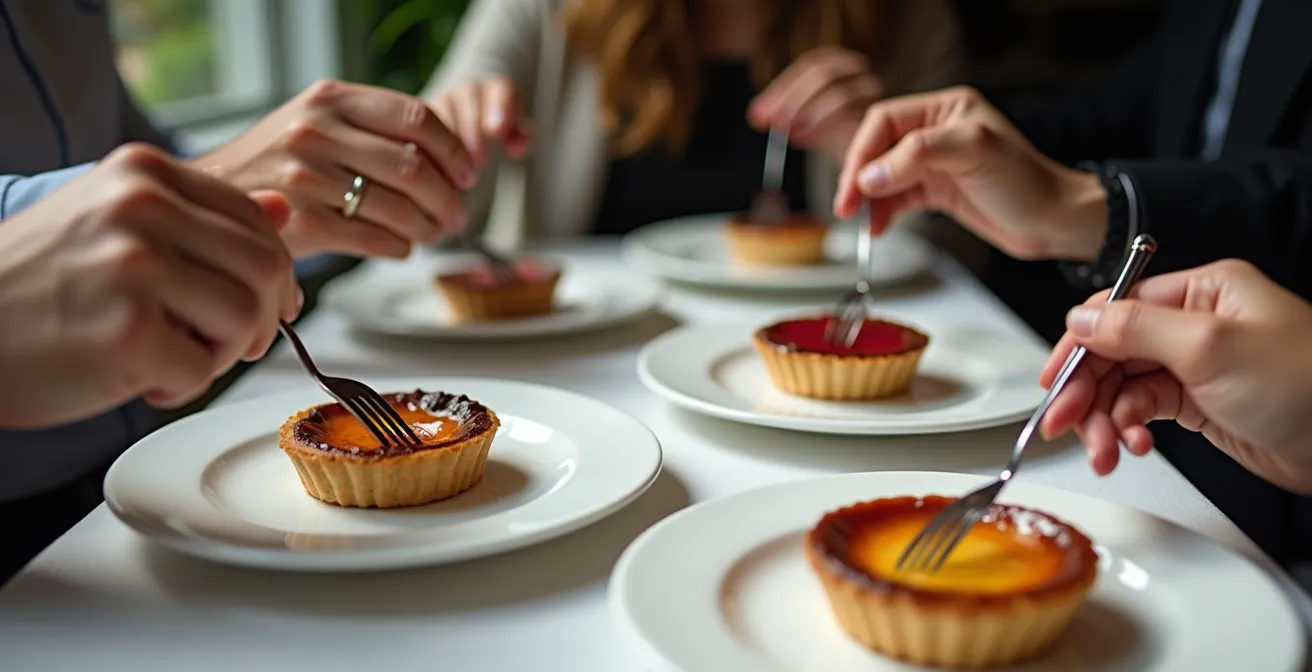
As the image above illustrates, the individual tart or cake creates a personal space. It is an experience for one, enjoyed in the company of others. This shift mirrors a broader cultural move towards individualism and curated personal experiences. While a shared platter fosters a sense of chaotic, family-style connection, the individual dessert promotes a more parallel form of social dining. Each person is on their own gastronomic journey, which they may or may not choose to share verbally. This isn’t necessarily better or worse, but it is fundamentally different.
This doesn’t negate the social power of the final course. As research from Rich Products points out, dessert remains a powerful catalyst for connection, regardless of format. The act of partaking in a sweet course together is, in itself, a shared ritual.
Desserts are a cornerstone of connection – something to awaken your senses, a conversation piece, a celebratory sentiment, a sweet ending to the gathering.
– Rich Products Research Team, 2025 Dessert Trends Analysis
The choice between an individual tart and a shared platter, therefore, becomes a choice between two different types of social interaction: one of intimate, parallel enjoyment versus one of boisterous, intertwined community.
The Flavor Mistake That Makes Dessert Taste Bland After Steak
One of the unstated reasons diners might forgo a restaurant’s dessert is a past experience of disappointment. A beautifully crafted dessert can fall flat after a particularly robust main course, like a steak, and this isn’t the chef’s fault—it’s a matter of sensory science. The phenomenon is known as palate fatigue or sensory adaptation. Our taste receptors become less sensitive to a stimulus after prolonged or intense exposure.
A rich, savory main course like steak bombards the palate with powerful flavors: umami from the seared meat, salt from the seasoning, and the coating sensation of fat. These intense signals can temporarily dull your ability to perceive more subtle flavors. A delicate vanilla panna cotta or a light fruit mousse served immediately after may taste bland or one-dimensional, not because it lacks flavor, but because your palate is still “recovering” from the main course.
An expert chef will attempt to counteract this by designing a dessert with contrasting elements—acidity (like a lemon tart), bitterness (dark chocolate), or a textural shock (a crunchy tuile). However, this is a difficult balancing act. The “unbundling” of the meal provides an unwitting solution to this problem. By putting physical time and distance between the main course and dessert—walking to a different location—the diner gives their palate a natural reset. This allows the dessert to be appreciated on its own terms, with its full flavor profile intact, leading to a more satisfying experience.
When to Serve Coffee with Dessert: Before or During?
The timing of the coffee order is a small moment laden with economic and experiential significance. From a purely gastronomic perspective, serving strong, bitter coffee alongside a sweet dessert creates a classic and beloved flavor contrast. The bitterness of the coffee cuts through the richness of the dessert, cleansing the palate between bites and enhancing the perception of sweetness. Serving them together creates a harmonious, integrated final course.
However, from an operational standpoint, this leisurely pairing is a luxury. Restaurants, especially during peak hours, are under immense pressure to maximize table turnover. The end of the meal is a critical period where efficiency can dramatically impact profitability. Serving coffee and dessert together, and then presenting the check, extends the time a party occupies a table. The modern, more efficient approach is to streamline this process. Many restaurants now train staff to offer coffee while presenting the dessert menu and to bring the check concurrently with the final course.
This isn’t just a perception; management data shows that presenting the check with the final items can significantly reduce table occupation time. This operational imperative subtly discourages the lingering that a traditional dessert course invites. The service is implicitly hastened, transforming the final act from a slow, savored ritual into an efficient transaction. For diners seeking a moment of true, unhurried indulgence, this rush can be a powerful motivator to take their dessert experience elsewhere.
Your Action Plan: Strategic Coffee and Dessert Pacing
- Offer coffee when presenting the dessert menu to signal the meal’s progression and allow for combined preparation.
- Present the check alongside the coffee or dessert service to expedite payment without making guests feel rushed.
- Train servers to gauge the party’s intent; special occasion diners warrant a slower, more traditional pacing.
- Use the coffee service as a natural transition point to begin clearing the table and preparing for the next guests.
- For extremely busy periods, consider offering a complimentary digestif or coffee at the bar to graciously free up the table.
When to Serve Dessert: The Perfect Timing for Maximum Gastronomic Emotion
The impact of a dessert is not solely in its flavor, but in the emotion it evokes. This gastronomic emotion is profoundly influenced by timing. There is a perfect window for a dessert to be served: not so soon that the main course is still being digested, but not so long after that the initial glow of the meal has faded and impatience sets in. This moment is about capturing the peak of anticipation, a feeling of pleasant fullness combined with a curiosity for the final chapter of the meal.
This perfect timing is, of course, subjective and dependent on the context of the meal. As restaurant industry benchmarks indicate, the natural rhythm of a meal varies with the size of the group. A party of two may be ready for dessert around the 45-minute mark, while a larger group of six, engaged in deeper conversation, might not reach that point for well over an hour. A skilled server acts as a conductor, reading the table’s energy to know when to present the dessert menu—the prelude to the final act.
The visual of a dessert in motion, just before it lands on the table, captures this very tension. It is a moment of pure potential. Rushing this moment by serving dessert too quickly can feel like an intrusion, while delaying it can break the spell of the dining experience. In the unbundled dining model, the diner takes control of this timing. The walk from the restaurant to the ice cream parlor becomes the “interlude,” a self-directed pause that allows anticipation to build naturally, ensuring the dessert is enjoyed at the perfect emotional and physiological moment.
Comfort Food or Haute Cuisine: Which Satisfies Emotional Hunger?
When we do choose dessert, what are we truly seeking? Is it a display of technical skill from a pastry chef, or is it something more primal? The evidence suggests that for many, dessert is the realm of emotional satisfaction. It is less about culinary exploration and more about comfort, indulgence, and nostalgia. This is a hunger that a minimalist, deconstructed dessert from a haute cuisine menu may fail to satisfy.
Market research strongly supports this drive for indulgence. An analysis by Tastewise notes that when it comes to dessert, consumer desire is defined by “richness and sweetness rather than freshness cues,” with chocolate being a dominant ingredient. This is further reinforced by Mintel’s market research, which reveals that 35% of women aged 18-34 prefer extra-indulgent dessert options. The desire is not for something light or healthy; it is for a genuine treat that feels like a reward.
Indulgence in desserts is defined by richness and sweetness rather than freshness cues, with chocolate appearing in 24% of ingredient mentions.
– Kelia Losa Reinoso, Tastewise Dessert Trends Analysis
This explains the success of specialized dessert shops. They offer an unapologetic celebration of indulgence. They serve towering slices of cake, oversized cookies, and triple-scoop sundaes. They deliver the rich, straightforward, and comforting flavors that satisfy a deep-seated emotional hunger. A high-end restaurant, focused on balance and subtlety in its tasting menu, may not be the right environment for this kind of pure, unadulterated gratification. The diner seeking comfort is better served by the specialist.
Key Takeaways
- The decline of the restaurant dessert is a cultural “unbundling,” not just a health or cost issue.
- Consumers are seeking “specialized satisfaction” from dedicated dessert venues rather than an all-in-one restaurant meal.
- The sensory experience (palate fatigue) and social dynamics (individual vs. shared portions) are key factors influencing this shift.
Why Does the Smell of Vanilla Trigger Childhood Memories?
Perhaps the most profound power of dessert lies in its connection to memory, a connection forged not by taste, but by scent. The aroma of vanilla, cinnamon, or baking chocolate can transport us back to a childhood kitchen with an immediacy that no other sense can replicate. This is not a poetic flourish; it’s a unique feature of our brain’s architecture. The olfactory system, which governs our sense of smell, is a superhighway to the brain’s emotional and memory centers.
As neuroscientists explain, while other senses like sight and sound are first routed through the thalamus (the brain’s switchboard), odors take a direct path to the limbic system, which includes the amygdala (for emotion) and the hippocampus (for memory). As Harvard neuroscientist Venkatesh Murthy explains, this direct route means that scent and emotion are wired together in a uniquely powerful way. This is why a simple smell can trigger such a vivid, emotional memory, often called a “Proustian moment.”
The desserts that often resonate most deeply are those that tap into this scent-memory connection. A simple vanilla custard or a warm apple pie offers a nostalgic comfort that a complex, modern creation may not. This deep-seated connection is established early in life. The scents we are exposed to in our formative years become the foundation of our lifelong olfactory preferences.
Smell and emotion are stored as one memory. Childhood tends to be the period in which you create the basis for smells you will like and hate for the rest of your life.
– Dawn Goldworm, Harvard Museum of Natural History Panel on Olfaction
Ultimately, the search for the perfect dessert is often a search for a feeling—of comfort, of celebration, of nostalgia. As the dining experience unbundles, diners are increasingly empowered to seek out the specific scent, flavor, and emotion that will provide the most satisfying conclusion to their meal, even if that means finding it somewhere else entirely.