
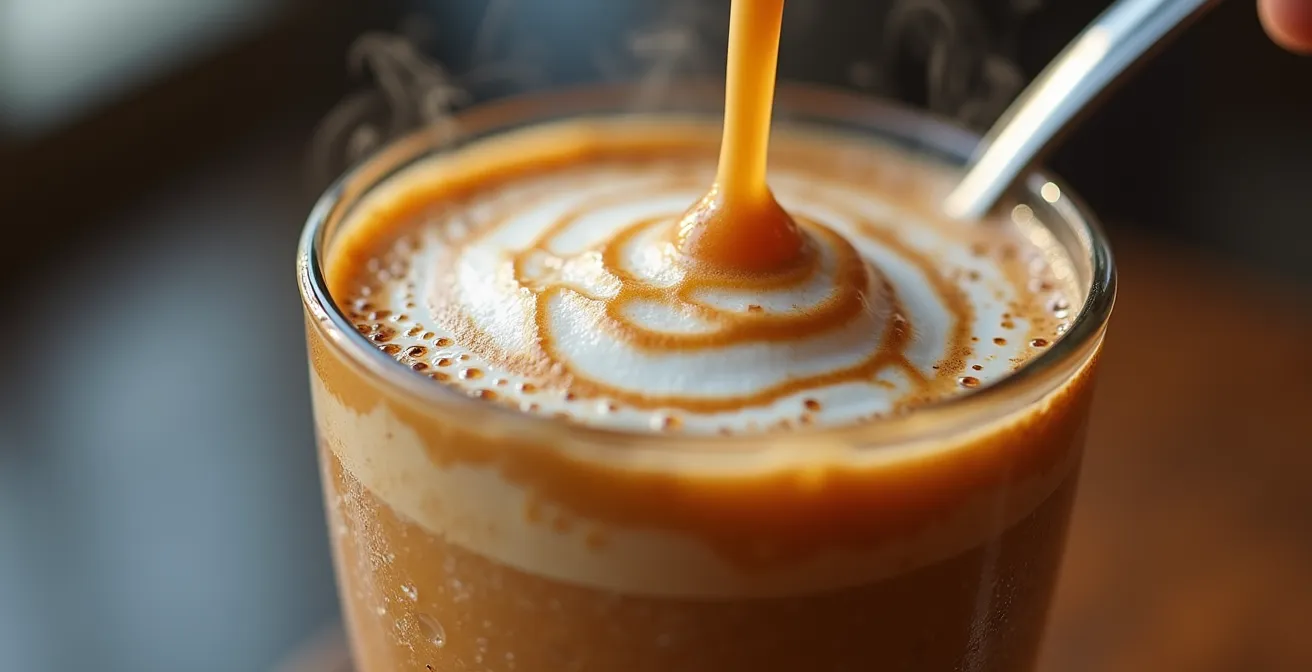
The perfect affogato is not a recipe, but a mastery of thermal shock; its failure is almost always due to incorrect technique, not poor ingredients.
- The structure of gelato is destroyed by rapid temperature change, creating icy crystals instead of a creamy melt.
- Pouring technique, glassware choice, and assembly timing are more critical than the specific coffee or gelato brand.
Recommendation: Focus on controlling the pour by using a chilled spoon to diffuse the espresso and serve in a pre-chilled, double-walled glass to preserve the sublime contrast of hot and cold.
There is a unique heartbreak that comes with attempting to recreate a classic Italian affogato at home. You procure the finest gelato, you pull a beautiful shot of espresso, and with great anticipation, you combine them. But instead of the sublime union of hot and cold, a masterpiece of texture and temperature, you are left with a sad, soupy puddle. A melted disappointment. Many believe the secret lies in simply buying “better” ingredients, but this is a common misconception.
The truth, spoken with the reverence of generations of Italian baristas, is that the affogato is not a simple recipe. It is a performance. It is an exercise in controlling a beautiful, fleeting moment of thermal shock. The soul of the affogato is found in the perfect, ephemeral balance between the searing espresso and the frozen gelato. To fail is to misunderstand the physics of this sacred interaction. The problem is rarely the ingredients themselves, but the lack of respect for the principles of temperature, technique, and timing.
This guide will not just give you steps; it will give you the philosophy. We will move beyond the what and into the why. We will explore how to manage the violent meeting of elements, how to choose your vessels and your tools, and how to respect the critical window of time where perfection exists. Forget what you think you know. We are going to build your affogato from the ground up, with the precision of a craftsman.
In the following sections, we will deconstruct every element of the process. You will learn the science behind the perfect pour, the secrets of extraction, and the non-negotiable rules that separate an amateur attempt from a truly authentic experience. Prepare to master the art.
Summary: A Guide to Mastering the Perfect Affogato
- Why Does Hot Espresso Cause Gelato to Crystallize If Poured Wrong?
- How to Pour Espresso Over Gelato Without Destroying the Scoop?
- Glass vs Ceramic: Which Cup Keeps Your Affogato Balanced Longer?
- The Extraction Mistake That Makes Your Affogato Taste Burnt
- When to Assemble the Affogato: The 30-Second Rule You Must Follow
- Why High Acidity Coffees Taste Sour When Brewed Too Cool?
- When to Engage Full Pressure: The Benefits of a 5-Second Soak
- Gelato vs Ice Cream: Which Choice for a Creamier Dessert?
Why Does Hot Espresso Cause Gelato to Crystallize If Poured Wrong?
The tragedy of a melted affogato begins at a microscopic level. When hot espresso is poured carelessly onto frozen gelato, it doesn’t just melt; it inflicts a violent thermal shock. This rapid temperature change forces the delicate microstructure of the gelato to break down and reform incorrectly. Instead of a smooth, velvety melt that integrates with the coffee, you create a grainy, icy soup. The water in the gelato melts and then refreezes too quickly, forming large, unpleasant ice crystals.
Case Study: The Impact of Thermal Shock on Gelato Microstructure
To understand this, consider the science. A perfect, creamy gelato texture comes from an abundance of tiny ice crystals, typically between 10 and 20 micrometers. They are so small the tongue perceives them as a single, smooth mass. However, as documented in studies on ice cream science, thermal shock causes a process called recrystallization. The rapid melting and refreezing don’t allow the water molecules to settle back into their fine microcrystalline structure. Instead, they clump together, forming coarse crystals larger than 50 micrometers, which the palate registers as a crunchy, grainy, and watery texture. Your perfect gelato is now, structurally, ruined.
The goal, therefore, is not to prevent melting—melting is a desirable part of the affogato experience. The goal is to control the rate of melting to ensure it is a gentle transition, not a destructive shock. This preserves the silky texture of the gelato as it slowly gives way to the heat of the espresso, creating a harmonious liquid rather than a separated, icy mess. Respecting this principle is the first and most fundamental step toward affogato mastery.
How to Pour Espresso Over Gelato Without Destroying the Scoop?
Knowing that thermal shock is the enemy, the act of pouring the espresso becomes a deliberate, gentle technique, not a dramatic splash. The objective is to introduce the heat gradually and indirectly. Pouring the hot liquid directly onto the peak of the gelato scoop is the cardinal sin of affogato preparation. This concentrates the thermal energy in one spot, causing immediate and catastrophic melting and crystallization. The true barista’s method is one of finesse and misdirection.
The most effective technique involves using the serving glass itself as a conduit for the heat. By pouring the espresso slowly down the inside wall of the chilled glass, you allow the coffee to pool at the bottom, creating a “moat” around the gelato. This allows the heat to transfer more gently, melting the base of the scoop from the bottom up and creating a beautiful gradient of temperatures and textures. For ultimate control, a chilled spoon can be used as a deflector, breaking the stream of espresso and allowing it to cascade softly over the gelato.
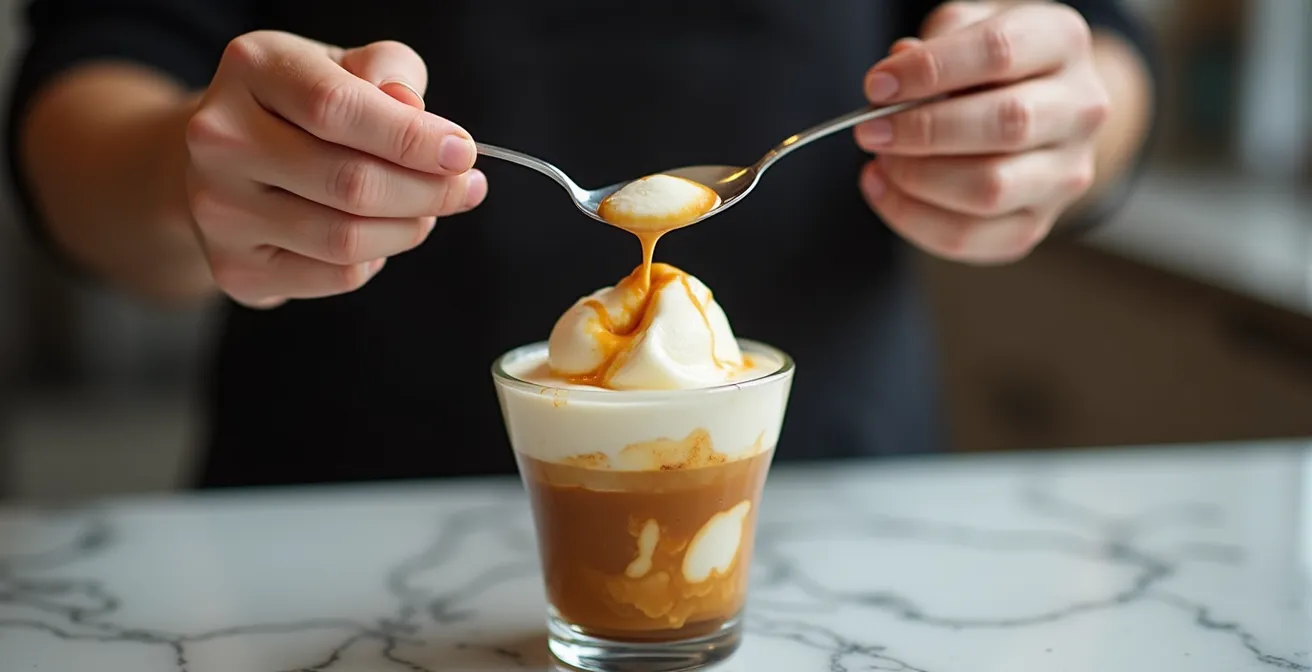
This controlled pour, as shown in the image, is the physical manifestation of respect for the ingredients. It is a technique that acknowledges the fragility of the gelato’s structure and works with it, rather than against it. This method ensures the top of the scoop remains firm and cold, providing that essential first-bite contrast that defines a great affogato.
Action Plan: The Professional Pouring Method
- Pre-chill the Stage: Always place your serving glasses in the freezer for at least 15 minutes. A cold glass is your first line of defense, slowing heat transfer from the environment.
- Let it Breathe: Allow the freshly pulled espresso to sit for about 10 seconds. This lets the temperature drop from a scalding ~90°C to a more manageable 75-80°C, reducing the initial thermal shock.
- Create the Moat: Pour the espresso very slowly down the interior side of the glass. Avoid hitting the gelato directly. Let the coffee pool at the base.
- Use the Spoon Deflector: For the ultimate technique, hold a cold spoon with its back facing up, just over the gelato. Pour the espresso onto the back of the spoon, allowing it to cascade gently and widely.
- Serve with Urgency: The performance is complete. Serve immediately to be enjoyed in its perfect, evolving state.
Glass vs Ceramic: Which Cup Keeps Your Affogato Balanced Longer?
The vessel you choose for your affogato is not merely an aesthetic choice; it is a crucial piece of thermal equipment. The battle between glass and ceramic is one of thermal conductivity. Your mission is to slow down the transfer of heat from every source: the espresso, the ambient air, and your own hand holding the cup. As experts from Thermtest Laboratory, a specialist in thermal properties, note, the material of your drinkware plays a significant role.
Glass has lower thermal conductivity than ceramic, slowing heat transfer from your hand and ambient air to the cold gelato.
– Thermtest Laboratory, Thermal Properties of Drinkware Materials Study
This insight is critical. While a traditional, thick-walled ceramic cup has a certain rustic charm, it is a poorer insulator than glass. Ceramic absorbs and transfers heat more readily, meaning it will pull warmth from your hand and the surrounding air and conduct it directly to the gelato, accelerating the melting process. A pre-chilled glass, particularly a double-walled glass, offers far superior thermal stability.
The following table, based on thermal property analysis, breaks down why glass is the superior choice for preserving the affogato’s delicate balance. The air gap in a double-walled glass acts as an exceptional insulator, keeping the cold in and the heat out.
| Material | Thermal Conductivity (W/mK) | Heat Retention | Best For |
|---|---|---|---|
| Glass | 1.1 | Better insulator | Slower heat transfer to gelato |
| Ceramic | 3.8 | Moderate | Traditional serving |
| Double-wall Glass | 0.02 (air gap) | Excellent | Ultimate thermal stability |
For the purist dedicated to crafting the ultimate affogato experience, the choice is clear. A pre-chilled, double-walled glass is the non-negotiable standard. It not only preserves the essential temperature contrast for longer but also beautifully showcases the cascading layers of coffee and cream.
The Extraction Mistake That Makes Your Affogato Taste Burnt
Even with perfect pouring technique and the ideal glass, an affogato can be ruined before the coffee even leaves the machine. A common mistake is using an espresso that is over-extracted or “burnt.” This creates harsh, bitter, and ashy flavors that completely overwhelm the delicate sweetness of the gelato. The cause is almost always excessive temperature during brewing. Many home machines run too hot, scorching the coffee grounds and extracting undesirable compounds.
For an affogato, the ideal brew should be intense and sweet, not bitter. To achieve this, precision is key. According to barista experts, the sweet spot for extraction is a temperature slightly lower than for a standard espresso. While many machines are set to 95°C or higher, for an affogato you should aim for a range where barista experts recommend brewing at 90-93°C (194-199°F). This temperature is hot enough to properly extract the sugars and oils but cool enough to avoid scorching the grounds.
Beyond temperature, the extraction time is also critical. An extraction that runs longer than 30 seconds will pull in more and more bitter compounds. A perfect affogato shot should be concentrated and quick. Aim for a 1:1.5 brew ratio (e.g., 18g of coffee yielding a 27g shot) in a window of 20-25 seconds. This creates a shot that is syrupy, sweet, and potent, with enough character to stand up to the gelato without overpowering it with bitterness. Ensuring even water distribution and preventing “channeling” in the coffee puck is also vital for a balanced extraction.
When to Assemble the Affogato: The 30-Second Rule You Must Follow
The affogato is a dessert that lives and dies by the clock. From the moment the hot espresso meets the cold gelato, a timer starts on its perfection. This is not just about melting; it’s about aromatics. The most beautiful, complex, and volatile aromatic compounds in a fresh espresso dissipate rapidly into the air. The first 30 seconds after pouring are when the affogato is at its absolute peak, offering an intoxicating bouquet of coffee scents that are a crucial part of the experience.
To serve an affogato even a minute after it has been assembled is to serve a shadow of what it could have been. The preparation must be done à la minute, ideally in front of the person who will enjoy it. The entire workflow—scooping the gelato, pulling the espresso, and pouring—should be a seamless sequence designed for immediate consumption. This is a performance with a time limit.

The 3-Minute Affogato Experience
Professional sensory analysis reveals that the entire lifespan of a perfect affogato experience is approximately three minutes. The first 30 seconds are defined by the peak of its aromatic expression. What follows is a beautiful evolution. The first bite is a shock of contrast—hot, bitter coffee against cold, sweet cream. With each subsequent spoonful, the temperatures and textures begin to meld and integrate. By the final spoonful, you should have a perfectly chilled, sweet, and creamy coffee liquid. To miss this evolution is to miss the point of the dessert entirely.
Therefore, the rule is absolute: assemble and serve. Do not let it sit. The 30-second rule is a pact of respect between the barista and the dessert. It ensures that the affogato is experienced as it was intended: a dynamic and evolving journey of flavor, temperature, and aroma.
Why High Acidity Coffees Taste Sour When Brewed Too Cool?
The choice of coffee bean is a place for artistry, but it is also fraught with peril. Modern specialty coffees, particularly light-roast single origins from regions like Ethiopia, are celebrated for their bright, vibrant acidity. This is not a flaw; it’s a feature that can offer beautiful notes of citrus or berry. When paired with the richness of gelato, a high-acidity coffee can create a spectacular flavor contrast. However, this pairing only works if the coffee is extracted correctly.
Acidity in coffee is a complex balance of different organic acids. When brewed at the proper temperature (typically 93-95°C for these beans), the heat unlocks the coffee’s inherent sugars, which balance the acidity and create a complex, sweet, and lively flavor profile. If you brew these same beans too cool, you commit the sin of under-extraction. The water is not hot enough to dissolve the sugars and heavier flavor compounds, so all you extract is the raw, sharp-tasting acids. This results in a coffee that is not pleasantly bright but unpleasantly sour, which clashes horribly with the sweet, creamy gelato.
High acidity in coffee from light roast single-origins is a feature that cuts through gelato’s richness when properly extracted at 93-95°C.
– Coffee Science Institute, Temperature Impact on Acidic Coffee Extraction
So, do not fear acidic coffees; fear under-extracting them. If you choose to use a bright, fruity coffee for your affogato, you must be confident that your machine can deliver the necessary heat to achieve a balanced extraction. If your setup tends to run cool, it is safer to stick with a more traditional, medium-to-dark roast with notes of chocolate and nuts, which are more forgiving at lower temperatures and offer a classic, comforting flavor profile.
When to Engage Full Pressure: The Benefits of a 5-Second Soak
Even with the right temperature, an espresso shot can be ruined by uneven extraction, a phenomenon known as “channeling.” This occurs when water finds a path of least resistance through the puck of coffee grounds, over-extracting that channel and leaving other parts of the puck under-touched. The result is a shot that is simultaneously bitter and sour. The single most effective technique to prevent this is pre-infusion.
Pre-infusion is the act of gently soaking the coffee puck with low-pressure water for a few seconds before engaging the full 9 bars of pressure. This allows the entire bed of coffee to become saturated, swelling the grounds and settling them into a more uniform and stable structure. This simple step eliminates dry pockets and dramatically reduces the chance of channeling, leading to a far more even and balanced extraction. For a rich, viscous shot ideal for affogato, a 5-8 second pre-infusion is what professional baristas recommend.
This technique doesn’t just improve consistency; it profoundly impacts the final texture and mouthfeel of the espresso, a quality that is paramount when it coats the gelato. A well-pre-infused shot has a noticeably rounder, sweeter flavor and enhanced viscosity.
As a competition barista, I’ve found that a 5-second low-pressure pre-infusion is the single most effective technique to prevent channeling. This creates rounder, sweeter shots with enhanced viscosity that coats the gelato beautifully, creating a luxurious mouthfeel essential for premium affogato.
– Professional Barista Experience
If your espresso machine offers pre-infusion capabilities, using it is not optional; it is a requirement for achieving a superior result. This brief, gentle soak is the secret to unlocking the full sweetness and creating a syrupy texture that clings to the gelato, making every spoonful a decadent experience.
Key Takeaways
- Control the Pour: Never pour hot espresso directly onto gelato. Use the sides of a chilled glass or the back of a cold spoon to diffuse the heat and prevent thermal shock.
- Master the Extraction: Brew your espresso at 90-93°C for 20-25 seconds. Use a 5-second pre-infusion to prevent channeling and create a sweeter, more viscous shot.
- Respect the Clock: The affogato’s peak perfection is within the first 30 seconds of assembly. Always prepare and serve immediately to capture the volatile aromatics.
Gelato vs Ice Cream: Which Choice for a Creamier Dessert?
Finally, we arrive at the foundation of our dessert: the frozen element. While many use the terms “ice cream” and “gelato” interchangeably, for an affogato, the difference is not just semantic—it is structural and profound. The authentic, superior choice is, and always will be, gelato. This is not a matter of snobbery, but of science. The unique properties of gelato make it far better suited to harmonizing with hot espresso.
The key differences lie in fat content, air content (known as “overrun”), and serving temperature. Gelato is made with more milk and less cream, giving it a lower fat content. More importantly, it is churned at a much slower speed, incorporating significantly less air. Ice cream can have an overrun of 50% to 90%, meaning it can be almost half air. Gelato’s overrun is typically only 20-30%. This makes it denser, silkier, and more intensely flavored.
When hot espresso is introduced, these differences become critical. The lower fat content of gelato means there’s less of a greasy film that can coat the palate. The lower air content means the melt is a creamy, fluid transition, not a foamy, separated one. Furthermore, gelato is served at a warmer temperature than ice cream, making it naturally softer and more ready to meld gracefully with the coffee.
This table from America’s Test Kitchen clearly outlines why gelato is the structurally superior choice for an affogato.
| Property | Gelato | Ice Cream | Impact on Affogato |
|---|---|---|---|
| Serving Temperature | 15-20°F (-9 to -7°C) | 10°F (-12°C) | Gelato melds more gracefully |
| Air Content | 20-30% overrun | 50-90% overrun | Gelato creates silkier melt |
| Fat Content | 4-8% | 10-25% | Less greasy film with gelato |
| Sugar Profile | Mixed sugars, lower freezing point | Standard sucrose | Softer texture integrates better |
Choosing gelato is choosing a denser, silkier, and more flavorful foundation. It is the final piece of the puzzle, ensuring that when all other principles of technique and timing are followed, the result is nothing short of sublime.
Frequently Asked Questions About Affogato Preparation
Should I use acidic coffee for affogato?
Yes, bright acidic coffees can complement gelato’s sweetness, but they must be extracted at the proper temperature (93-95°C) to develop their own sweetness and avoid turning into a one-dimensional sour flavor that clashes with the dessert.
What happens if I brew acidic coffee too cool?
Under-extraction from brewing at too cool a temperature will fail to extract the balancing sugars in the coffee. This turns the coffee’s complex acidity into a harsh, puckering sourness that clashes with the gelato instead of complementing it.
Which coffee origins work best?
When properly extracted, Ethiopian coffees with their characteristic berry and citrus notes can be a fantastic pairing for a classic vanilla or fior di latte gelato, creating a harmonious and exciting flavor combination.