
V60 clogging is rarely a simple grind size issue; it’s a failure in flow dynamics caused by a collapsed coffee bed structure.
- Inconsistent drawdown is a symptom of either channeling (too fast) or compaction (too slow), which can be precisely diagnosed.
- Filter paper type and aggressive pouring techniques have as much impact on flow rate and clogging as the grind itself.
Recommendation: Stop chasing a “perfect” grind setting and start manipulating agitation, pouring strategy, and filter choice to manage the hydraulic resistance of your coffee bed.
You’ve followed the recipe to the gram. You bought the expensive burr grinder. You pour with the focus of a surgeon. Yet, your Hario V60 brew stalls, the water pooling on top of a muddy, stubborn coffee bed, turning what should be a bright, clean cup into a bitter, over-extracted mess. The common advice—”just grind coarser”—is a frustratingly simplistic answer to a complex problem. This approach treats the symptom, not the disease. The truth is, V60 clogging is a systems-level failure, a breakdown in the delicate physics of water flowing through a porous medium.
The secret to unlocking consistent, clog-free V60 brewing isn’t about finding a magic number on your grinder dial. It’s about becoming a diagnostician of your brew system. It’s about understanding the concepts of bed integrity, fines migration, and hydraulic resistance. Instead of blindly following a recipe, you need to learn how to manipulate the variables—the force of your pour, the subtle motion of a swirl, the very porosity of your paper filter—to build a stable coffee bed that promotes even extraction instead of choking itself off.
This guide deconstructs the brewing process from a flow dynamics perspective. We’ll move beyond generic advice and delve into the specific mechanics that cause your brew to stall. By understanding the *why* behind the clog, you’ll gain the control to prevent it, transforming your V60 from a source of frustration into a tool for consistent perfection.
To help you master this complex dripper, we will dissect each variable that influences the flow of water through your coffee. This structured approach will equip you with the knowledge to troubleshoot and perfect your technique.
Summary: A Brewer’s Guide to Mastering V60 Flow Dynamics
- Why the 60-Degree Angle Requires a Faster Pour?
- How to Swirl Your V60 to Flatten the Bed?
- Bleached vs Unbleached: Which Paper Tastes Like Cardboard?
- The Pouring Mistake That Creates Tunnels in the Coffee Bed
- When to Start the Main Pour After the Bloom?
- How to Pour Water to Ensure Even Saturation of Grounds?
- How to Brew Yirgacheffe to Maximize Jasmine Aromas?
- Immersion vs Pour-Over: Which Method for a Cleaner Cup?
Why the 60-Degree Angle Requires a Faster Pour?
The V60’s iconic 60-degree angle is not an arbitrary design choice; it’s a commitment to a specific brewing philosophy. Unlike flatter-bottomed drippers, this steep cone forces a deeper column of coffee grounds. This depth increases the path water must travel, creating higher hydraulic resistance. To counteract this and achieve a target brew time of around three minutes, the system is designed for speed. The single large hole at the apex means there’s nothing to restrict the flow out; the only thing slowing the brew is the coffee bed itself.
This design necessitates a more aggressive and continuous water delivery. A slow, hesitant pour allows the water level in the dripper to drop, causing the coffee bed to compact and settle. This settlement can trap “fines”—the smallest coffee particles—in the lower portion of the cone, creating a dense layer that acts like concrete, effectively clogging the dripper. To maintain a fluid, evenly saturated slurry, you must pour quickly enough to keep the grounds in a gentle, suspended state. Experts recommend a pour rate of around 6-8 grams of water per second to maintain this momentum.
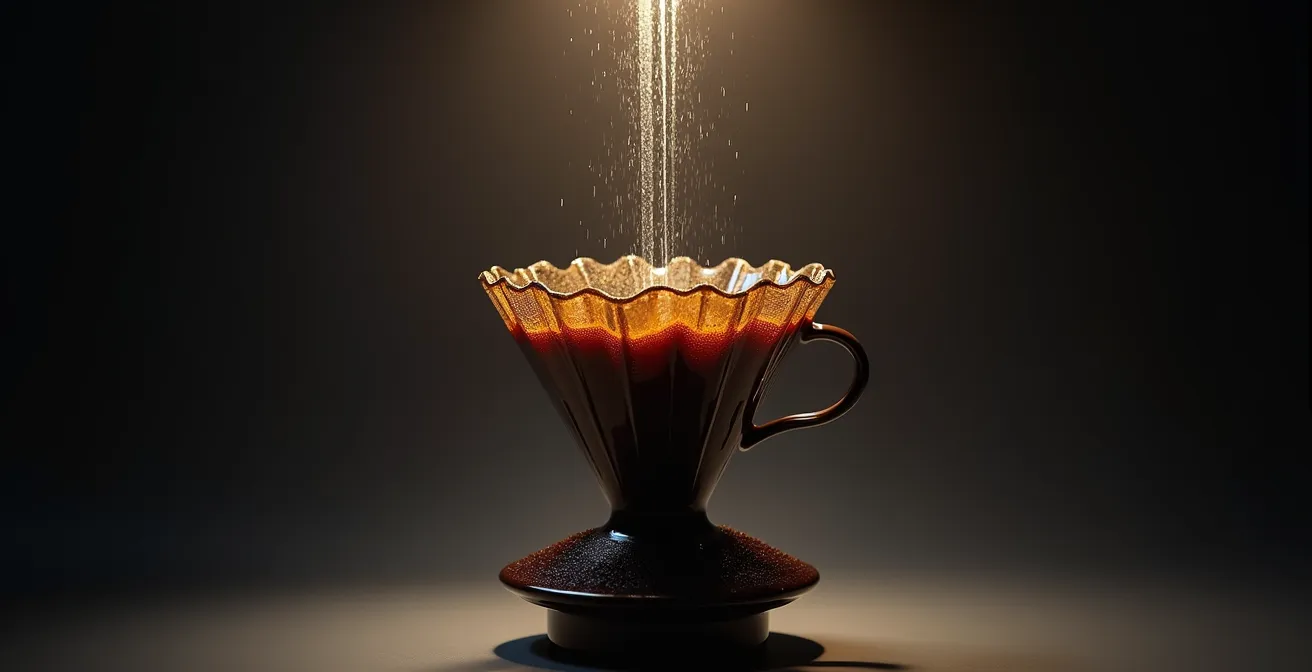
As visualized in the flow dynamics, the steep walls of the V60 encourage water to move vertically. A fast pour maintains a high water level, applying consistent pressure across the entire surface of the coffee bed and promoting a more uniform downward extraction. A slow pour, by contrast, encourages water to drain along the paper’s sides—a phenomenon known as bypass—leaving the core of the coffee under-extracted while the edges are over-extracted. Therefore, the V60’s geometry demands a faster pour not just for speed, but for extraction quality.
How to Swirl Your V60 to Flatten the Bed?
Agitation is one of the most powerful—and most misunderstood—tools in a brewer’s arsenal. The goal of a post-pour swirl is to resettle the coffee bed into a flat, even surface, ensuring that no grounds are left clinging to the walls and that the final drawdown of water passes uniformly through the entire bed. However, the *wrong* kind of agitation can instantly ruin a brew by promoting fines migration, the very cause of clogging.
An analysis of World Brewers Cup champions who use the V60 reveals a clear pattern: they employ a gentle, planar swirling motion. Think of gently swirling a glass of wine, not creating a violent vortex. The objective is to use centrifugal force to level the slurry’s surface, allowing the grounds to settle evenly by gravity. A vigorous, cyclonic swirl does the opposite; it churns the entire coffee bed, kicking the microscopic fine particles up into suspension. As the swirl subsides, these fines settle as a dense, impermeable layer on top of the bed, choking the flow and causing a dramatic stall in the final drawdown phase.
The choice between a swirl and a gentle tap on the side of the dripper depends on your coffee and grinder performance. A gentle swirl is highly effective for light roasts with a uniform grind, while tapping can be a safer option for darker, more brittle roasts or if your grinder produces a higher amount of fines.
| Method | Risk of Fines Agitation | Bed Settling Effectiveness | Best For |
|---|---|---|---|
| Gentle Swirl | Medium | High | Light roasts with uniform grind |
| Side Tap | Low | Medium | Dark roasts or high-fines grinders |
| No Agitation | None | Low | Very fine grinds prone to clogging |
Ultimately, the technique must be deliberate. Perform one or two smooth, flat swirls immediately after your final pour and then stop. Let the bed settle on its own. Any further agitation risks disturbing the delicate structure you’ve worked to build, compromising the clarity and sweetness of the final cup.
Bleached vs Unbleached: Which Paper Tastes Like Cardboard?
While we obsess over grind size and pouring technique, the humble paper filter is an equally critical variable in flow dynamics. It’s not just about taste; the filter’s material, thickness, and manufacturing process directly dictate the maximum possible flow rate of your brew. Unbleached, brown filters are notorious for imparting a distinct papery or cardboard-like taste to the coffee if not rinsed thoroughly. This is because they contain more lignins and other wood compounds that are removed from their bleached, white counterparts.
Beyond taste, the physical structure of the paper is paramount. The original Hario filters made in Japan are renowned for their fast flow rate, a result of their specific crepe (the crinkly texture) and fiber composition. In contrast, many brewers find that the tabbed versions, often made in the Netherlands, have a different structure that can lead to dramatically slower drawdown times, sometimes extending a brew to over five minutes and causing clogging even with a perfect grind. Comparative tests show that Japanese Hario filters can achieve a 30 seconds faster drawdown than their European-made counterparts under identical conditions. Specialty filters like the Cafec Abaca, which blend hemp and wood pulp, offer yet another variable, often allowing a finer grind without stalling due to their unique porosity.
This variability makes one step non-negotiable: aggressively rinsing your filter paper. This isn’t just to wash away paper taste; it’s to seat the filter perfectly against the dripper walls and preheat the entire brewing apparatus. Any gaps between the paper and the dripper will allow water to bypass the coffee bed, leading to a weak, under-extracted brew. A thorough rinse with water just off the boil ensures the filter is a perfect, sealed cone, ready for an even extraction.
Action Plan: Foolproof Filter Rinsing Protocol
- Use at least 100ml of water just off the boil (around 96°C or 205°F).
- Pour slowly in a circular motion to saturate the entire filter surface, not just the bottom.
- Check to ensure the filter is seated perfectly flush against the dripper walls with no air gaps.
- Discard the rinse water to remove any residual papery taste from the server.
- This action simultaneously preheats the V60 and the server, preventing temperature shock during brewing.
The Pouring Mistake That Creates Tunnels in the Coffee Bed
Channeling is the silent killer of pour-over quality. It occurs when water, following the path of least resistance, carves tunnels or “channels” through the coffee bed instead of percolating through it evenly. This results in a disastrously uneven extraction: the coffee directly in the path of the channel is massively over-extracted and bitter, while the surrounding grounds are left under-extracted and sour. The result in the cup is a hollow, weak, and often astringent brew with a shockingly fast drawdown time.
The single biggest cause of channeling is an aggressive, non-uniform pour. Aiming the stream from your gooseneck kettle too forcefully at one spot, or pouring too high above the slurry, creates excessive turbulence that disrupts the integrity of the coffee bed. This localized agitation erodes a path through the grounds, creating a low-resistance highway for water to rush through, bypassing the rest of the coffee. A proper pour should be gentle, with the kettle spout held only 2-4 inches above the slurry, and the water distributed in slow, even spirals to cover the entire surface.
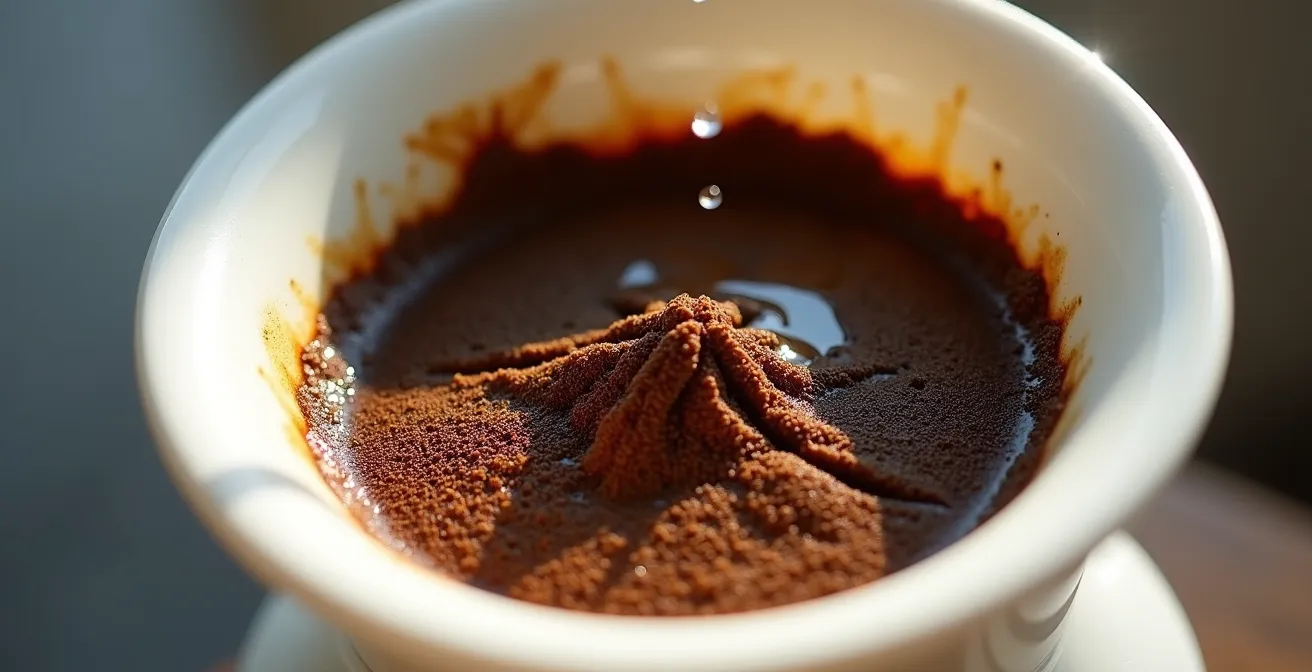
It is crucial to distinguish channeling from clogging, as they are opposite problems with similar-sounding names. Clogging is caused by compaction and fines, leading to a slow, stalled brew. Channeling is caused by bed disruption, leading to a brew that finishes far too quickly. A brewer who misdiagnoses a fast, sour brew from channeling as “under-extraction” and grinds finer will only make the problem worse, increasing the risk of both channeling *and* clogging.
| Issue | Drawdown Time | Taste Profile | Visual Signs |
|---|---|---|---|
| Channeling | Very fast (under 2:30) | Sour, weak, under-extracted | Visible tunnels or divots in the spent bed |
| Clogging | Very slow (over 4:00) | Bitter, muddy, over-extracted | Dense, flat bed with a layer of fine “mud” on top |
| Optimal | 2:30-3:30 | Balanced, sweet, clear | Even, slightly domed, or flat bed |
When to Start the Main Pour After the Bloom?
The bloom—that initial pour of a small amount of water to saturate the grounds—is the most critical phase for setting up a successful extraction. Its primary purpose is to allow the rapid release of trapped CO2 from the freshly roasted coffee. If you begin your main pour while this degassing is still occurring violently, the escaping gas creates massive turbulence within the slurry. This turbulence is a primary cause of channeling and an uneven, unpredictable extraction. Therefore, the timing of your main pour is not arbitrary; it must be dictated by the visual cues of the bloom itself.
The goal is to wait long enough for the most vigorous off-gassing to subside, but not so long that the bed begins to dry out. As the world-renowned coffee expert James Hoffmann advises, you’re looking for a specific visual cue. His “Ultimate V60 Technique” provides the clearest guidance on this crucial step.
The bloom is complete when the initial vigorous bubbling subsides and the bed’s surface appears glossy and settled.
– James Hoffmann, Ultimate V60 Technique
The ideal duration of the bloom is not a fixed number; it’s a variable dependent on the coffee’s roast level and freshness. Very fresh beans (less than a week off roast) are packed with CO2 and may require a bloom of 45 to 60 seconds. Older beans (2+ weeks post-roast) have already degassed significantly and may only need 30 seconds. Similarly, porous dark roasts release their gas more quickly than dense, light roasts. Rushing this stage is a false economy; starting the main pour just 10 seconds too early can compromise the entire brew by creating a chaotic, unstable bed structure.
How to Pour Water to Ensure Even Saturation of Grounds?
Even saturation is the holy grail of pour-over brewing. It means that every single coffee particle has had an equal opportunity to come into contact with water, leading to a uniform extraction. Achieving this requires mastering two interconnected variables: a consistent grind and a meticulous pouring technique. The ideal grind for a V60 is not just “medium-fine,” but a uniform particle distribution. Scientific measurements show the target is a tight cluster of particles, as V60 requires particles between 400-700 microns for optimal flow. Too much variation—an excess of both large “boulders” and fine “dust”—makes even saturation impossible.
With a consistent grind, the next step is a controlled pour. The most effective method for ensuring the entire coffee bed is engaged is pulse pouring. Instead of one long, continuous pour after the bloom, you divide the total water volume into 3-5 smaller, distinct pours. This technique gives you multiple points of control throughout the brew cycle. By allowing the water level to drop slightly between each pulse, you encourage vertical flow through the coffee bed, preventing bypass and ensuring the water column maintains contact with the grounds.
Each pulse should be executed with precision. Use a slow, concentric spiral motion, starting from the center and working your way out, then back in. Critically, you must avoid pouring directly onto the filter walls. Water poured on the sides will run straight down the paper and into the server, completely bypassing the coffee. This water adds volume but no flavor, effectively diluting your final cup and skewing your extraction. The goal is to keep the water interacting with the coffee slurry at all times.
- Divide your main pour (e.g., 220ml) into 3-5 smaller concentric pours (e.g., 4 pours of 55ml).
- Allow the water level to drop about halfway between each pulse to encourage vertical flow.
- Never pour directly on the filter paper walls; keep the pour focused on the coffee slurry.
- Maintain a consistent pouring height of 2-4 inches above the slurry to minimize disruptive turbulence.
- Use a circular motion, starting from the center and spiraling outward to about a centimeter from the edge.
Key takeaways
- V60 clogging is a “flow dynamics” problem, not just a grind size issue, caused by a collapsed coffee bed.
- Diagnose your brew: a fast, sour cup indicates channeling; a slow, bitter cup indicates clogging or compaction.
- Your choice of paper filter (e.g., Japanese vs. Dutch Hario) and your swirl technique are powerful variables that directly control flow rate.
How to Brew Yirgacheffe to Maximize Jasmine Aromas?
Brewing a delicate, floral washed Ethiopian coffee like a Yirgacheffe on a V60 is the ultimate test of a brewer’s control over extraction. These coffees are prized for their light body and complex aromatics, particularly notes of jasmine, bergamot, and stone fruit. However, these volatile compounds are easily lost or masked. They can be obliterated by excessively hot water or left behind in an under-extracted brew. To maximize these jasmine notes, you must adapt your entire V60 technique to favor delicacy and clarity.
Because Ethiopian beans are typically very dense, they require a finer grind than many other origins to properly extract their nuanced flavors. However, grinding finer directly increases the risk of clogging. This is where a systems-based approach becomes crucial. To compensate for the increased hydraulic resistance of the finer grind, you must use a faster-flowing filter paper, like a Cafec Abaca or the original Japanese Hario filters. This strategic choice allows you to “get away with” the fine grind needed for flavor extraction without causing the brew to stall.
Temperature is the next critical lever. The delicate jasmine and citrus notes in a high-quality Yirgacheffe are sensitive to heat. Using water that is too hot (96°C+) can scald these aromatics, resulting in a flat or generically “roasty” cup. A lower brewing temperature, in the range of 92-94°C (198-201°F), protects these compounds while still being hot enough for efficient extraction. This, combined with a multi-pulse pouring technique to maintain flow, creates the ideal environment for these flavors to shine.
A complete recipe for a 15g dose would look like this:
- Grind: Finer than usual for V60, resembling table salt (approx. 0.75mm particle diameter).
- Filter: A fast-flowing paper like Cafec Abaca+ or Japanese Hario. Rinse thoroughly.
- Water: Soft, low-TDS water at 92-94°C (198-201°F).
- Technique: Employ 5-6 small pulse pours to maintain a steady flow and prevent the fine grounds from compacting.
- Target Time: Aim for a total brew time of 2:30-3:00, which is achievable despite the fine grind due to the fast paper and pulse pouring.
Immersion vs Pour-Over: Which Method for a Cleaner Cup?
The very reason the V60 is so technically demanding is also the source of its greatest strength: unparalleled cup clarity. The entire design—the conical shape, the fast-flowing paper, the large single outlet—is engineered to produce a coffee with a light body, minimal sediment, and a clean, vibrant flavor profile. This stands in stark contrast to full immersion methods like the French Press, which steeps all the coffee grounds in all the water for the entire brew time. While foolproof, the French Press’s metal filter allows significant amounts of fine particles and oils into the cup, resulting in a heavy body and a character some describe as “muddy.”
The V60’s reliance on percolation (water passing through the grounds) is what creates its signature clarity. However, this method is inherently prone to user error like channeling and clogging, which can compromise that clarity. For brewers frustrated by the V60’s steep learning curve, a new class of hybrid brewers offers the best of both worlds. Devices like the Hario Switch or Clever Dripper combine a full immersion phase with a paper-filtered drawdown.
These brewers allow you to immerse the grounds for a set period, ensuring total, even saturation and eliminating any risk of channeling. Then, by flipping a switch or placing the dripper on a mug, you initiate a rapid drawdown through a paper filter. This process captures the sediment and oils, producing a cup with the high clarity of a pour-over and the forgiving, even extraction of an immersion brew. A recent Reddit pour-over tournament saw the V60 win, but the Hario Switch was the runner-up, proving the exceptional quality achievable with these foolproof devices.
| Method | Clarity Score | Body | Grind Size (microns) | Risk of Issues |
|---|---|---|---|---|
| V60 (optimal) | Very High | Light | 500-650 | High (channeling/clogging) |
| French Press | Low | Heavy | 750-1000 | Low |
| Hario Switch | High | Medium | 600-700 | Very Low |
| Clever Dripper | High | Medium | 600-750 | Very Low |
While the V60 remains the champion’s choice for ultimate control and peak clarity, understanding that these alternatives exist is empowering. They provide an excellent daily brewing option or a diagnostic tool to taste a coffee’s potential without the variable of pouring technique.
By shifting your mindset from following recipes to diagnosing flow dynamics, you have gained true control over your V60. You are no longer at the mercy of a stubborn brew; you are its conductor. Apply this systematic approach to every coffee you brew to consistently produce a clean, sweet, and clog-free cup.